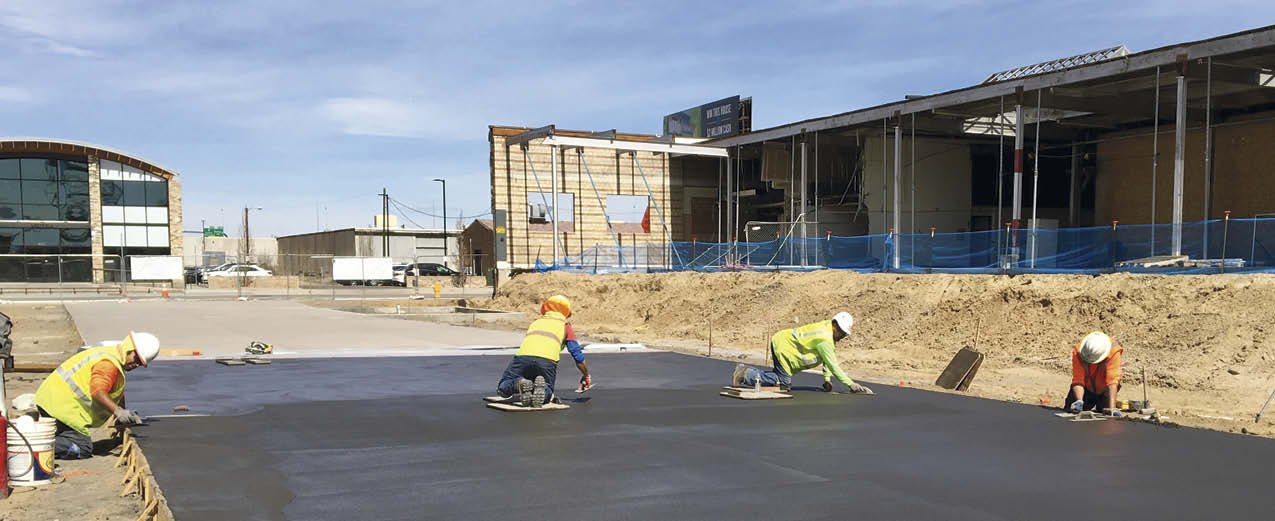
Commercial Concrete Contractor in West Texas
Commercial concrete across West Texas starts with a ruler laid over a highway map. Before anyone talks about mix designs or finishing, we want to know how many miles separate the nearest batch plant from the slab, how far the crew drives each morning, and whether the farm-to-market road in between can carry a loaded truck in July. Those answers set the price and the pour calendar more reliably than square footage does.
The Ports-to-Plains corridor gives a sense of the scale we plan around. It follows US 277 to San Angelo and US 87 through Big Spring and Lamesa to Lubbock, with SH 158 and SH 349 tying Midland into the same network. A job on one end of that line and a job on the other are different mobilizations, with different ready-mix suppliers and different weather.
We take on commercial work for general contractors, developers, industrial owners, municipalities and utility companies. That means building slabs, foundations, flatwork, paving and structural concrete, while site utilities and earthwork stay with partner crews under our coordination. The rest of this page explains how we set up a job, what moves the number, and what we ask for at bid time.
Conditions that shape a remote commercial pour
San Angelo gets roughly 20.94 inches of precipitation in a year, with around 30 triple-digit afternoons and around 60 mornings that start under freezing. A single project can see both extremes between groundbreaking and turnover, so the schedule carries a plan for each. Summer pours follow our hot and windy weather practices, and winter pours need blankets and a decision about when the slab is safe to leave unattended.
Distance changes the risk list too. A town with one ready-mix plant means one breakdown can stop every job nearby, so we confirm backup supply and delivery windows before a date goes on the calendar. We also check road restrictions and gate widths, since a pump truck or a loaded mixer that cannot reach the pad is a lost day nobody budgeted.
Concrete placement and related trade coordination
The concrete partners we coordinate place and finish concrete: footings, slabs, walls, curbs, sidewalks and pavement. We set the forms, lay the reinforcing, run the pour and cure the work. When a scope also takes in water lines, sewer, storm drains or grading, partners we manage do that digging, and their sequence gets folded into our own calendar so nobody pretends the trenches are ours.
That arrangement keeps accountability clear. The owner sees one concrete contractor responsible for what gets poured, and one set of coordination meetings for the dirt and pipe work that has to happen first. Where a utility crew needs to finish before a slab can close in, we say so early, because a pipe test that slips by a week moves the pour by a week.
How we set up a job before the first truck rolls
We begin with a haul-time study. For each candidate ready-mix source we note the drive to the site, the typical load size, and how long the concrete can ride before the mix needs adjustment. The result tells us how many trucks we can keep moving, which in turn limits the size of a placement. Sometimes the right answer is two smaller pours rather than one large one.
Next comes equipment staging. Pumps, screeds, saws and curing supplies travel with the crew, so we plan what rides out on day one and what can follow. A remote site cannot send someone to a hardware store at noon, so a short checklist on mobilization day often saves more time than any finishing technique.
What moves a commercial concrete price out here
Volume and thickness matter, but on West Texas jobs the surrounding costs often matter as much. Crew travel and lodging, mobilization of pumps and finishing equipment, and long ready-mix hauls all add to the unit price. We show those items separately so an owner can compare a nearby site with a distant one and understand why the same slab costs more at the far end of a county road.
Other drivers include wind and heat protection, reinforcing complexity, subgrade preparation by partners, and testing. Bid packages that say who supplies base stone and who pays for a delay shrink the contingency we would otherwise carry.
Buildings we pour for
Our commercial work spans warehouse floors, municipal buildings, schools, clinics, retail centers, shops and light industrial structures. Each building type has its own concrete priorities: a warehouse cares about floor flatness and joint durability, a clinic about vapor control and a clean finish, and a retail center about parking and sidewalks that suit foot and truck traffic.
Robert Lee is described as the oilfield supply center for its area, a reminder that many small West Texas towns support yards, shops and storage buildings that need heavy slabs and aprons. The same crew often builds the floor and the truck court that serves it.
Specifications, permits and acceptance
We build to the project drawings and specifications, and we read the concrete section before we read anything else. Strength, air content, slump limits, curing methods, joint layouts and tolerance requirements all get written into our work plan.
Permit rules differ from one county seat to the next, and several small places rely on the adopted building code with limited review staff. We ask the local permit office early about inspection scheduling, because an inspector who has to drive a long way needs notice. We also arrange third-party testing for cylinders, slump and temperature so acceptance paperwork is ready when the owner needs it.
Safety on open ground
Remote sites bring their own hazards. Heat illness is the obvious one, so crews carry shade, water and a schedule that puts hard labor in the cooler hours. Wind complicates form bracing, material handling and crane work, and we stop when gusts make a task unsafe. Traffic on narrow farm-to-market roads is another risk, which is why we plan truck routes and flagging before the pour.
Every job has a site-specific safety plan covering excavations, pump placement, rebar handling and silica control during cutting. We coordinate with partners working in the same area so equipment paths do not cross crews on foot.
Let us price the miles along with the slab
Send drawings, the site address and your target pour dates. We will check the haul distance, crew routes and supplier options, then respond with questions that matter. If your project also needs concrete paving or coordination with a general contractor, tell us now so the mobilization covers it.
Common Questions
How do you price a job that is a long drive from any town?
We separate the cost of the concrete from the cost of getting to it. Crew travel, lodging, equipment staging and long ready-mix hauls each get a line, so you can see what distance adds. Where several nearby projects can share a mobilization, we say so and pass the saving to each owner. A realistic estimate beats a number that grows with change orders.
What if the only ready-mix plant in town breaks down?
We identify a backup source during preconstruction, even if it adds miles to the haul. For large pours we may ask the supplier to confirm batching capacity and aggregate stock in writing. If a plant goes down on pour day, we hold the placement rather than accept concrete that has traveled too long, and we reschedule as soon as supply returns.
Can you work alongside our utility contractor?
Yes. Partner crews we manage can take the pipe and dirt work, or we fit around the contractor you already have. What matters is sequence: pipe tests, backfill compaction and base approval all need to finish before forms go in. We share a weekly lookahead so everyone sees the dates that affect the pour.
How do you handle summer heat and winter freezes on the same project?
We build both into the schedule. Hot weather means early starts, controlled mix temperature, evaporation protection and prompt curing. Cold weather means blankets, heated enclosures when needed, and temperature monitoring until the concrete reaches strength. We note the planned method in the bid so it is not a surprise at the invoice.
Do you need a site visit before bidding?
For remote work, we prefer one. A drive to the site shows us road conditions, gate access, overhead lines, soil surface and the real distance to the plant. If a visit is not practical, photos and a pin location help, and we list our assumptions so the bid can be tightened once we see the ground.