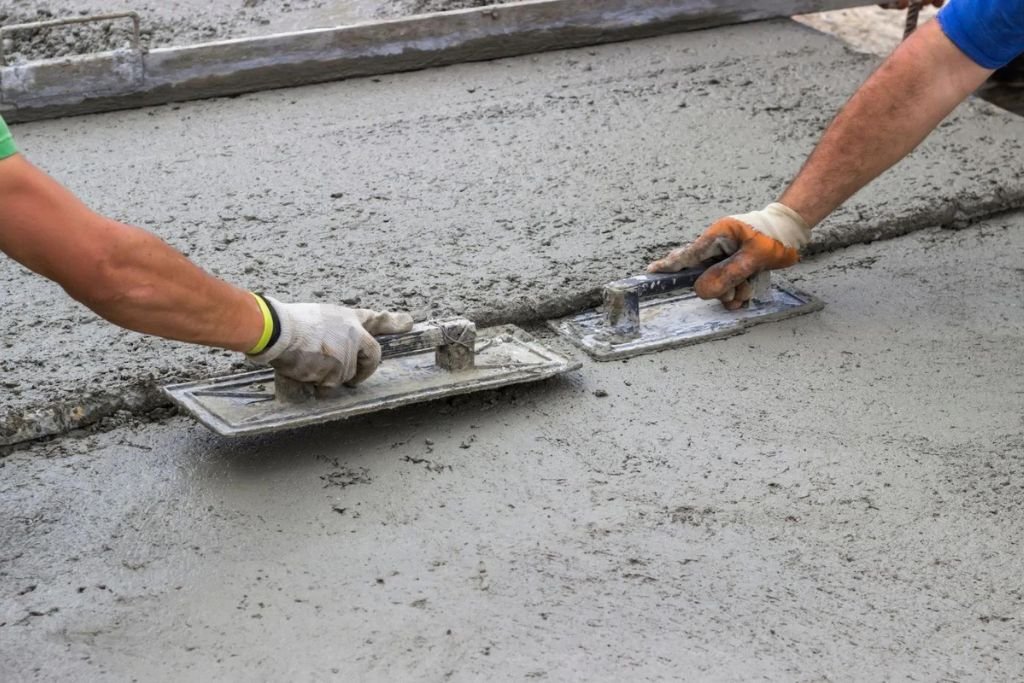
Concrete Paving in West Texas
Concrete pavement outlasts asphalt where trucks turn, stop and park, and West Texas has plenty of places like that. Oilfield yards, wind farm roads, grain facilities, truck stops and distribution lots all put heavy wheel loads on a small area, and the heat softens asphalt right where the load is worst. A rigid slab carries the load without rutting and holds its shape through the summer.
We pave with concrete for plants, yards, drive aisles, intersections, entrances, truck courts, bus lanes and municipal streets. The work covers subgrade acceptance, base, forming or slipforming, reinforcing and dowels, placing, texturing, curing and joint sealing. Earthwork and utility trade partners prepare the ground, and we coordinate them so the base is finished before the paving crew shows up, and we keep one person on the job whose only task is to compare finished grade with the plan.
The sections that follow describe the owners who pave in concrete, the price drivers, our scope, the buildings involved, related services, scheduling, who does what and the ground we cover.
Owners who choose concrete pavement
Wind and power developers lay concrete roads and pads at turbine and substation sites. Texas has 198 wind farms with a combined nameplate capacity of over 40,000 MW, and CREZ transmission lines built by 2013 cut ERCOT wind curtailment from 17 percent in 2009 to 0.5 percent by 2014. Projects in that market call on utilities and energy companies for heavy-haul roads and laydown yards.
Oil and midstream operators need durable yard slabs and entrances, and industrial owners need pavement that survives equipment. Public owners pave intersections and bus pads in concrete to reduce maintenance. Each owner type has its own load, and we ask for the heaviest expected vehicle before choosing thickness.
What drives the price
Thickness, reinforcing, joint pattern and area are the main inputs. A ten-inch yard slab with dowelled joints costs far more than a six-inch light-duty lot, and the engineer decides which one is right based on traffic. Subgrade stabilization by partners can be a large cost too, and we keep it as its own line.
Crew travel, paving equipment mobilization and haul distance add to the unit price. Large projects spread those costs, while small ones feel them. Around West Odessa the ground is a thin gravelly loam resting on caliche and gypsum, and caliche pits dot the southwest side of the community, so local base material can make a difference in cost where it is close at hand.
What our paving scope includes
We form or slipform the pavement, place dowels and tie bars, install reinforcing where specified, place and finish concrete, texture the surface, cure it, saw joints and seal them. We also handle edge details and transitions to existing pavement. A quality log records mix, temperature, slump and test results.
Subgrade preparation, base stone, drainage and utilities are coordinated trade-partner work. We insist on a proof roll or equivalent approval of the subgrade, because paving over soft ground is the most common cause of early failure. We hold a pre-paving meeting to confirm tolerances, joint layout and handoffs. Joint layout deserves special care, because slabs that are too long or too square crack in places nobody planned, and a layout drawn before paving costs far less than a repair after.
Facilities that need heavy pavement
Distribution centers and truck terminals need pavement for trailer storage and turning. Culberson County Airport is a county-owned public-use airport about 3 miles northeast of Van Horn, and airfield aprons and access roads are among the heavy-duty applications that favor concrete. Plants, gins and processing sites use it for aprons and circulation.
Fort Hancock Independent School District lists its Secondary School at 100 School Drive and Benito Martinez Elementary at 460 Knox Avenue. For a school paving package, we ask the owner to identify bus, parent and service movements. The design requirements and actual vehicle use establish the pavement detail and proposed circulation plan.
Related paving work
Many projects pair this service with parking lot concrete for customer areas and truck courts and dock aprons for heavy traffic. The subgrade for road work is covered under road subgrade preparation, which we coordinate with partners.
We recommend choosing the paving design together with the drainage design, since water is the enemy of any pavement. A slab that sheds water to a clean edge keeps its subgrade firm, while one that ponds on a low corner will pump fines out of the joint under truck traffic. Curbs, inlets and swales should be set before concrete is placed, and we can help coordinate them.
Scheduling a paving run
Paving needs a steady supply of concrete, a clear work area and good weather. We confirm the plant's capacity and plan the number of trucks, then set the paving direction to keep trucks moving on the fresh base. Saw cutting follows within hours, and the road is closed to traffic until the concrete reaches strength.
Long hauls call for mixes designed for time and heat, and large paving runs benefit from a second batch source when one is available. We watch wind and humidity too, since fast drying can lead to surface cracking, and we keep curing compound sprayers close behind the texturing so the surface is sealed within minutes of finishing. When conditions are poor, we shorten the day or reschedule.
Who does what
The concrete partners we coordinate run forms, steel, concrete placement, finishing, sawing, sealing and curing. We coordinate the finishing tools, screeds and trade requirements for pavement texture and joint timing. Partners handle excavation, grading, base and utilities, and we coordinate their schedule to avoid gaps.
We do not claim to perform that earthwork ourselves. What we promise is a clear handoff: grade tolerances written, base approved and paving started in the planned order. If a section is off, we report it before the pour so the partner can correct it.
Where we coordinate concrete paving
We mobilize crews to West Odessa, Van Horn and other towns across the Permian Basin and the Trans-Pecos. The farther the site, the more the staging plan matters, and we choose yards, hotels and supply points to keep crews close to the work. We price from that plan.
Send the traffic and the site plan
Tell us who drives on the pavement, how heavy the loads are and where the site sits. We will check the supply, the crew route and the base conditions, then reply with a plan and a question list.
Common Questions
How thick should a concrete yard slab be?
Slab depth comes from the heaviest vehicles, how often they pass and the strength of the subgrade. Light lots may use five or six inches, while heavy yards use much more. We review the traffic information and recommend questions to confirm with the designer.
Why use dowels and tie bars?
Dowels transfer load across joints so adjacent slabs move together, and tie bars hold lanes together. Without them, joints can fault and break. We place them on chairs or baskets at the specified spacing and check alignment.
How long before trucks can use new pavement?
Usually several days in warm weather, depending on the mix and the strength required. Heavy loads wait for test results. We give the owner a date and a barricade plan.
Can concrete paving handle oilfield traffic?
Yes, if it is designed for it. Heavy axle loads, frequent turning and spills call for thicker slabs, strong subgrade and sealed joints. We help the owner choose the right design.