Concrete Testing and Quality Control in West Texas
Cylinder breaks are the paperwork of a pour, and in West Texas the paperwork has a travel problem: a test lab might sit one hundred miles or more from a farm-to-market road slab, and a set of fresh cylinders cannot wait in a hot pickup bed while a crew finishes the day. Testing and quality control on our jobs run as a field routine with a clear chain, from the sample taken at the chute to the break report that reaches the engineer, and we plan the logistics before the first truck pulls in.
Quality control on our jobs covers the checks that prove the concrete delivered matches the concrete specified: slump, air content where required, temperature, unit weight and compressive strength. It also covers the placement conditions that influence the result, such as subgrade moisture, reinforcing position, ambient wind and the timing of curing. A passing cylinder from a poorly cured slab says little about the slab, so we treat testing and workmanship as parts of one record.
Owners in the region often manage projects far from their offices, and a clear report is how they stay informed. We organize results by truck ticket, pour location and date, so a question from an inspector months later can be answered in minutes rather than weeks. The concrete partners we coordinate place and finish, and we coordinate independent testing partners for the lab work so the numbers come from a source with no stake in the pour.
Sampling safely at the truck
Taking a sample means standing close to a running mixer, a moving chute and wet concrete, so the technician and our foreman agree on a spot before the first load. The spot keeps the person with the scoop out of the truck path, and it keeps the cylinders in shade where they can rest undisturbed. Gloves, eye protection and boots are routine because fresh cement burns skin, and eyewash stays within reach.
Heat is a serious hazard on summer sampling days, and wind adds dust. We move cylinders into curing boxes right away and keep the boxes shaded so initial curing stays in the allowed temperature range. Wind on exposed ground can reshape a sand pile overnight, as it does in the dunes near Monahans, so the cylinder box gets a windbreak and a level stand on every job.
Reading the spec before the pour
Every project sets its own testing frequency, and the numbers come from the structural drawings, the specification and the local permit office. A footing may need one set of cylinders for each pour, while a building floor can require a set for every certain volume of concrete or each day, whichever is more. We read the testing section before we order the first truck and write the frequency into the pour plan, so the technician is scheduled for each placement.
Municipal and school projects often add special inspection duties, and the special inspector's report goes to the building official. Public owners such as those in municipal and public works may also require lab certification and reporting formats written into the contract. We ask for those rules early. If a drawing asks for something unclear, we send a written question to the engineer and keep the answer in the project file.
What testing costs, and what it saves
The main cost is the technician's time, including the drive. A lab visit to a pour fifty or a hundred miles out is billed for the round trip, so we group visits by day and combine pours when the schedule allows. Lab fees for the breaks, the curing boxes and the reports are small by comparison. Rush breaks at an earlier age, extra sets for early form removal and post-tensioning release add expense, and we price each of them on its own line, which shows the owner exactly what an option adds.
The savings are harder to see but real. A low cylinder break found at seven days gives the team time to review the mix, check the curing and decide on cores before more work is stacked on the slab. Without the data, the same problem might surface months later during a tenant fit-out. For a post-tensioned slab, the early strength results also decide when stressing can start, which can shorten the schedule.
The chain from chute to report
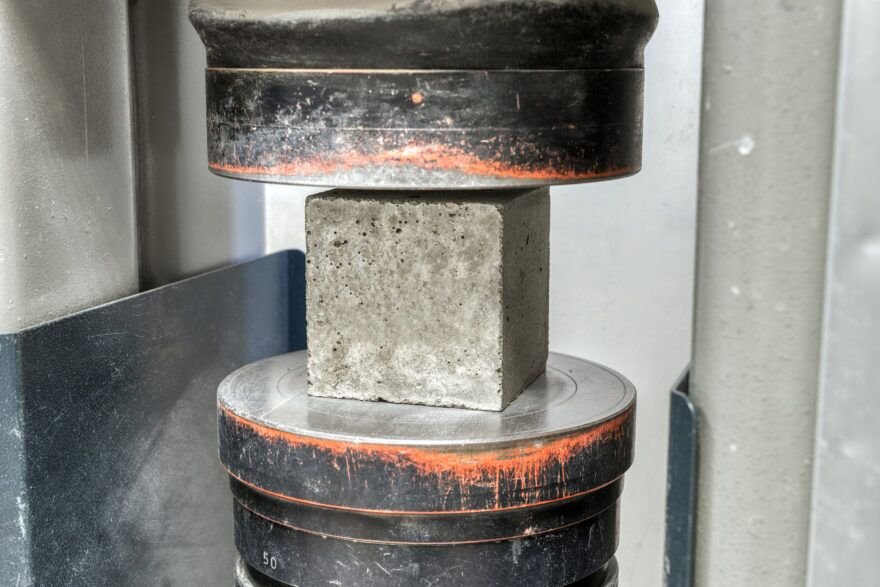
We assign each test a number tied to the truck ticket, the placement area and the time of the sample. The technician checks the slump and temperature at the truck, makes the cylinders, and marks them. Cylinders stay at the site in a controlled box for the first day, then travel to the lab in a padded container. At the lab, they cure in a moisture room and break at the ages named in the spec.
Our foreman reads each result against the spec as soon as it arrives. If a slump is high, we do not accept a load without checking the mix with the plant, and if a truck exceeds the allowed time on the ticket, we reject it. Rejecting concrete is uncomfortable when a crew is waiting, but it is far cheaper than removing a slab. A written note goes to the project team the same day, and the break reports are filed in the order the owner requested.
Testing alongside the other concrete work
Quality control links to nearly every other service we perform. On a ground-supported slab pour, it includes checking the subgrade moisture, the vapor barrier and the reinforcing before concrete is placed, then confirming flatness and cure afterward. On a pumped placement, the sample comes from the pump discharge rather than the truck chute when the spec requires it, since pumping can change air content and slump.
When weather turns, testing helps decide if the pour can proceed. Our hot and windy weather practices use concrete temperature and an evaporation estimate to choose between pouring, adding fogging and sunshades, or waiting for a better window.
Distances that shape the testing plan
West Texas towns are far apart. From Coleman, U.S. Route 84 reaches Abilene after roughly 52 miles to the northwest and Brownwood after roughly 30 to the southeast, so a pour in Coleman relies on labs located at least that far away unless a field lab is set up. For these jobs we arrange cylinder pickup in advance, and we sometimes keep the cylinders on site longer under supervision before transport.
The dunes of Monahans Sandhills State Park, a few miles outside town, sit 31 miles from Odessa and 55 from Midland, a fair picture of the gap between a remote pour and the nearest large lab. Our schedule includes the time for the sample to travel, because the standard methods limit how long a cylinder may remain in the field. When lab distance is excessive, we propose a temporary curing setup at the site, with the engineer's approval.
Share the testing section
Send the specification pages on testing and the pour schedule, and tell us how far the project sits from the nearest lab. We will talk through the sampling, the pickup plan and the reporting format with you.
Common Questions
How many cylinders do we need for a pour?
The specification sets the number, usually by volume or by day of placement, and a single set typically includes several cylinders broken at different ages. We read the testing section before ordering concrete and schedule the technician for each placement. If the spec is unclear, we ask the engineer to confirm.
Does one weak cylinder mean the slab failed?
One low result does not mean the slab has failed, because cylinders can be affected by handling, curing or testing error. The engineer reviews the other breaks, the mix records and the placement notes, and may order cores from the slab. We keep the record complete so those decisions can be made quickly.
Can you test concrete on a remote pour with no lab nearby?
Yes, with planning. We arrange the field curing box, the transport schedule and the lab appointment before the pour. For long distances, we sometimes ask the engineer to approve a temporary curing setup so cylinders are not rushed over rough roads.
Who pays for the testing, the owner or the contractor?
That depends on the contract. Many owners pay for independent testing directly, while other contracts include it in the contractor's scope. We read the contract language before pricing and list testing separately so nothing is assumed.
Do you reject loads that arrive late or with the wrong slump?
We do, when the ticket time or the test result shows the load does not meet the spec. It is an unpleasant call in the middle of a pour, but removing a bad slab costs much more than a returned truck.