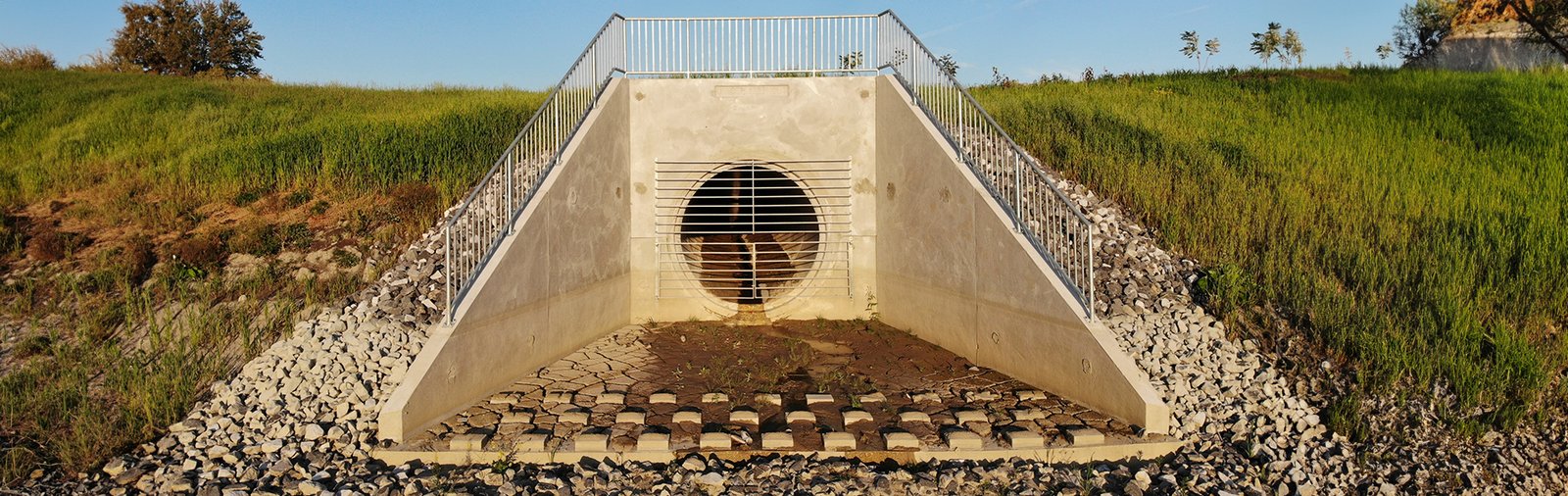
Concrete for Municipal and Public Works Owners in West Texas
County seats in West Texas run their capital programs with small staffs, tight budgets and one or two engineers who also handle everything else. When a city or county advertises a sidewalk, curb, drainage or building project, the bids it receives come from contractors who have to decide whether the miles are worth it. We want to be one that bids honestly and finishes what we price.
Concrete Contractors of West Texas works for cities, counties and other public owners on flatwork, curb and gutter, ramps, drainage structures, building foundations and paving, with trade partners under our schedule taking the utilities and earthwork on the same projects. A public job has different rules from a private one: advertised bidding, bonds, prevailing documentation, board approvals and an inspector who watches every pour. We build our approach around those rules and around the plain fact that taxpayers will see the results every day.
Public concrete is local because it sits in a town square or on a main street, and regional because the crew, the forms and sometimes the concrete come from somewhere else. When a city has only one ready-mix source, we talk to that plant before the bid is submitted so the advertised schedule is not built on a supply that cannot be delivered.
Municipal buildings and street-side concrete
Public work covers a wide range. A government or municipal building such as a city hall, library or maintenance shop needs foundations and floors like any other commercial building, with extra attention to accessibility and long-term durability. Streets and sidewalks demand quantity and consistency: many linear feet of curb, gutter and walk placed in short, repetitive sections.
Highway corridors define how crews and trucks reach those jobs. In Lamesa, U.S. 87 runs along Lynn Avenue on the east side, U.S. 180 appears as 4th Street, and State Highways 137 and 349 meet the town, with 349 running southwest to Midland. Highways 115 and 176 and US 385 all reach Andrews. On a street project in either town, we plan truck routes so that deliveries do not block the road we are repairing. Interstate 10 passes just south of Ozona with exits 363, 365 and 368, and State Highway 163 runs through the center of town, which gives a project there more than one approach for trucks coming from different directions.
Working in a public right of way
A street or sidewalk job is a conversation with the neighbors. Business owners want access to their doors, residents want driveways, and the city wants complaints to be few. We post notices before work starts, stage pours in sections so entrances reopen quickly and keep a phone number on the job that someone answers.
Behind the visible work is a quantity takeoff built from the plans and the field. We measure the actual length of curb, the number of ramps and the depth of base, then compare those numbers with the bid tabulation so that change orders, if they come, are based on measured differences. Public owners appreciate seeing the same numbers on both sides of the table, and an engineer who has to explain a change order to a council wants clear support.
Bids, bonds and the paperwork public owners need
Public bids come with requirements that private bids do not: bid bonds, performance and payment bonds, insurance certificates, workforce documentation and sometimes local preference language. We read the bid package in full, list every submittal and calendar the deadlines before pricing begins.
Inspection is close and frequent. A city inspector or the engineer's technician checks forms, steel and slump, and a testing lab collects cylinders. We keep the concrete partners we coordinate ready for stop-work on a failed test and communicate with the engineer when something in the field disagrees with the plans. Permits for work in a highway right of way, a drainage easement or a floodplain are the owner's responsibility in some jurisdictions and the contractor's in others, so we ask early and put the answer in writing.
Where public work meets utilities and schools
Public projects often share a site with other owners. A road reconstruction involves utilities and energy companies whose lines run under the pavement and must be located, protected or relocated before concrete is placed. A new campus or clinic reaches us through schools and healthcare owners, many of whom are public bodies themselves.
Oil history marks the region's towns too. The Santa Rita No. 1 well struck oil on May 28, 1923, at 3,028 feet near Big Lake, and by 1924 the Big Lake field was the first major oil field in the Permian Basin. Public works in these towns still reflect that economy in wide streets, heavy truck traffic and drainage systems sized for industry as well as homes.
Concrete placement and related trade coordination
On public projects the concrete partners handle forming, steel, placing and finishing for ADA ramps, curb and gutter and sidewalk and flatwork sections. Because that is a finish-driven trade, we keep the same foreman on a street from start to end so the work looks uniform from block to block.
Utilities and earthwork go to partners we manage, including the storm drain installation that often sits beside curb work. We keep the schedule that links them, supply the survey stakes and insist that trench backfill is tested before we place anything on it.
Scheduling around budgets, boards and school years
Public schedules rest on contract days, council meetings and funding cycles. We prepare a baseline schedule at the notice to proceed, update it with each pay application and warn the engineer when weather or supply may consume float. Concrete work is easy to count in days, and owners often hold a fixed number of working days before liquidated damages begin.
Crosbyton, the county seat of Crosby County, was chosen in a 1910 election over Emma, a reminder that these towns care about where public buildings sit. We schedule work around events on the square, school start dates and harvest-season traffic, and we talk to the owner's representative about what the community will notice first.
Send the bid package
Send the plans, addenda and bid date. We walk the site, check the plant and return a priced bid that breaks mobilization out separately.
Common Questions
Do you bid on advertised public projects in small towns?
Yes. We read the bid package, visit the site and price the work with mobilization broken out so the cost of distance is visible.
Can you provide bonds?
Bond requirements are set by the owner. Send us the bid documents and we will confirm what we can provide before the bid date.
How is business access maintained through street construction?
We place concrete in short sections, keep temporary access routes and talk to owners before the pour. Where a door is blocked, we plan a plate or a ramp until the concrete cures.
Who handles testing on a public job?
The owner usually hires a testing lab. We coordinate cylinder casting, curing and pick-up with the lab and give the inspector advance notice of every pour.
How do you price a sidewalk or ramp job spread over many blocks?
We price per unit for each element, such as linear feet of curb or each ramp, and add a separate line for mobilization and for the number of moves between blocks. Owners can then compare the cost of one large contract against several small ones.
What happens if a utility line is found where the plans do not show it?
We stop, notify the engineer and the utility owner, and document the location. The fix may involve a change in alignment, a relocation by the utility or a revised pour sequence.