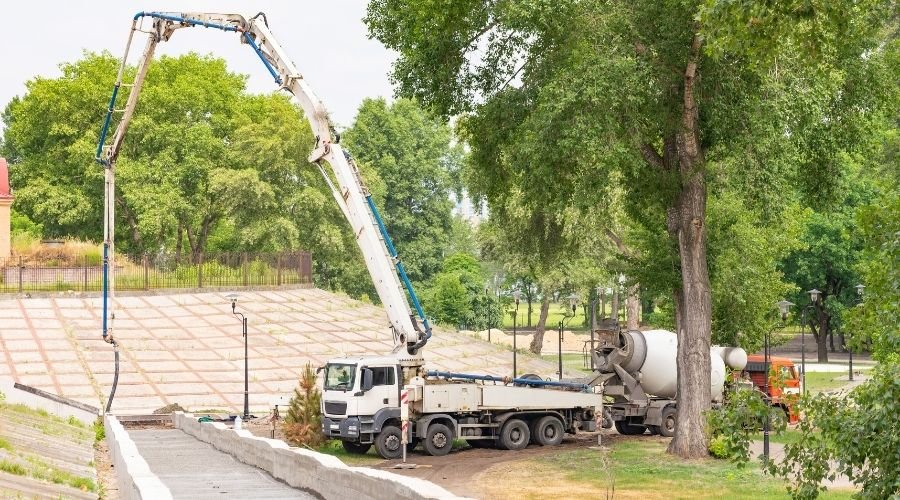
Concrete Pumping and Placement in West Texas
Pump booking in West Texas begins with a question about drive time, because a boom truck that leaves its staging lot at dawn can still be an hour from a slab on the Plains, and the mixers feeding it may be farther away than that. We place concrete by pump, by conveyor, by chute and by bucket, and the choice follows the site rather than habit. On a long footing run with open access, a chute from the truck is cheaper and quicker. On a congested wall, an elevated deck or a pad behind a fence, a line pump or boom is the only way to deliver mix where the forms stand.
Each trip starts with a sketch of the road from the batch plant to the pour and from the pump to the pour. We want the weight limits on county bridges, the turning room at the gate and the distance the hose has to reach once it unfolds. Those answers decide which unit we book and when the first truck should leave the plant, and they keep a delayed mixer from leaving a finishing crew standing in the sun.
Which buildings call for a pump
A pre-engineered metal building with a simple slab usually places by chute, since mixers can back up to the edge of the pad. Pumps earn their cost where trucks cannot reach: floors poured inside a closed shell, tight service yards, second-story slabs and equipment rooms behind existing walls. Hospitals and clinics fall into that group because the footprint is tight and the site is busy with parked cars and ambulances.
School additions are a similar case. A new wing beside an occupied campus leaves little room to maneuver, so for an education building we often schedule placement for a weekend or holiday week. For agricultural owners with pads far from any town, and in rural towns where the whole county may have one ready-mix supplier, we confirm supply before booking any pump, because a pump with no concrete to move is a wasted trip.
What moves the price of a placement
The largest cost driver is travel. A pump truck moves slowly on farm-to-market roads, and a long haul turns into billed hours before a single yard is placed. We list mobilization separately so an owner can see what distance costs and compare it with a smaller trailer line pump or a conveyor. Setup time, washout, minimum hours and boom reach follow, and each depends on how close the truck can park.
Volume matters less than owners expect. A few yards can cost nearly as much to pump as a large pour, because the truck and operator are booked for a minimum block. Combining pours is the cheapest saving we offer: a footing, a pad and a wall placed on one day share a single mobilization, unless a combined day would force finishing in conditions that threaten quality.
Site conditions that decide the method
Ground that looks firm in a dry month can soften after rain, and a loaded pump puts heavy loads through its outriggers. Where a base is thin or the fill is new, we lay timber mats or rock pads under the outriggers and avoid setting up over utilities that the drawings have not located. Overhead lines are the other major constraint, since a boom must stay well clear of energized conductors, and a remote pad can have lines running in directions that are easy to miss from the road.
Wind affects pumping more than most owners expect. When gusts rise we shorten the boom, change the setup spot or wait. Our formwork crews also check bracing first, since pumped concrete arrives with force and a form set for a chute pour may need more bracing to take it.
Safety at the boom and the hose
Pump work combines moving machinery, pressurized lines and wet concrete, so the job begins with a briefing on setup, traffic paths and signals between the operator and the placing crew. People near the hose end stay clear of the line when the pump is under load, and no one stands under a boom while it moves. Delivery drivers get a marked route so they never have to guess where to park.
Heat and fatigue are the other hazards. A summer morning pour reaches working temperatures early, and a crew that has been moving hose since four needs rest and water. We rotate tasks, place shade at the finishing area and contain the washout so slurry never reaches neighboring ground. On elevated decks, edge and fall protection are checked before anyone steps on the surface.
From the plant to the form
We start with the supply. In a small county seat, one ready-mix plant may cover a wide area, and its hourly output sets the ceiling on how fast we can place. We confirm the mix, the truck count and the first load time, then work back to the pump booking. If the plant cannot keep pace, finishers stand idle and cold joints become a risk, so we choose a smaller line or a second pour day.
On the day, one person on the concrete team owns communication with the plant and another owns the pump line, so a delay in one place reaches the other quickly. Afterward we record the yards placed and any irregularities, and send the notes to the team along with our testing and quality control coordinator so cylinder results match the right truck tickets.
Placement across the regional road network
Floydada sits where two U.S. highways, a state highway and two farm roads meet, which gives pump units several routes into the Floydada area, while a job on a single county road farther out may allow only one. Stanton lies on Interstate 20 and is the Martin County seat, so work around Stanton can use the interstate for the heaviest trucks, with the final leg on a local road.
In Andrews County, a field that has produced over a billion barrels of oil has left a lot of heavy-haul roads, though wells and lease roads need careful routing. Lubbock has more suppliers and pump companies, with traffic and tighter site rules. Our rebar placement crew works from the same schedule so steel is tied before the pump arrives.
Send the pour details
Tell us the volume, the access, the supplier and the date you have in mind, and we will check the drive time and the pump options. A short phone call with the plans in hand is usually enough to line up the right unit and crew.
Common Questions
How far ahead should I book a pump for a rural pour?
Book as soon as the pour date is realistic, and confirm the concrete supply at the same time. Pump units in the region are shared among many contractors, and farm and energy seasons can crowd the calendar. We usually settle the pump, the plant and the crew in one call so the three bookings cannot drift apart.
Can you pump concrete when it is windy?
Light and moderate wind is manageable with a shorter boom and a protected setup. When gusts pass the limit the pump maker sets, we stop and wait, because a swinging boom is a hazard and a poor finishing condition. We watch the forecast through the morning and will move a pour to another day.
Is a pump always more expensive than a chute placement?
The pump costs more per hour, but it can save labor and shorten the pour, which sometimes lowers the total. A chute works when trucks can reach the forms. If the crew would otherwise move concrete by wheelbarrow over a long distance, a line pump often pays for itself.
What limits how fast concrete can be placed?
The slowest link sets the pace: the plant's output, the haul time, the pump rate or the finishing crew. We try to match all four so none sits idle. In a small-town job the plant is usually the limit, so we size the pour around what it can supply.