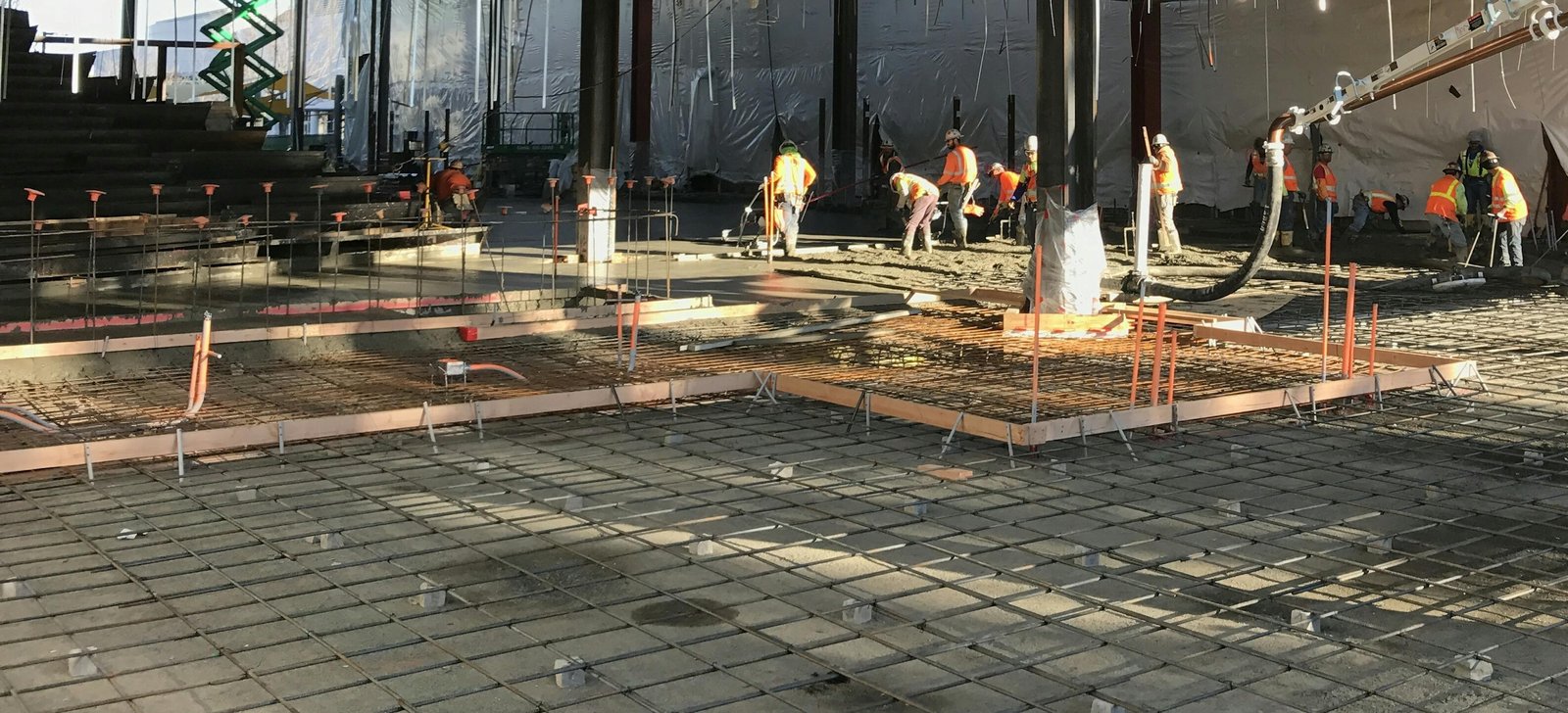
Slab-on-Grade Floors in West Texas
Slab-on-grade pours in West Texas lose moisture to the air faster than they gain strength from the mix, and that single fact explains most of how we run a floor. Fort Stockton, at roughly 2,972 feet, is hot and semiarid, and it collects just 13.66 inches of precipitation in an average year. Dry air, strong sun and steady wind pull water off a fresh surface, which leaves crazing and plastic shrinkage cracks unless somebody plans against them.
We place slabs for shops, warehouses, medical buildings, retail centers, plants and yard buildings. A slab is the part of a building that everybody walks on and that nobody notices until it goes wrong, so we focus on subgrade, reinforcing, jointing, finishing and curing in that order. Each step has a clear owner on the concrete team and a checkpoint before the next begins.
If the plant sits a long drive away from the pad, the plan picks up extra steps: confirming supply, staging equipment, and setting crew times so the truck count matches the finishing pace. The sections below cover how we handle each of these.
Safety on a floor pour
A slab pour combines heavy equipment, wet concrete, moving trucks and a crew working at ground level, so it gets a written plan. Truck routes keep mixers away from workers on foot, and a spotter backs trucks to the chute or pump. Workers who kneel on wet concrete wear boots and gloves, because the alkaline mix burns skin, and eyewash is kept within reach.
Heat is the other main hazard on a West Texas pour. Finishing is hard labor under a hot sun, often with wind drying the surface. We start before dawn when the work allows, rotate finishers, provide shade and water, and stop work when conditions are unsafe. Saw cutting follows the pour with dust controls, since silica is a real concern for the crew and for others nearby.
Pouring slabs from the Trans-Pecos to the South Plains
Slab conditions change with the terrain. Midland stands near 2,779 feet and Midland Draw crosses the north side of town, so drainage and low spots matter on city lots. The city places the Littlefield municipal airport entrance about three miles west of town, off Highway 54. We review the final access to each property and the exposure of its concrete work when arranging delivery and surface protection.
The Rio Conchos joins the Rio Grande near Presidio, creating a flood plain suited to farming, and building near a flood plain calls for attention to groundwater and base drainage. The concrete partners we coordinate travel to these places from staging points chosen for each project. We price from the road distance for Midland work, for Fort Stockton work and for Presidio, rather than a flat rate for the whole region.
Sequencing the pour and the supply
A good slab schedule starts with the building. The subgrade must be approved, the underslab utilities tested and the base compacted before steel goes in. We then set the pour date with the ready-mix plant and confirm batch capacity, because a large slab can use every truck a small plant has. On a long haul we often split a slab into placements that match what the plant can supply in a day.
Weather steers the final decision. We watch forecasts for wind, rain and temperature, and move the start time or the date if conditions would harm the surface. Following the pour, saw cutting is timed to the strength of the concrete, usually within a few hours in hot weather. Once curing is complete, we hand the slab to the next trade with a joint plan and a record of what was placed.
Who does what on the slab
The concrete partners form edges, place vapor barrier when it is in our scope, tie and chair reinforcing, set screeds, pour, float, trowel, cut joints and cure. We use laser screeds on larger floors when the project warrants it, and hand screeds on small ones. The finishing crew works as a unit with one lead, so the surface reads as a single floor rather than a patchwork, and a second finisher stays on the floor to catch low spots while the concrete can still be moved.
Excavation, fine grading, base stone and underslab plumbing and electrical are trade-partner work that we coordinate. We walk the pad with those partners before the pour to confirm elevation and cleanliness. If a pipe has settled or a conduit sits too high, we want to learn it that morning, not after the concrete is in place.
Reinforcing deserves its own attention. Welded wire, bar mats or fibers each suit different loads, and we follow the drawings on size, spacing and cover. Chairs keep the steel in the middle of the slab rather than on the ground, and we walk the mat before the first truck arrives to confirm that nothing has been trampled flat. A short checklist for the lead finisher covers edge forms, blockouts, drains and slope to drain before the first load is discharged.
Where a slab connects to other work
Many owners want more than ordinary flatness and levelness, and for those floors we offer super flat floor slabs. Hot summer pours follow the methods described under hot and windy weather concrete, and acceptance runs through concrete testing and quality control.
Slabs serve many buildings, with a warehouse being the most common, and the owners behind them include logistics and warehouse developers who care about joint durability under forklift traffic. If you are weighing options for a floor, send the use and the loads and we will suggest a thickness and joint pattern to discuss with your engineer.
Bring us the floor plan
Send the plans, soil report and site address, and tell us the use of the floor. We will look at the miles, the supplier and the finish requirements, then call with questions before any numbers go out.
Common Questions
Why does my new slab have hairline cracks?
Concrete shrinks as it dries, so some small cracks are normal, and control joints are meant to guide them. In West Texas the dry air and wind raise the risk of surface cracking when curing is delayed. We reduce it with evaporation control, timely joint cutting and immediate curing. We cannot promise a crack-free floor, but we can keep cracks where the design expects them.
How soon can we start moving equipment onto a new slab?
What decides it is the mix design, the air temperature and the loads the floor will carry. Light foot traffic often begins the next day, while racking and heavy forklifts need the concrete to reach design strength, which we confirm with cylinder breaks. We share the strength results so your move-in date rests on data.
Do you pour slabs in winter?
Yes, when we can protect the concrete. Cold snaps arrive quickly across open country, so we use blankets, heated mix water and enclosures when needed, and we monitor temperature until strength is reached. If a hard freeze is forecast, we reschedule rather than risk the surface.
What does the vapor barrier do?
It limits moisture moving up from the ground into the concrete, which counts under coverings like tile, resilient flooring and sealed finishes. We lap and tape seams as specified, protect the barrier from rebar chairs and foot traffic, and repair punctures before the pour.
Can you pour part of a floor now and the rest later?
Yes, with planning. We place construction joints where the drawings allow, use dowels for load transfer, and keep the bulkheads straight. The joint locations are agreed in advance with your engineer so later pours match the first.