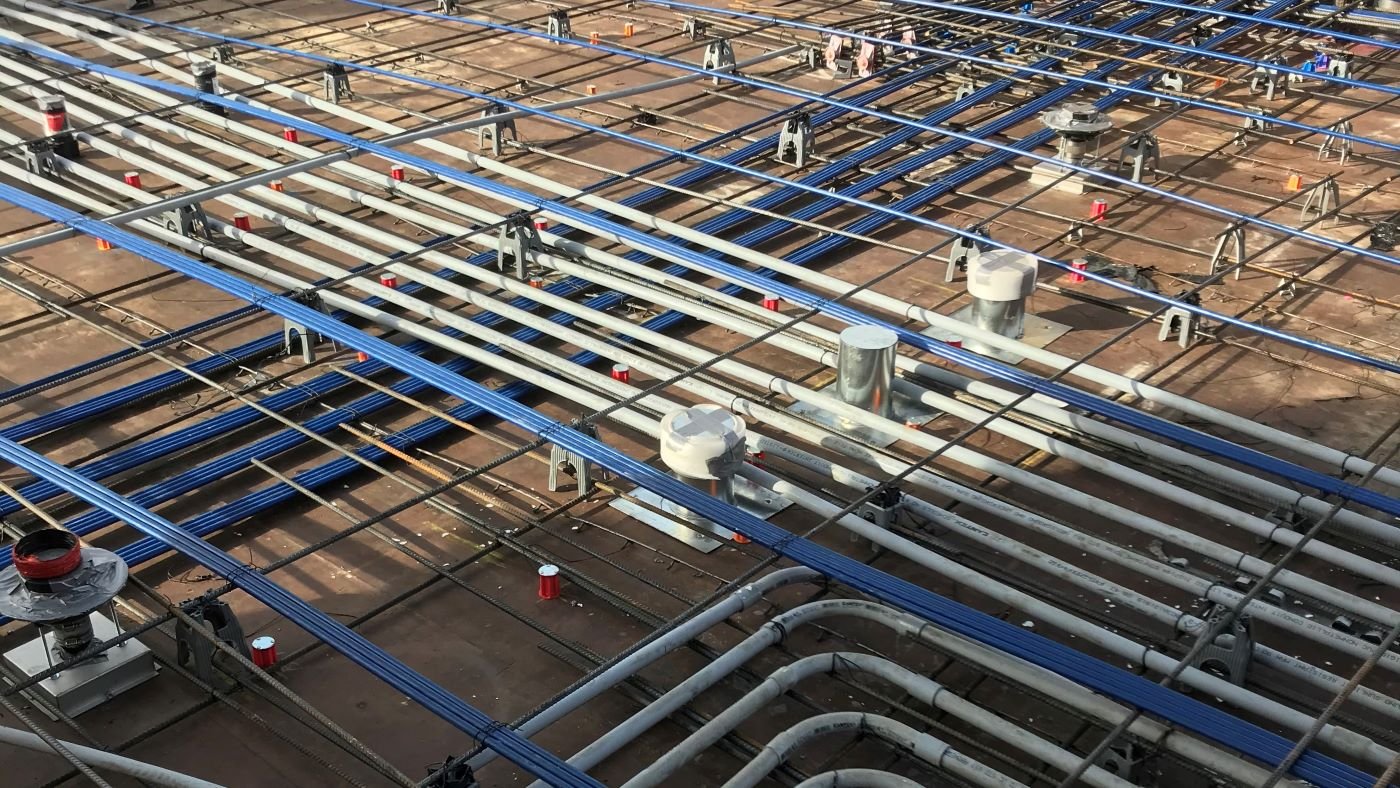
Post-Tensioned Slabs in West Texas
Post-tensioned slabs need stressing crews, tendon layouts and concrete strength tests lined up in a precise order, and a missed step on a remote site can cost days. The method places steel strands in the slab and tensions them after the concrete gains strength, squeezing the slab so it resists cracking and carries loads with less thickness. For the right building, it saves concrete, reduces joints and tightens floor performance.
Post-tensioning is used for large floors, elevated decks, residential podiums and some foundation slabs where the soil moves with moisture. It is a specialty system, and the details live on the structural drawings: tendon profile, spacing, sequence and stressing force. We build these slabs by following the engineer's shop drawings closely, and we bring a plan for the distances the concrete partners we coordinate travel to get there.
This page describes how we divide the work, how a pour is prepared and sequenced, what owners use it, what the scope covers, what changes cost, and which neighboring services connect.
Who does what on a post-tensioned slab
The concrete partners build edge forms, set pocket formers at stressing ends, place the supporting reinforcing, pour, finish and cure the concrete. The tendon supplier and stressing contractor are specialty trade partners that we coordinate: tendons are placed to the shop drawings, inspected, and stressed after the concrete reaches the required strength. We do not claim to perform the stressing ourselves.
What we control is the sequence around it. We schedule the tendon crew, the inspector, the pour and the stressing date together, with the cylinder tests that release the stressing. When tendon placement happens a day ahead of the pour, the concrete partners keep foot traffic away from the strands and cut no tendon while setting embeds. Once the slab is stressed, we make sure pockets are filled and finished neatly.
How we prepare for a stressed slab
We begin with a review of the shop drawings, because the tendon layout drives the forms, the blockouts and the pour. Sleeves, plumbing penetrations and embeds are placed to avoid the tendons, and we mark locations so no one cuts through steel later. A pre-pour meeting with the engineer, the tendon contractor and the inspector settles hold points.
On pour day, we watch consolidation near the stressing ends where the concrete must be dense to take the load. Vibrators work around pocket formers without moving them. Finishing follows the same discipline as other slabs, and curing starts quickly so the concrete reaches stressing strength on schedule. Records of the pour go to the engineer the same day, including placement times, concrete temperatures and any delays that touched the tendon layout, so the stressing decision rests on a complete file.
Strength, wind and the stressing window
Stressing normally waits for the concrete to reach a specified strength, determined by cylinders or maturity methods, so the calendar depends on weather as much as on crew effort. The dunes at Monahans Sandhills State Park shift with the wind, sometimes in a single night, and the park lies about 5 miles from Monahans, 31 from Odessa and 55 from Midland. That kind of wind affects a slab too, so we shield the surface and keep curing moisture in place.
Because the stressing crew and the pump may both be traveling from a distance, we line up their dates early and keep a backup day. Farm-to-market roads with load limits can restrict deliveries, and we confirm routes. The Texas farm-to-market road system dates to the 1949 Colson-Briscoe Act, which set out to connect rural and agricultural areas to market towns, and it now makes up over half of the mileage TxDOT maintains, so we are on them often.
Owners who use post-tensioning
Larger commercial and multifamily developers use post-tensioned slabs where spans, soil movement or floor thickness make the method worthwhile. Homebuilders and multifamily developers sometimes choose it for residential foundations and podium decks. Warehouse developers see benefits in large floors with fewer joints, since saw cuts are where forklift wheels do their damage.
Public owners and school districts consider it for gym floors, additions and shops where cracking is a concern. We talk with the owner and the engineer about whether the method fits the building; sometimes a conventional slab with good joints is the better answer and we say so. The choice is a design decision, and our job is to help the owner see the trade-offs.
What our scope includes
Our scope on a post-tensioned slab typically includes subgrade acceptance, forming, reinforcing other than tendons, coordination of tendon placement, embeds and blockouts, concrete placement, finishing, curing, cylinder and stressing coordination, and pocket closure after stressing. We also record the elongation measurements the tendon contractor reports, to be filed with the engineer.
Outside our scope are the design, the tendons themselves, and the stressing and cutting operations, which belong to the engineer and the specialty partner. Earthwork and utility work come through other partners. Defining these boundaries in writing prevents a gap that nobody notices until the day the strands are meant to be tensioned.
What changes the price
The price turns on slab area, thickness, tendon quantity and the number of stressing ends. Complex edges and many penetrations add labor. A very remote site adds crew travel and equipment staging, as does the possibility of a second visit for tendon placement and stressing. Concrete strength requirements can push the mix to a higher cement content or require extra testing.
Savings can come from a thinner section, fewer joints and a shorter formwork period. We help owners compare a post-tensioned option against a conventional slab on installed cost, schedule and long-term performance, including repair costs for joints and cracks. A fair comparison counts all of them.
Connected work
Post-tensioning relates closely to cast-in-place structural concrete and to elevated slabs and decks, and many owners compare it to a standard slab on grade. Large floors often combine the method with warehouse layouts, and testing is coordinated through our quality control work. Projects near Monahans and other remote sites run on the same disciplined schedule.
Describe the slab and the site
Send the structural drawings and the project location. We will look at the tendon layout, the supplier miles and the stressing sequence, then follow up with questions that affect the schedule and the budget.
Common Questions
Why would an owner choose post-tensioning over a regular slab?
It lets the slab be thinner, resist cracking and span wider spaces with fewer joints. The tradeoff is added planning, specialty trades and restrictions on cutting or coring after the slab is stressed. We help owners weigh the benefits for the particular building.
Is coring a stressed slab possible down the road?
Only with care. Tendons are under tension, and cutting one can be dangerous. We mark tendon locations and give the owner a record so future work avoids them, and we recommend scanning before any coring.
How long before stressing can happen?
It depends on the strength the engineer requires, the mix and the weather. In warm conditions it can be a matter of days, while cold weather takes longer. We confirm strength by cylinder results and give the stressing contractor an update as soon as the numbers come in.
Does the remote location change how you build?
It changes the planning. Crew travel, tendon delivery and stressing equipment all have to arrive on time, and we leave extra buffer days in the calendar. The slab itself is built to the same standard wherever it sits.