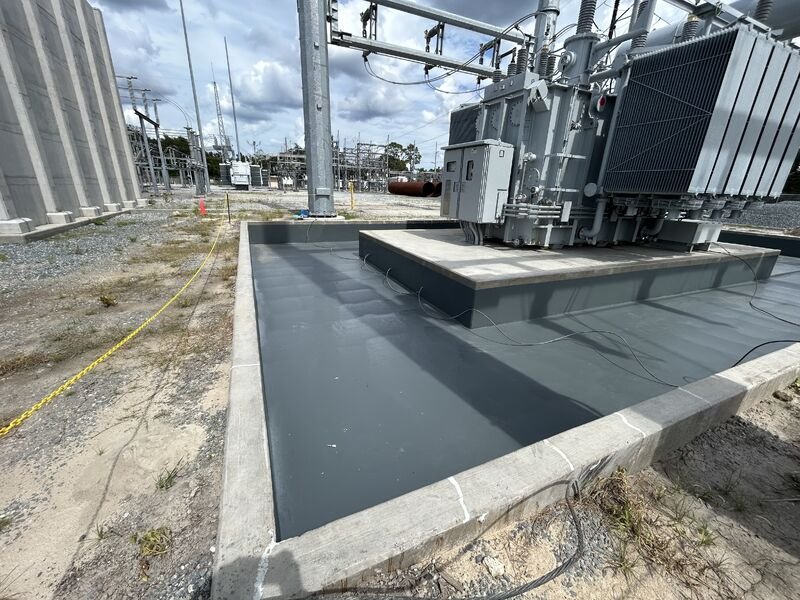
Containment Pads and Secondary Containment in West Texas
Secondary containment on a West Texas tank battery or chemical yard begins with one question: if the primary vessel fails, where does the liquid go, and does the concrete hold it long enough for someone to arrive with a vacuum truck. Concrete that has to hold a spill is held to a different standard than concrete that has to hold a pickup, and the difference shows up in joints, curbs, sealants and slopes.
We build containment pads, diked tank bases, truck unloading pads, wash racks, sump pits, curb walls and spill-control slabs for oil and gas operators, midstream companies, chemical and fertilizer handlers, municipal treatment facilities and agricultural processors. We build the forms, set the steel and place the slab, and partners we coordinate handle grading, liners, joint sealants and coatings so the system is tested as a whole.
Most of these pads are far from town and far from a plant. We plan around that distance with pour windows, mix choices and curing methods that hold up to long haul times, and we document the work so the owner has records ready for an inspection.
Why containment concrete is a regional staple
Rainfall at Post runs near 22 inches in a typical year, and June has touched 115 degrees F, a range that tests any slab edge and any sealant. West Odessa spreads over roughly 63 square miles in the middle of Ector County, a wide stretch of industrial yards, storage lots and service facilities where containment is a daily concern.
Oil, gas and midstream owners are the main buyers, but fertilizer dealers, fuel distributors, water haulers and agricultural cooperatives also need liquid-tight concrete. Each has different chemicals, different volumes and different inspection regimes, and the pad design changes with each. A fertilizer yard may need a wash-down slope and acid-resistant coating, while a produced-water facility needs thick walls, a sump and truck-loading protection.
Designing the pad around the liquid
We start by asking what the pad will hold: crude, produced water, fuel, fertilizer, solvent or wash water. The answer controls the mix design, the joint and sealant system, any coating and the slope to the sump. Chlorides, sulfates and acids attack concrete differently, and a pad that is perfect for diesel may fail in a few years under salt brine.
On the build, we set tight tolerances on the surface slope and on the curb or dike height, because a half-inch low spot in a wall is where a spill will go over. Joints get the sealant the engineer specifies, installed once the slab has finished most of its shrinkage, and we leave a clean, dry joint face for the installer. Where required, we coordinate leak testing by flooding the containment and checking the water level over a set time.
Services that touch the same site
Containment seldom stands alone. Equipment pads and machine foundations sit inside the diked area, trench drains and concrete drainage route stormwater out of clean areas, and bollards and site concrete protect tanks and piping from truck traffic.
On sites where the surrounding grade needs rebuilding, we coordinate earthwork and base preparation through partners so the pad sits on a stable, drained subgrade. Surface hardening and drainage work around a containment pad often costs less when planned together than when added after the first rain, and a single mobilization for all of it saves a long drive for the crew, the forms and the finishing equipment.
Spill risk, access and recordkeeping
Work inside or beside live tank batteries needs a site-specific safety plan. We attend the operator's orientation, follow the hot work and gas monitoring rules the site sets, and keep vehicles and equipment out of designated zones. Concrete trucks and pump lines are routed so they do not cross piping or valves, and we ask for a lockout on any line that must be crossed.
For recordkeeping, we keep the mix tickets, cylinder breaks, inspection sign-offs, joint sealant data sheets and leak test results with the project file. Whether the owner is a large operator or a small local business, a clean file shortens the conversation when an inspector asks how the containment was built.
Concrete placement and supplied components
Placing, finishing and curing the slab, plus building the curbs and sumps, falls to the concrete partners we coordinate. Grading, geomembrane liners where used, joint sealant, coatings and any electrical or mechanical work inside the dike come through partners we line up.
Sterling City is on the North Concho River in the east central part of Sterling County, a reminder that many pads sit near drainages that flood. We take the nearest creek, draw or low-water crossing seriously when planning staging, and we also keep the pad's finished elevation above the likely high water line wherever the layout permits.
Distance, weather and cure on a remote pad
A containment pad is a poor candidate for a rushed pour. Heat and wind can cause plastic shrinkage cracking in a large flat slab, and a crack in a containment floor is a leak path. We schedule pours for early morning where we can, use evaporation control, and begin curing immediately after finishing. The measures we apply are described under hot and windy weather concrete.
Delivery distance drives mix choice. A long haul calls for set control, so we work with the plant on retarders and water-reducing admixtures. Crosbyton lies on U.S. Highway 82 about 36 miles east of Lubbock, and a ready-mix source that far from the site can stretch the truck cycle. We build that into the number of trucks and the order they are dispatched.
Describe the liquid and the location
Tell us the product, the volume to be contained and where the pad will sit. We will check the haul from the nearest plant, advise on mix, joints and curing, and map out the pour so the pad is ready for its first fill. Contact a project manager through the form or by phone.
Common Questions
How do you keep a containment slab from cracking?
We control subgrade stiffness, mix, joint spacing and curing. Joints are placed to the engineer's layout, curing begins right after finishing and we protect the slab from wind and sun. Small cracks can still happen in concrete, so the design usually includes a joint sealant or coating to handle movement.
Do containment pads need to be tested before use?
Often the owner or the regulator asks for a water test, where the containment is filled and monitored for a period. We coordinate access, water supply and test records so the process is not a surprise.
What if the liquid is corrosive?
Tell us the chemicals. Concrete can be protected with coatings, specialty mix designs or liners, and the choice depends on concentration and exposure time. The engineer or the owner's environmental staff usually selects the system and we build to that spec.
Can you retrofit containment around existing tanks?
Yes. Retrofit is harder than new work because tanks, pipes and operations are in the way. We plan around the equipment, phase the pours, and use hand placement or small pumps when needed.
Who handles the sealant and coating?
Specialty applicators handle them, coordinated by us as trade partners. We prepare the surface to their requirements, and the work follows the cure time stated on their data sheets.