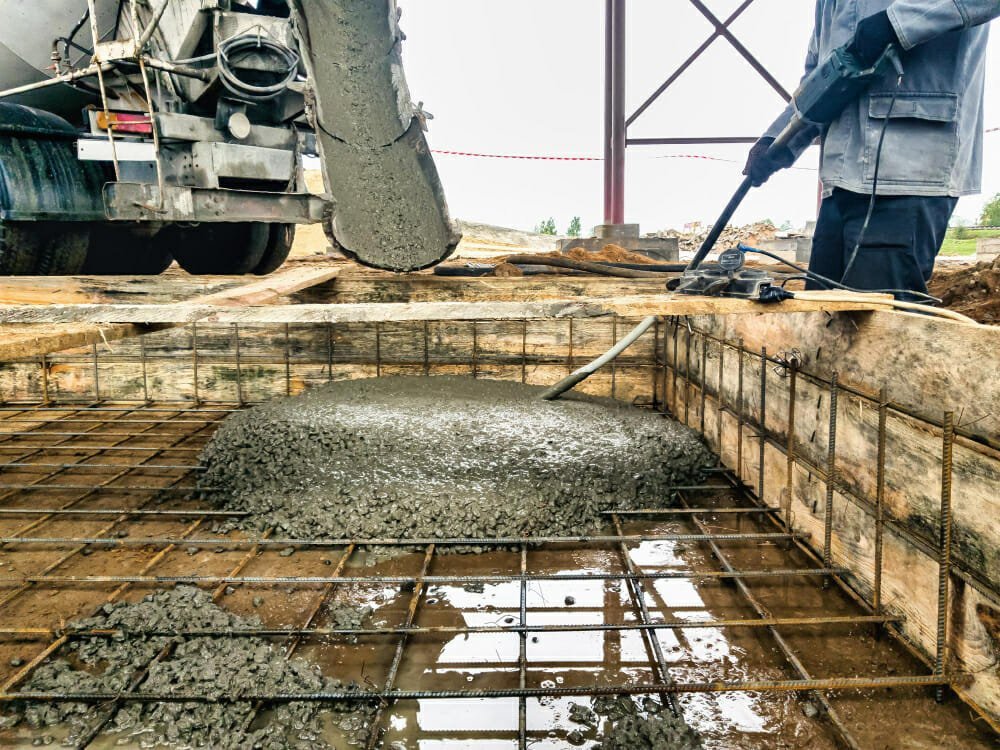
Equipment Pads and Machine Foundations in West Texas
Vibration, not weight, is the first question on a machine foundation, and the answer determines how much concrete, how much steel and how many days of curing the pad needs before a compressor, generator or pump skid can run on it. Heavy equipment pads look like plain slabs from the road, yet the tolerances on flatness, embed position and grout space are tighter than on almost any other flatwork we pour.
We build equipment pads, machine bases, inertia blocks, generator and transformer pads, tank rings, compressor foundations and conveyor supports for industrial owners, energy operators, municipalities and agricultural processors. Forming, steel and concrete are in our hands. We bring in survey, anchor bolt suppliers, grouting crews and any earthwork needed under the pad as coordinated partners.
Remote equipment sites add a second set of problems. A compressor station may be an hour down a lease road, with one chance to bring in the pump and the trucks. We plan around that single window, confirm vendor drawings before forms go up and set the pour date from the equipment delivery schedule so the machine does not wait on concrete or the other way round.
Facilities that need engineered pads
Machine foundations show up inside manufacturing plants and food and beverage processing buildings, where presses, mixers, chillers and packaging lines each need their own base, isolated from the surrounding floor. They also appear in pump stations, gin yards, well sites, water treatment works and substations scattered across the region.
Each facility type has its own risk. A plant floor needs saw-cut isolation joints and level tolerances that match the machine vendor's drawings. A well site or compressor pad needs drainage, containment and a surface that will hold up to heavy rig traffic. Knowing which of these you are building shapes the mix, the reinforcing and the finish, and it tells us whether the pad needs a hard steel-trowel surface, a broom texture for traction or a sloped top that sheds fluid toward a sump.
Pad types and what we include
Our scope on a typical equipment foundation includes layout, excavation coordination, subgrade preparation, formwork, reinforcing steel, embedded plates and sleeves, anchor bolt templates, concrete placement, finishing, curing and documentation. For larger machines we add inertia blocks, pit walls, isolation joints and post-pour grout beds under baseplates.
We also cover smaller, repeatable pads such as transformer bases, switchgear pads, tank rings and generator slabs, sometimes dozens of them across a utility project. Repetition helps with unit pricing, and a standard set of forms speeds the work, but each location still needs its own check for soil, drainage and clearances.
Soil, climate and daily temperature swing
We review the forecast temperature and the design requirements before scheduling a thick equipment pad. The accepted thermal-control and curing requirements guide the placing operation. We coordinate the specified protection and any required temperature observations so the installation follows the reviewed concrete plan.
We specify blankets, curing compound or water curing for massive pads and measure the temperature when the mix or the design calls for it. Soil support gets equal attention. A pad on poorly compacted fill will settle under a running machine, so we confirm compaction results and proof-roll the subgrade before we place steel. If the pad touches mass concrete pours, the thermal plan becomes part of the engineering submittal.
Who does what on a machine base
Placing and finishing belong to the concrete scope we coordinate. The survey firm that sets baseplate elevations, the supplier who furnishes anchor bolts and sleeves, and the grout installer who fills the space under the baseplate all report through us. When excavation or compaction is needed, an earthwork partner is scheduled ahead of the formwork partner.
This division keeps accountability clear. The person who sets the bolt template is the person who pours the pad, so the bolt pattern is checked against vendor drawings by the same crew that owns the result. We record elevations at baseplate corners before turning the pad over, so the mechanical contractor starts with a documented surface and nobody argues later about whether the pad was level when it left our hands.
Matching concrete to equipment arrival
Equipment manufacturers publish minimum cure times before a machine can be set or run, and lead times for the machines are often longer than the concrete schedule. We work backward from the delivery date, pour early enough for the pad to reach the required strength and keep a cushion for weather delays. On remote sites, that cushion matters because a wind or rain day can cost a week.
We ask the equipment supplier to confirm the shipping method and unloading requirements before arranging installation access. The delivery route and lifting position must work with the available site space and the concrete release conditions. We coordinate those handoffs with the responsible parties before the machine is dispatched.
Pads rarely stand alone
Equipment foundations connect to other scopes. Containment pads and secondary containment often sit around fuel, chemical or produced-water equipment. Concrete formwork and rebar placement set the quality of the pad itself, and trench drains or sumps may need to be cast in.
For plant work, we also coordinate concrete sawing, cutting and coring where a pad ties into an existing slab, so the cut line, the dowels and the new pour match.
Along the Ports-to-Plains route and beyond
The Ports-to-Plains corridor follows U.S. 277 to San Angelo and U.S. 87 through Big Spring and Lamesa to Lubbock, with State Highways 158 and 349 connecting Midland. That corridor carries a lot of equipment into the region, and we mobilize from it to Big Spring, Lamesa, San Angelo and the smaller towns around them.
Robert Lee is described as the oilfield supply center for its area, which is typical of how small towns in the Concho Valley keep an energy economy running. For oil, gas and midstream owners we price equipment pads with travel, staging and weather windows built in.
Send the vendor drawings and the delivery date
Share the equipment submittals, the site location and the date the machine arrives. We will work backward to a pour date, list the trade partners needed and give you a plan that treats curing time as a real constraint. Use the quote form or call a project manager.
Common Questions
How soon after the pour can a machine be set on the pad?
The answer depends on the machine manufacturer and the engineer. Some require seven days, some require full design strength. We provide cylinder results and a written release when the pad reaches the threshold, and we do not guess from the calendar.
What tolerances can you hold on a machine base?
Tolerances come from the equipment vendor's drawings. We form to them, check elevations at baseplate corners and document what we find. Where a vendor calls for a grouted baseplate, the pad is poured slightly low to leave the right grout depth.
Can you pour several identical pads in one trip?
Yes, and it is the best way to control cost on a spread-out site. We stage forms, steel and a finishing crew, then pour in a planned order based on truck availability and the order of equipment delivery.
Do you handle pads in active plants?
We do, with attention to noise, dust, forklift traffic and the plant's own safety rules. Work is often phased around production shifts and shutdowns, and we cut and break existing slab with controlled methods so nearby machines are not disturbed.