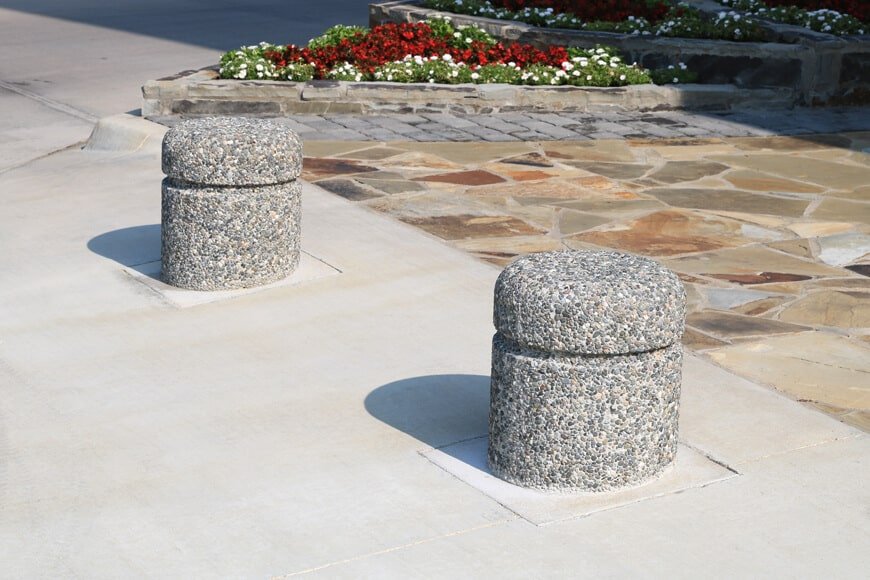
Bollards and Site Concrete in West Texas
A steel pipe filled with concrete and set in a drilled footing is the cheapest insurance a loading dock, gas meter or storefront can buy against a pickup that misjudges a turn. Bollards, wheel stops, curbs, pads, pole bases, steps and small site slabs are the pieces of concrete that make a site work after the building and paving are finished, and they get built by a crew that can handle many small items in a single trip.
We install bollards, light pole bases, sign foundations, dumpster pads, enclosure slabs, wheel stops, equipment pads, stairs, landings and miscellaneous flatwork for general contractors, developers, schools, municipalities and industrial owners. The concrete partners we coordinate drill, form, place and finish. We coordinate trade partners for steel pipe, fabricated rails, electrical conduit and layout.
Site concrete in West Texas is small work spread over long distances. A dozen bollard footings at one store are an afternoon, but the drive to the next town is half a day. We build the schedule around grouping: every footing, pad and step on a site in one mobilization, and where the owner has several sites in an area, one route.
The small pieces that complete a site
Bollard work starts with layout and locating utilities, then drilling or forming a footing, setting the pipe plumb, filling it with concrete and shaping a domed top that sheds water. Pole bases for lights and signs follow the same sequence with larger footings, anchor bolts to the fixture manufacturer's template and conduit stubs placed to the electrician's drawing.
Other items include trash enclosure pads, equipment screens, curb sections, wheel stops, steps at doors, dock bumpers and transformer pads. Each has tolerances that matter. A pole base off by a few degrees puts the fixture crooked, and a bollard set too shallow tips when a truck leans on it. We check depth, diameter and plumb at each location and record the work.
Frost, caliche and the water table
Tahoka has a semiarid climate with average annual precipitation of about 20.68 inches, a July mean daily high of 93.3 degrees F and a record low of 15 degrees below zero F. That range matters for small footings, because freezing weather can heave a shallow base and summer heat can crack a thin pour that is not cured.
Depth and diameter follow the engineer or the fixture maker, and we adjust for caliche, rock or loose fill by coordinating drilling equipment suited to the ground. Along the Concho rivers around San Angelo, where the city sits at the junction of the North, South and Middle Concho rivers and a flood in 1882 destroyed the Tom Green County courthouse at the former county seat of Ben Ficklin, we pay attention to groundwater and flood-prone low spots when we set footing depth and drainage.
Work that goes with the small stuff
Bollards seldom come alone. Sidewalks and flatwork and parking lot concrete surround them, concrete formwork handles the pads and curbs, and equipment pads and machine foundations cover larger units like generators and transformers.
When a site includes a loading dock or a fuel island, the bollards protect equipment and piping while the slabs are sloped to drains. We combine these into one scope so the crew, the forms and the concrete trucks make a single trip, and the details line up where one item meets another.
Owners who protect their equipment
Commercial developers specify bollards at storefronts, pickup lanes and fuel canopies. Schools and healthcare owners need them at entrances, utility yards and emergency vehicle lanes. Utilities and energy companies protect meters, switchgear and pumps.
Crane sits on U.S. 385 and State Highway 329, with Odessa 32 miles up the highway and McCamey 21 miles down it. Oilfield yards, pump stations and tank batteries along such a route all have valves, meters and piping that a stray truck can damage, and bollards are the first defense. We set them to the owner's standard or to the engineer's detail.
Grouping small jobs across big distances
Small concrete items are priced by trip as much as by volume. We schedule pole bases and bollard footings together so one drill rig and one pour handle all of them, and ask owners for a complete list of items on each site. For multi-site programs, such as a chain of stores or a series of pump stations, we plan a route that minimizes backtracking.
Climate normals at Midland International Airport list about 13.5 inches of yearly precipitation, 24 days at triple digits and 58 mornings at or under freezing, so in a typical year both hot and freezing weather will cross a small-items schedule. We plan around them with curing methods for each season, and we do not pour a base in a week when the forecast says it will freeze overnight.
Who does what on a small site
The concrete partners drill small footings where access allows, form and pour pads and curbs, set pipe and anchor bolts and finish the tops. We coordinate trade partners for larger drilling rigs, steel fabrication and delivery, conduit and electrical connections and surveying.
The Texas Tech University Center at Junction is a satellite campus on a 410-acre site, an example of a spread-out property where small concrete items multiply across parking, walks, utilities and equipment. For such sites we keep a punch list, check items off in the field and send the owner a list with photographs when the work is done.
Where bollards and site slabs turn up
Retail shopping centers use bollards, wheel stops and trash enclosures. Self-storage facilities need gate pads, bollards at office entries and light pole bases. Warehouses use bollards at dock doors, columns and equipment, and healthcare buildings need them at ambulance entries and utility yards.
Clyde belongs to the Abilene metropolitan area and has its own consolidated school district. In communities like it, school and municipal projects bring many small site items alongside the main building, and we handle them in the same mobilization as the building's flatwork.
Send the site plan and the item list
List every bollard, pole base, pad and step with its location. We will group them by trip, check drilling conditions and reply with a sequence that reduces drive time and the number of separate pours.
Common Questions
What footing depth does a bollard need?
The depth comes from the design or the manufacturer, and it depends on the load the bollard must resist. We follow the drawings and adjust for ground conditions by consulting the engineer.
Can bollards be added to a finished site?
Yes. We core or saw-cut the paving, drill the footing, place the pipe and close up the pavement. Utility locating comes first, because existing lines often run close to the places owners want protection.
Do light pole bases need special tolerances?
Yes. Anchor bolt projection, pattern and orientation come from the pole manufacturer's template. We set the template, pour, survey the bolts and correct problems before the pole arrives.
What is the minimum job size?
There is no hard limit, but a small job far away carries a trip charge. Sending a full list of items, even from several sites on one route, brings the unit cost down.
What finish do bollards get?
Most are filled with concrete, crowned at the top and painted or covered with a sleeve. The drawings or the owner's standard control the color and cover.