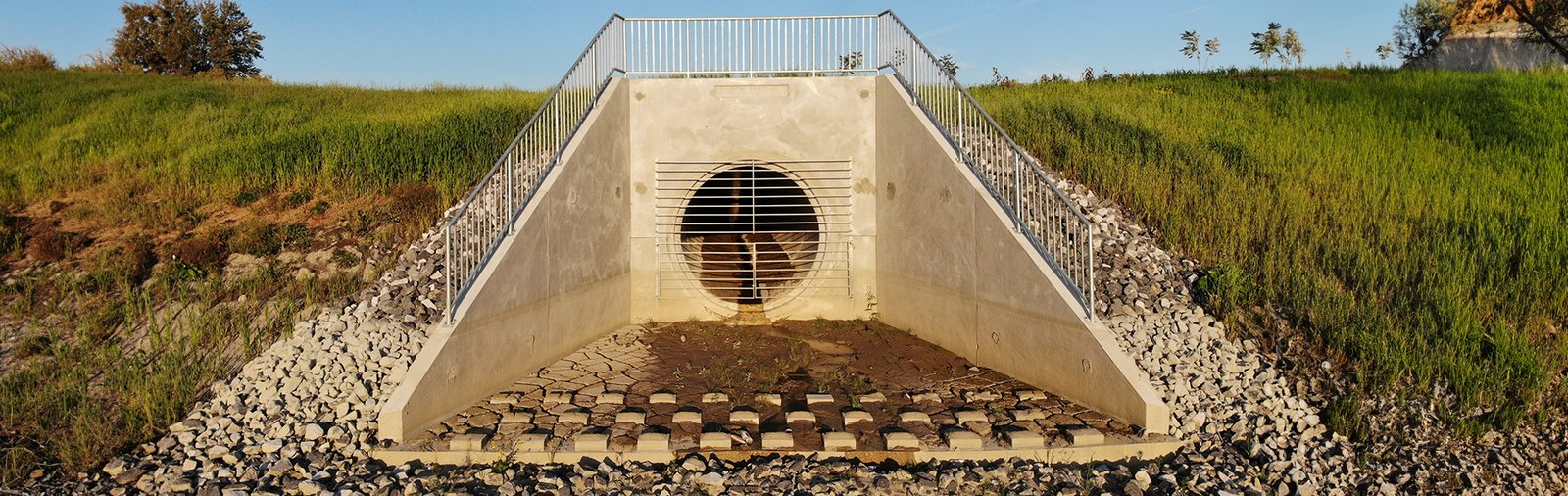
Culverts and Headwalls in West Texas
Dry draws look harmless for eleven months of the year, which is exactly why a culvert gets sized by the one month that matters. We build culverts and headwalls for driveways, farm access roads, plant entrances, county roads and site drainage: pipe or box sections placed under a crossing, with concrete headwalls, wingwalls, aprons and cutoff walls at each end to hold the embankment and guide the water. Trade partners we coordinate take the excavation, pipe and backfill, and the concrete partners we coordinate build the forms, set the steel, pour and finish the concrete.
A culvert fails in a predictable way. Water finds a gap at the inlet, undercuts the pipe, carries off the fill and drops the road. Good headwalls and aprons stop that sequence at the start, which is why the concrete at the ends of the pipe matters as much as the pipe. We take care with cutoff depth, wingwall angle, bar placement and finish on every headwall, because those details decide whether the crossing lasts through the first big storm.
Crossings are often remote, and their work comes with unique challenges: a ditch with only one truck route, a county road that cannot close, a landowner whose field sits on the other side. We plan access, detours and concrete supply as carefully as the structure itself, and we speak with the road owner before the first cut.
Roads built to reach the farms
The Texas farm-to-market road system was created in 1949 under the Colson-Briscoe Act to link rural and agricultural areas with market towns, and it now makes up over half of the mileage TxDOT maintains. Thousands of culverts sit under those roads, and many are aging. Replacement and extension work follows as traffic grows, fields are developed and storms scour old structures.
Hale Center sits on the Llano Estacado at about 3,419 feet, near Running Water Draw and Yellow House Draw. Around Hale Center, flat ground and shallow draws mean that a culvert often serves a wide, slow sheet of water, and the headwall design pays more attention to scour than to velocity. Agricultural owners in that sort of country add crossings to reach fields, tanks and barns.
The first call on many of these jobs comes from a landowner or a county road crew who found a washed-out edge after a storm. We drive out, measure the existing pipe, look at the channel above and below it and write down what we see: the pipe diameter, the condition of the ends, the size of the drainage area and the debris in the channel. That walk usually shows whether a simple extension and a new headwall will solve the problem or whether a larger opening is needed.
Concrete scope in the agreed package
The culvert package includes concrete construction alongside the pipe and earthwork. The concrete partners build the forms for headwalls and wingwalls, set the reinforcing, place the concrete and finish the aprons and cutoff walls. The formwork is built to the plan dimensions and braced for the pour, and the bar placement is checked before concrete arrives.
Excavation, pipe or box laying and backfill go to trade partners under our coordination. Doing it this way keeps one schedule and one contact. It also means the pipe invert and the headwall elevation come from the same survey, which prevents the common error of a headwall poured an inch off the flow line.
Who approves a crossing
A culvert on a county road needs county approval, one on a state highway needs the state transportation department, and one on a private drive follows the city or county driveway rules. Any crossing that affects a stream may add a federal or state review. The engineer sizes the opening for a design storm, and the reviewer checks it against hydrology.
Standard details exist for many headwalls and wingwalls, and many agencies publish them. When a standard detail applies, we build to it without change. When it does not, we submit shop drawings. Inspections typically cover the bedding, the pipe joints, the reinforcing and the final backfill, and we schedule them in sequence so the concrete crew is not waiting.
Stormwater rules apply when the work disturbs ground. Silt fence, inlet protection and rock check dams keep sediment from leaving the site, and the crew inspects them after rain. Once the concrete is complete and the slopes are stable, the owner or the road agency receives a short record with the pipe size, the invert elevations and photos of the finished headwalls.
Crossings from canyon country to the draws
Terrain varies a great deal across the region. Ransom Canyon is about 12 miles east of Lubbock in canyon terrain on the North Fork of the Double Mountain Fork of the Brazos River, and culverts near Ransom Canyon deal with steeper slopes and faster water than those in the flat plains. Lake Sweetwater and Oak Creek Reservoir, built in the last century to serve the Sweetwater area, are reminders that the region's drainage is often managed for storage as much as for flood control.
We mobilize crews to each crossing based on the actual road distance and price travel as its own line. Where several crossings sit along one county road, one trip can handle them all, which reduces the cost to the owner.
What a crossing costs
Opening size and pipe length are the main drivers: a large box culvert costs far more than a small pipe. Depth of cover, wingwall size and apron length add concrete, and rock riprap adds delivery cost. Traffic control and detours can cost as much as the structure on a busy road.
Time matters too. A county road closed for a week affects school buses, farm trucks and emergency vehicles, so some agencies require phased construction or a temporary bypass, both of which add cost. We price those alternatives side by side, and we add the cost of hauling concrete over a long distance when the nearest plant is far from the crossing, since a small headwall poured a long drive from the plant still needs a full truck and a careful mix schedule. Tying the work to storm drain or detention pond construction on the same site can spread mobilization over more work.
Bring the crossing location
Tell us where the crossing is, who owns the road and what the engineer has specified. A site photo helps. We will talk through the access, the forms and the supply before settling on a time.
Common Questions
How do you size a culvert?
The engineer sizes the opening using the drainage area, rainfall and the allowed headwater at the road. Larger watersheds and flatter slopes call for larger openings. We build to the size on the plan and flag field conditions that differ from the design.
Why do headwalls matter so much?
They hold the embankment, direct the water into the pipe and protect the ends from scour. A pipe without a headwall can be undercut or pulled apart. The wingwalls and aprons extend that protection.
Can a culvert be replaced without closing the road?
Sometimes, with phased construction, a temporary bypass or a precast box that goes in quickly. The road owner decides what is acceptable. We discuss the options in preconstruction.
What causes a culvert to wash out?
Common causes are undersizing, debris blocking the inlet, scour at the outlet and poor compaction around the pipe. Good bedding, headwalls and aprons reduce the risk.