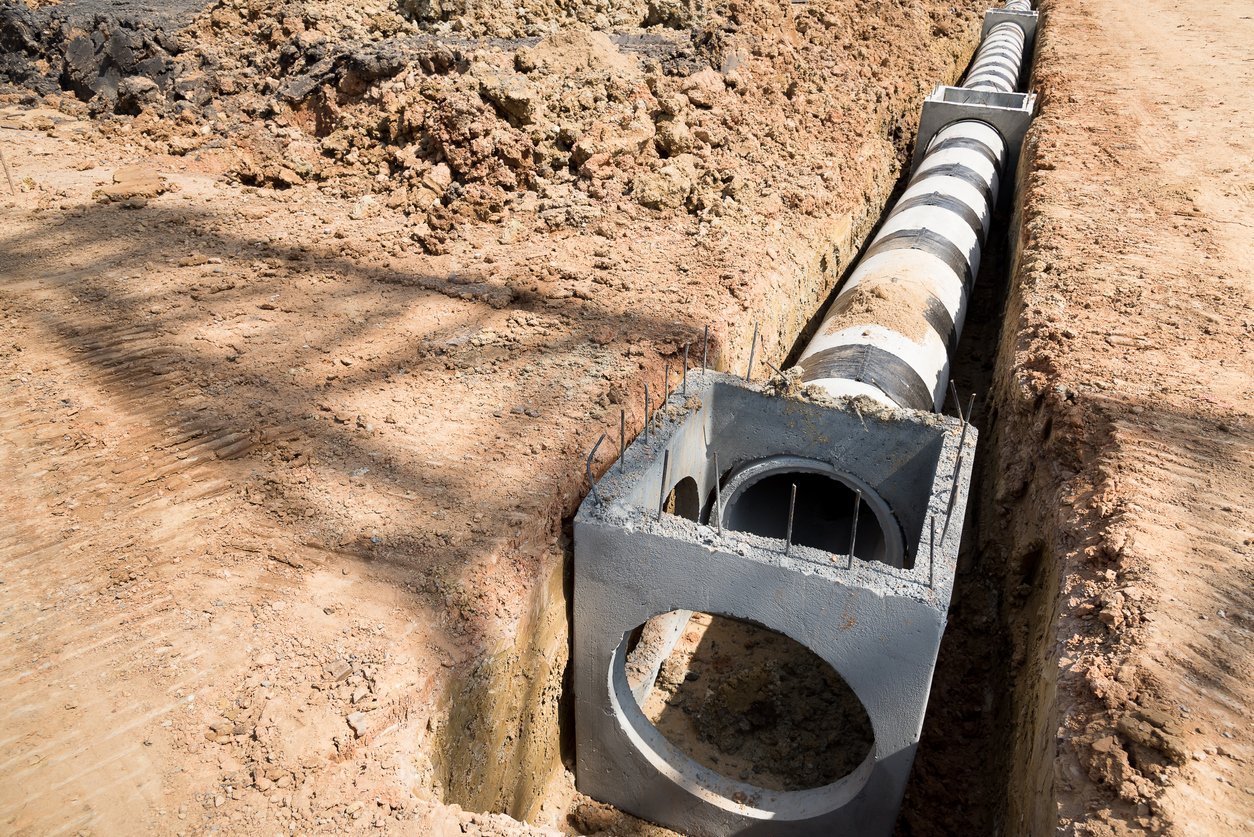
Storm Drain Installation in West Texas
Cloudburst runoff on a flat West Texas lot moves in sheets, carries sand and caliche, and arrives faster than most people expect from a region that averages so little rain. A storm drain system exists for those few hours: inlets that catch the sheet flow, pipe that carries it away from buildings and parking, and outfalls that release it without cutting a gully into a neighbor's field. We install storm drains for commercial lots, industrial yards, subdivisions and municipal projects, with trade partners handling the trenching and pipe while the concrete partners we coordinate place the concrete inlets, junction boxes, headwalls, flumes and aprons.
Drainage design is checked closely by cities and counties because a wrong grade pushes water onto someone else. Our task is to build what the engineer drew, and to raise a flag when the field condition does not match the plan. A storm line is rarely the deepest on a site, but it is often the most constrained, since it must hold a precise grade while crossing sewer, water and conduit.
Drainage review and the permit path
Most cities and counties require a drainage study and a plan approval before storm work starts. The review looks at pipe size, inlet capacity, the detention need and the point of discharge. Projects that disturb a larger area also fall under the state construction stormwater program, which calls for a pollution prevention plan, inspections and records. We obtain the approved drawings and confirm the discharge location before we mobilize.
Work in a highway right-of-way brings the state transportation department into the picture, and farm-to-market road culverts and ditches have their own requirements. For public works clients, we follow the owner's standard details for inlets, manholes and pipe class.
From inlet to outfall
We build a storm system from the outfall upstream, which keeps the water moving toward the discharge even during construction. The first structure and the first pipe set the grade for everything above, so we verify them with a survey crew before moving on. Each pipe joint is gasketed and checked, structures are set from the manhole and vault schedule, bedding is compacted, and inlet boxes are set to the finished surface elevation and protected from backfill.
Concrete work comes next: inlet throats, aprons, collars and flared end sections. We cure the concrete properly in hot weather, and we shield fresh work from vehicle traffic. Temporary inlet protection keeps sediment out of the new pipe until the surface is stabilized.
What storm drains cost to build
The pipe is the visible cost, but structures often dominate. A large precast junction box or a cast-in-place headwall can cost more than a long stretch of pipe. Pipe class, diameter and depth all raise the price, and reinforced concrete pipe costs more than plastic, though the engineer may require it under traffic or where the loads are high.
Distance to the outfall controls the pipe length, and a site with a distant creek or a far-off ditch can add considerable footage. Large paved lots such as a retail shopping center shed a lot of water to a few inlets, so inlet count and pipe size rise with the pavement. Surface restoration, including pavement patching and curb work, is a frequent surprise. Our proposals list the structures, the pipe by size and the restoration separately so the owner can adjust the design in response to the numbers. A detention pond may cut pipe size and cost on large sites.
Planning around rain and rail
Storm work follows the weather in a way few other trades do. A wet week stops trenching and floods open sections, while a dry month allows rapid progress. We stage work so that the pipe at the outfall end is complete first, which allows early storms to drain rather than collect in the trench.
Delivery of reinforced pipe and precast boxes depends on trucks and plants that may be several hours away. Slaton has a major BNSF Railway yard, and rail-served suppliers in that part of the Plains can shape how pipe and aggregate reach a project. We confirm delivery windows before opening ground and keep a day or two of float for late trucks.
Open trenches and moving water
Storm trenches are wide, deep and often near traffic. Protective systems, daily inspections and clear access ladders are part of every shift. Water is the added hazard: a sudden storm upstream can send a surge down a trench, so we watch the radar and pull crews out of low sections when a cell approaches.
Heavy precast pieces require rigging plans that name the pick weight, the crane and the swing radius, qualified signalers and exclusion zones. We check ground conditions before the crane sets up, since wet fill can fail under outriggers. Concrete workers wear gloves, long sleeves and boots, and we provide shade and water during hot-weather work.
Soils, outfalls and neighbors
Sandy soils soak up water, while clay holds it, and both affect pipe bedding and backfill. Caliche layers can make trenching slow. Outfalls require attention because erosion at the outlet is the most common failure. At Ballinger, the Colorado River and Elm Creek converge, a reminder that Ballinger projects near streams need outfalls, riprap and bank protection suited to higher flows.
Neighbors matter too, and so do the people who will live or work beside a new outfall for years. Water that leaves a new project must go where the law and the design allow, not onto the next field. We document the outfall conditions with photos before and after, so a later complaint can be answered with evidence.
Concrete and drainage installation interfaces
The concrete partners place and finish the concrete elements of a storm system: inlets, headwalls, flumes, aprons, curbs and collars. We coordinate trade partners for trenching, pipe laying and backfill, so the schedule is run by one party and the interfaces are managed. Where a job includes culverts and headwalls, the concrete work is ours and the pipe comes from the partner.
San Angelo is served by U.S. 87, 67 and 277 and State Highways 208 and 126, and work near San Angelo shows how many road crossings a storm line may meet in a city, each with its own permit.
Send the drainage plan
Send the drainage sheets, the study if you have one and the address of the site. We will talk through the outfall, the structures and the weather risk with you.
Common Questions
Do I need a detention pond with my storm drain?
Many cities require detention when new pavement raises runoff above its predevelopment rate. The drainage study decides whether a pond, an underground chamber or an enlarged pipe is the answer. Ponds are usually cheaper where land is available.
What pipe material is used for storm drains?
The engineer specifies reinforced concrete, plastic or corrugated metal based on loads, depth and the owner's standards. Reinforced concrete is common under roads and heavy truck areas. We follow the approved plans and submit alternates for review when a supply issue arises.
What happens to the storm water after it leaves the site?
It must discharge to a public system, a creek or a drainage channel that the drainage study approves. Outfalls need erosion protection such as riprap or a concrete apron. We build those to the drawings.
Can storm drains be built during winter or in wind?
Yes. Cold and wind affect concrete work and plastic pipe handling more than trenching, so we adjust curing methods and time the pours. Rain is the greater limit.
Who inspects the work?
The city, county or state agency that will own the system inspects the pipe, structures and backfill. The stormwater program requires separate site inspections for erosion control. We keep both sets of records.