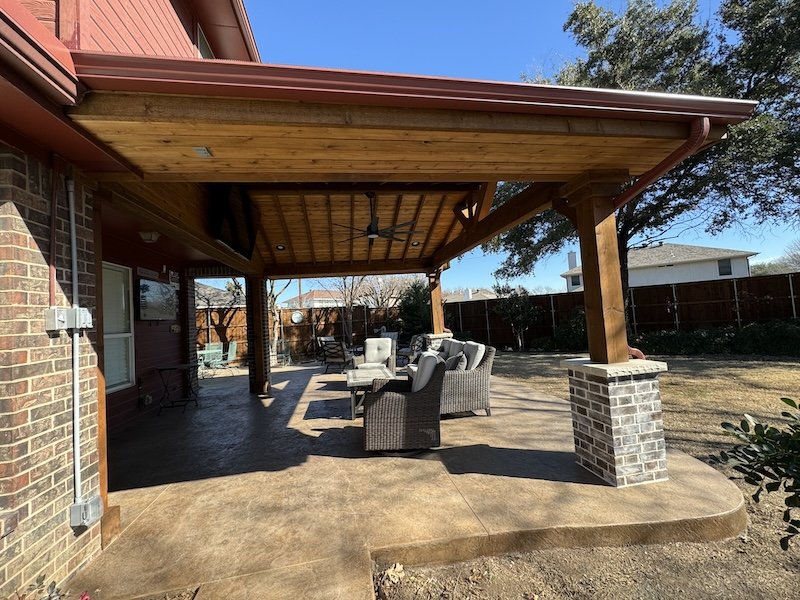
Decorative and Stamped Concrete in West Texas
Stamped patterns, integral color and exposed aggregate all depend on timing, and West Texas weather keeps tightening the window. A crew that stamps a patio in a mild climate may have an hour to work the surface before it sets, while in dry wind and high heat that window can shrink to minutes. We build decorative concrete with that clock in mind: more hands on the pour, retarders where useful, and a plan for each step.
Our decorative work includes stamped and textured slabs, colored concrete, exposed aggregate, broom and sand finishes, saw-cut patterns and borders. The typical project is a plaza, a restaurant patio, a courthouse entry, a campus walkway or a hotel drive court, where the surface is part of the architecture and not only a floor.
The sections below explain how we run decorative work, the buildings that use it, the decisions owners make, the specifications that matter, our scope and cost drivers, and who tends to ask for it.
How we run a decorative pour
We start with a mockup or a sample slab so the owner can see color, texture and pattern in the actual light. Subgrade and base follow the same discipline as any structural slab, since decorative finishes show settlement and cracks far more than plain broom does. Reinforcing, thickness and joint placement are laid out so that joints land on pattern lines.
On pour day, the crew places, screeds and floats the concrete, then applies color hardener or release agent, and stamps while the surface is ready. Timing is everything, so we stage mats, tools and extra labor ahead of time. Cleaning of the release agent, sealing and joint cutting follow. Wind screens and cover protect the surface until it can take the sealer.
Buildings and places that use it
Hotels and restaurants use decorative concrete for entries and patios, and hospitality projects often combine stamped drive courts with plain sidewalks. Retail centers use colored bands to guide customers, and civic buildings use patterned paving at entries. McDonald Observatory directs visitors from Fort Davis north along Highway 118 for 16 miles to its visitors center. For a proposed visitor-area project, we review the paving pattern and finish against the architecture, circulation needs and accepted design.
Schools and public buildings add plazas and courtyards. Retail centers look for texture and color that stay bright under heavy foot traffic. Each site gets a pattern and palette that suits the architecture and the surrounding ground, whether it is native stone tones in the hills or a cleaner modern look in town.
What to decide before the pour
Choose the pattern, color and sheen first, then confirm that the sealer will survive local sun and traffic. Color fades differently with the sealer chosen, and solvent-based products behave differently from water-based ones. Big Spring lies in the Beals Creek valley near 2,441 feet, and drainage on a site in a creek valley deserves attention to avoid standing water on a stamped surface.
Decide how joints will look. Control joints can follow pattern lines, which hides them, but only if the layout is planned. Also settle who maintains the surface, because resealing every few years keeps the color rich. We provide a care sheet and offer a return visit for resealing when the owner prefers.
Specs, accessibility and permits
Public decorative concrete must meet accessibility rules for slope, cross-slope and slip resistance. Deep texture can create a tripping hazard, so we confirm that the stamp profile is acceptable on an accessible route. Interstate 10 passes just south of Ozona with exits 363, 365 and 368, and State Highway 163 runs through the center of town; work in the public right of way near roads like these may need extra permits and traffic control.
We follow the specification for strength, air, color additive dosage and curing, and we keep batch tickets and sample panels as a record. If the specification does not name the sealer or the release agent, we offer options with data sheets. Third-party testing takes place on structural elements, not on every cosmetic slab, unless the owner asks for it.
What our scope covers
Our scope on decorative work covers forming, reinforcement, concrete placement, coloring, stamping or texturing, curing, joint cutting and sealing. We also include a simple mockup. When the project has an architect, we work from their pattern and color selections and request approval of samples before the full pour.
Subgrade, base stone and utilities are handled by partners we coordinate, and we confirm their work is finished before forms go in. Repairs after the fact are harder on decorative surfaces than on plain ones, so we like to confirm the pad condition and the outlets of irrigation, lighting conduit and drains before pouring.
What affects the price
Pattern complexity, color method and the number of different finishes in one slab drive labor. Integral color costs more than a surface hardener but lasts longer, and exposed aggregate depends on the stone. The sealer system matters too, since high-solids sealers cost more but last longer under West Texas sun.
Distance changes the budget as well. Crews, tools and mats travel together, and a remote site needs a full day of setup. Where a small job is far from our staging, we may suggest bundling it with other work. The proposal keeps decorative labor and mobilization apart, which lets the owner judge each one.
Who asks for decorative concrete
Commercial developers use it to give a center some identity. Municipalities and campuses use it for public space. Highway access into Andrews comes by way of US 385 plus SH 115 and SH 176, and civic projects in places with that kind of road access can add streetscape and plaza work to a main road improvement. We support those owners from small entry pads to larger plazas.
Many projects are close to our everyday flatwork, including sidewalks and flatwork, and some owners use the decorative finish only where people gather. If you are choosing between decorative and polished surfaces for an interior, see polished concrete floors, and for a site near Fort Davis we can discuss how local materials affect color.
Show us the surface you have in mind
Send a sketch, a pattern name or a photo from a similar project. With the address and target dates, we will check crew routes, material supply and weather exposure, and then arrange a sample panel.
Common Questions
Will stamped concrete crack?
Any concrete can crack. Reinforcement, a solid base and joints placed along the pattern reduce the chance and keep cracks less visible. We explain this before the pour so expectations match the material.
How long does color last in the West Texas sun?
Pigment mixed into the concrete holds up best since it is present all the way through. Color applied to the surface relies on its sealer, and that needs refreshing every few years. Strong sun fades some pigments faster than others, so we recommend colors with a good outdoor record.
Can new work match an older decorative slab?
Close, but never exact. Age, weather and the original mix change how a surface looks. We pour test panels so the owner can approve the match before we commit to a large addition.
Does a stamped surface get slick?
Rain makes it so, particularly under glossy sealers. We recommend a slip-resistant additive in the sealer for entries, pool decks and ramps, and we choose textures that are friendly to walking.
Which season suits a decorative pour?
Spring and fall are kindest, with mild air and calmer wind. We do pour in summer, using early starts and extra labor, and in winter with protection. The schedule shows the plan for the season.