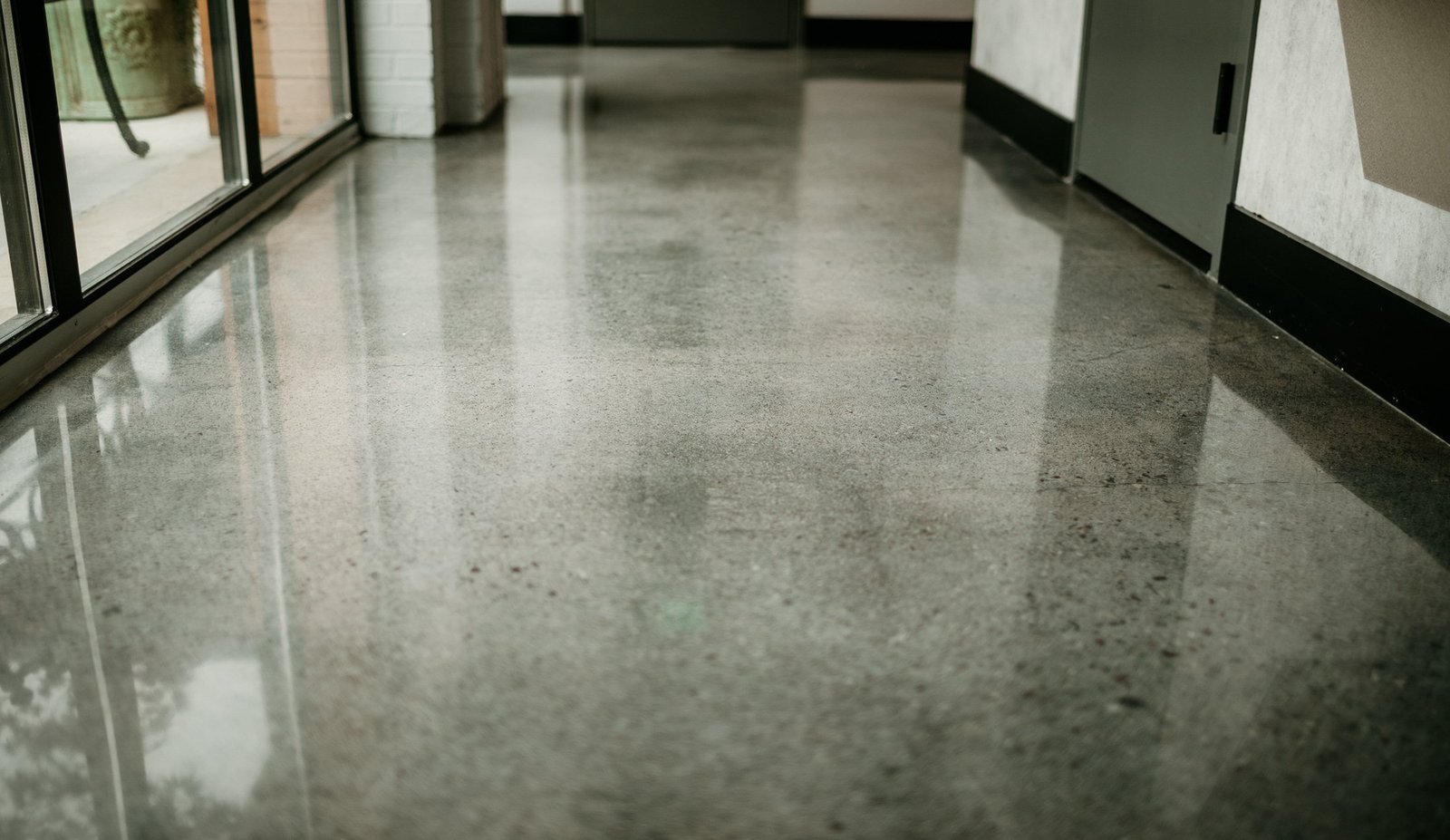
Polished Concrete Floors in West Texas
Polished concrete floors begin as ordinary slabs, but the finish you see years later was decided on pour day. Mix choice, finishing method, joint layout and curing all show up in the final sheen, and a floor that dried unevenly under West Texas sun will polish unevenly too. That is why we plan the polish before the pour, not after, and why the concrete crew and the grinding step belong in the same conversation.
We build slabs meant to be ground, densified and polished for retail stores, schools, clinics, offices, showrooms and shops. The concrete partners we coordinate pour and finish the slab, and the polish is staged with the grinding partner we coordinate on the project. The result is a hard, reflective surface that needs no wax or coverings, which is a good fit for owners who want low maintenance in a dusty, windy climate.
The sections below cover the regional context, what an owner should decide early, how we manage dust and slurry safely, the sequencing of the work, our scope and the buildings that benefit.
Why polished floors suit this part of Texas
Abilene sees a normal 23.78 inches of rain a year, and it built its own reservoirs for supply: Lytle, Abilene, Kirby and Fort Phantom Hill. In a place that works hard to conserve water, a floor that never needs wet mopping or waxing has an appeal. Dust blows in from open ground and parking lots, and a sealed, dense surface wipes clean.
The West Texas campus of Texas State Technical College introduced a wind energy program in 2007, the first of its kind at a Texas community college, and campuses and training buildings like it often call for durable floors in labs and shops. Polished concrete handles rolling equipment and spills. Owners also appreciate that the floor is part of the structure, so there is no covering to replace when the lease ends.
Decisions that make or break the polish
Decide the level of finish early: how much aggregate shows, what sheen is wanted, and whether joints will be filled or left open. A floor with exposed aggregate needs more grinding and a mix with uniform stone, while a cream finish needs a gentler cut. Mockups help, and we pour a sample panel on larger jobs so everyone agrees before the main floor. The mix matters as well: water content, fly ash or slag use and the stone itself influence color, and a plant that changes its aggregate source mid-job can leave a visible seam across a room. We ask the supplier to hold one source for the entire floor.
Also consider when the floor will be polished relative to other trades. Grinding in a closed building with other trades working above is a recipe for rework. Abernathy sits on the Llano Estacado at about 3,360 feet elevation, with most of the city in Hale County and about a quarter extending south into Lubbock County, a reminder that the high plains are windy, and we protect an open building with temporary walls before the pour begins.
Dust, slurry and slip control
Grinding concrete creates silica dust, so we require wet methods or vacuum-equipped machines, and respiratory protection where the plan calls for it. Slurry from wet grinding is collected, not rinsed into storm inlets, and it is disposed of as the permit rules require. Floors are barricaded during work, with signs for other trades, and we keep a clean path so that the dust is controlled where it is created, not where it lands.
Finished floors can be slippery when wet or when overly burnished. We discuss slip resistance with the owner and the design team and propose finishes with traction where traffic or moisture is expected. Sealers and densifiers have safety data sheets that our partners keep on site, and the crew reviews them before work begins.
Sequencing the pour, the cure and the polish
The schedule runs in sequence: slab placement, seven days or more of curing as the plan requires, joint cutting, then grinding in stages. Coarse cuts open the surface, densifier hardens it, and finer grits bring up the sheen. A guard or sealer completes the floor. Each step has a window, and an interruption between cuts can leave lines.
Because crews often travel to remote buildings, we try to combine visits where possible. The pthe concrete team finishes and cures, then the polish team arrives when the building is closed in and other trades are out of the way. We confirm temperatures too, since densifiers and sealers need specific conditions and do not cure well in extreme cold.
What our scope covers
Our scope usually covers slab preparation, placing and finishing for polish, curing, joint cutting and early protection. The grinding and polishing work is coordinated with a specialty partner and included in the proposal, or priced separately if the owner prefers to hire the polisher directly. We explain the split in the bid so no one is confused about who is accountable for the finished sheen.
The scope normally excludes subgrade preparation, underslab plumbing and electrical, and later floor markings. We include protection recommendations for the trades that follow, such as plywood walkways and wheels that will not scar the floor. A cleaning and maintenance sheet goes to the owner at turnover, and can be matched to local conditions like dust and sand.
Buildings that benefit
Schools choose polished floors for hallways, gyms and shops. Clinics and offices like the hygiene and look, and retail centers value the durable, light-reflecting surface. Owners in school and healthcare work get the benefit of floors that are easy to clean, and showrooms for vehicles and equipment use them for the same reason.
When the budget calls for a more decorative surface, we point owners to decorative and stamped concrete. If an existing floor is being renovated, concrete repair and restoration can prepare it, and we can describe how the process compares with new construction. See also how we handle Abilene projects when a polished floor is planned for a retail or public building.
Plan the polish with the pour
Send the finish schedule, plans and location. We will look at the pour sequence, travel routes and the timing with your other trades, then propose a mockup and a schedule that fit the building.
Common Questions
Will an existing slab take a polish?
Usually, though results differ. A floor that was placed and finished without polish in mind may show trowel marks, patches or uneven color. Planning the slab for polish gives a better outcome and often lowers cost, since less grinding is needed. We examine existing slabs before promising a result.
How long does the process take?
The pour and cure come first, then grinding in several passes over a few days, depending on the size. A large floor takes longer. We give a schedule for each stage, and we note which steps need the building closed in and the other trades out.
Will the floor crack?
Concrete can crack, and polishing does not hide every line. Control joints guide most cracks, and we place them with the finished look in mind. Hairline cracks may remain visible, and we talk about this openly before the work starts.
Does a polished floor need ongoing care?
Less than most coverings, but not none. Sweeping and damp mopping with a neutral cleaner keep the surface bright, and a periodic burnish restores sheen where heavy traffic dulls it. Grit tracked in from dirt lots wears a floor faster, so entry mats make a real difference in this region.
Does a polished floor get slick?
It can when wet or when burnished to a high gloss. A lower sheen and a traction-tested sealer help. For entries and wet areas, we recommend a finish with better grip.