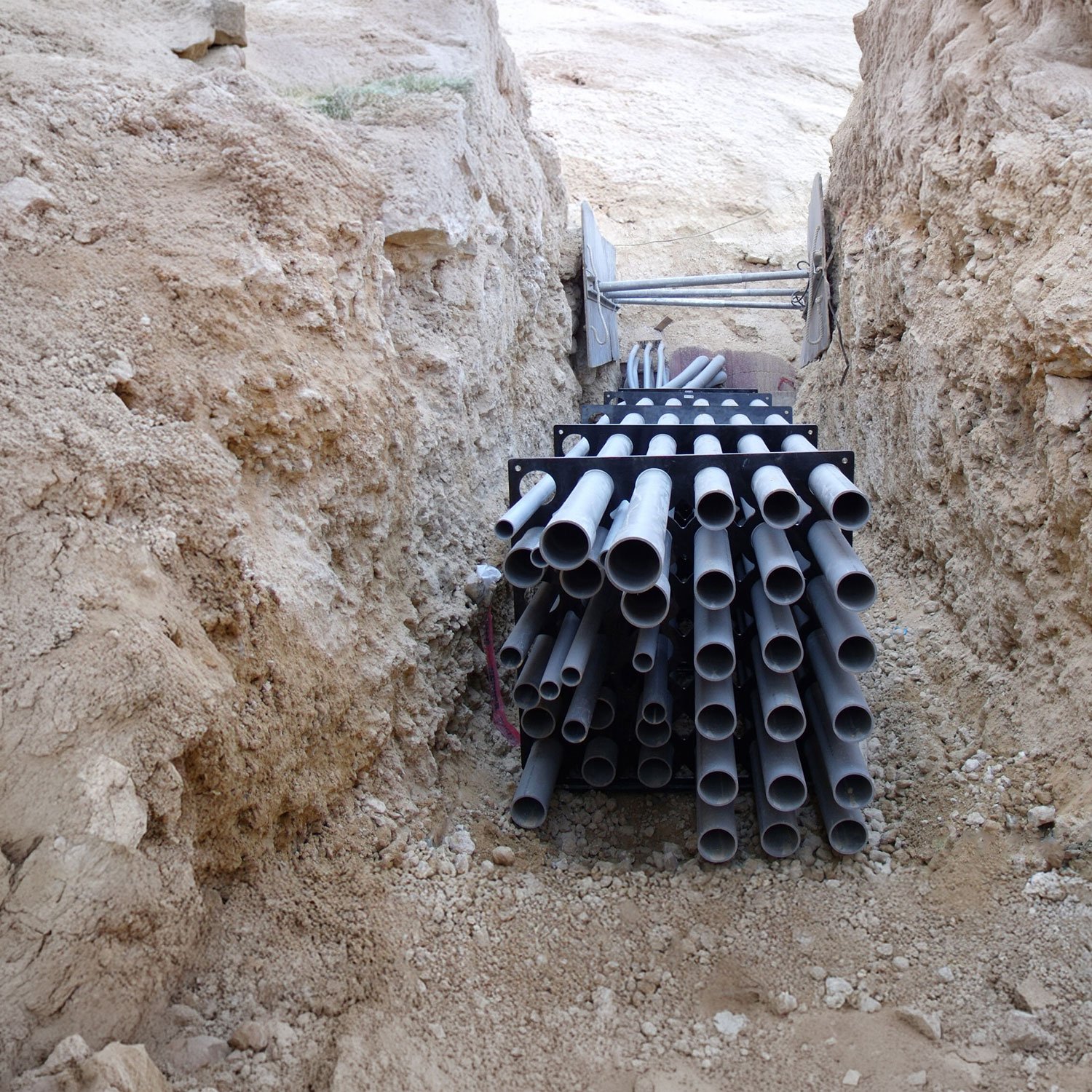
Electrical Duct Banks for West Texas Sites
Conduit bundles in a duct bank sit under a site for the life of the building, and the only chance to get the spacing, slope and concrete right is the day the trench is open. We build electrical duct banks for plants, pump stations, substations, campuses and commercial lots: a set of PVC or steel conduits held at fixed spacing, wrapped in concrete or sand, and routed to handholes, vaults and equipment pads. The concrete partners we coordinate place the concrete envelope and structures, and we coordinate trade partners for the excavation, conduit assembly and backfill.
The design usually comes from an electrical engineer and the serving utility, and the field task is to follow it exactly. Spacers hold the conduits apart, couplings are cleaned and glued, sweeps are set to the radius on the drawing, and the whole assembly is blocked down so it does not float when concrete is placed. A bundle that moves during a pour can pinch a conduit, and pulling cable through a pinched run is a problem that no one wants to find later.
Distance changes the planning on remote sites. A duct bank that runs from a utility pole at a county road to a well pad, a gin or a plant a half mile away is a long trench with a single concrete supplier. We consider the number of truck loads, the setting time and the weather as we choose how to pour it in sections.
Duct banks next to the rest of the utilities
A duct bank seldom travels alone. It shares a corridor with water, sewer, storm and communication lines, and the engineer shows required separations on the plans. The work flows naturally with conduit and fiber trenching for lighter runs, and, when an old line has to be moved out of the way of new construction, with utility relocation.
The concrete elements on a duct bank are part of our core trade. Handholes, pull boxes, vault floors, transformer pads and encasements are formed and placed by the concrete partners, and the formwork for them is built to the drawings. Having the same crew place the pad and the encasement makes the interface between conduit stubs and the pad accurate, which saves time when the electrician arrives to terminate.
Owners who rely on duct banks
Utilities and energy companies use duct banks for substations, generation sites and transmission interfaces, and they apply their own standards for conduit type, concrete strength and inspection. Industrial owners need them to feed motors, process lines and control rooms, while municipalities use them under streets, traffic signals and treatment plants.
Lamesa, the Dawson County seat, draws most of its economy from cotton farming, and a gin or an irrigation pump station in the Lamesa area depends on dependable electrical service. Agricultural owners often bring us a one-line diagram and a site photo rather than a full set of drawings, and we help turn that into a buildable plan before work begins.
Standards that govern the bank
Duct banks fall under the electrical code adopted by the local jurisdiction, the construction manual of the serving utility and the project specification. Those documents set cover depth, conduit separation, concrete color and strength, the use of warning tape and the layout of pull points. Where a bank crosses a road, the road owner issues a permit, and where it crosses a pipeline or a ditch, the owner of that facility may impose conditions.
The inspection sequence matters. An inspector often needs to see the conduit assembly, the spacers and the reinforcing before concrete is placed, and a second visit may follow after backfill. We request the first inspection as the assembly is finished so concrete trucks are not waiting. The local permit office tells us which visits are required, and we record the dates in the daily log.
Industrial land and power in the region
Webb Air Force Base closed in 1977, and the site became the industrial park now known as the McMahon-Wrinkle Industrial Airpark near Big Spring. Reused industrial land like that comes with old infrastructure, and a new tenant often needs new conduit, duct banks and transformer pads to replace or supplement what is there.
Across the region, new load is arriving from energy production, wind and solar interconnections, pumping plants and expanding towns. Each adds a feeder, a control run or a service entrance that needs underground conduit. A duct bank poured today may be extended by someone else in ten years, so we leave stub locations marked on the as-built drawing and photographed before backfill. Because crews and materials come from far away, owners benefit from a contractor who plans for delivery windows and keeps trench open only as long as it takes to inspect and pour.
Sequencing the trench and the pour
A typical duct bank runs through excavation, bedding, conduit assembly, inspection, concrete encasement, backfill and a final proof of the conduit with a mandrel. We aim to open only the length we can complete in a working day, because an open trench with conduit in it is easy to damage and attractive to runoff. Delivery quantities are calculated for the encasement section being placed. Truck intervals must also fit the batch plant’s available capacity.
Weather can stop a pour. High wind and heat shorten working time, so we start early, use retarders where the mix design allows and cover finished sections. After curing, we backfill in lifts and compact each one so the concrete is not loaded by loose material.
Long banks are usually poured in sections with planned construction joints at handholes or at points the engineer approves, and the conduit continues through each joint with its couplings kept clear of the cold seam. Where a bank must cross a county road, we ask the road owner for a closure window or a bore, and we line up the concrete delivery so that the open cut is poured, covered and reopened to traffic within the permitted hours.
Send the one-line and the site plan
Share the one-line diagram, the conduit schedule and the route, along with the nearest concrete supplier if you know it. We can talk through the pour sections, the inspections and the crew travel together.
Common Questions
What does the concrete around the conduit do?
It shields the conduit from heavy loads, dig-ins and shifting soil, and it holds the spacing the engineer designed. Encasement is common under roads, at crossings and for high-voltage runs. Some lighter runs use sand or flowable fill instead, and the drawings state which applies.
Can you install conduit and pull the cable?
We coordinate trade partners for the conduit assembly, and the electrical contractor pulls the cable and terminates it. Our role is the concrete, structures and the schedule that ties them together. We confirm the conduit stub locations with the electrician before pouring.
What holds the bundle down while the concrete goes in?
Spacers and straps hold the bundle, and tie-downs or weights keep it in place. The concrete is placed in even lifts, so the weight does not push the assembly sideways. We check the position during the pour.
What if we find an existing line in the path?
We stop, mark it and notify the engineer. Potholing before the trench is the best defense, but surprises still occur, and the response may be a re-route or a coordinated shutdown with the owner of the line.
Is a mandrel test always required?
The specification decides. Many owners ask for a proof test to confirm that the conduit is clear and round before cable is pulled. It is a modest cost compared with replacing a damaged run.