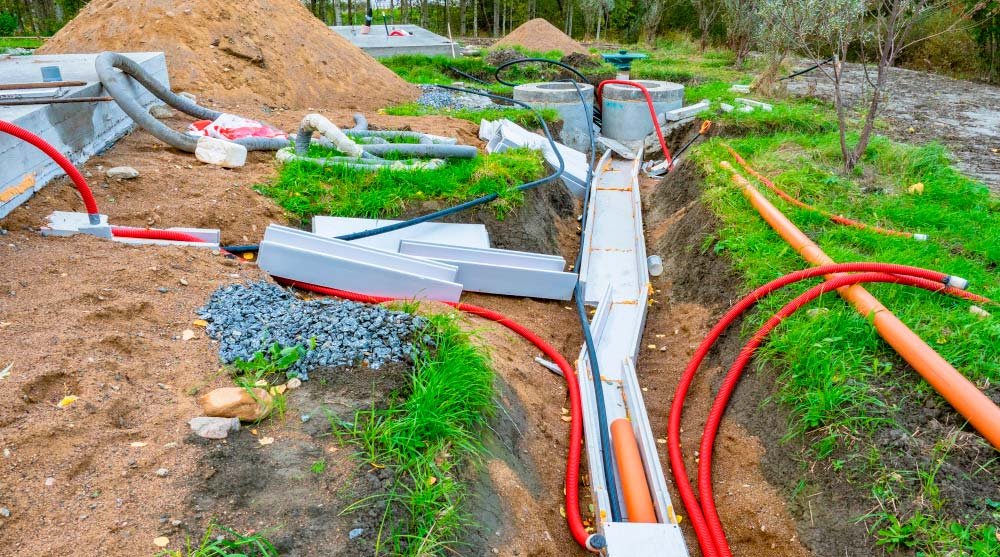
Conduit and Fiber Trenching in West Texas
Fiber follows the highway because the right-of-way is already cleared, and that habit decides how much of our conduit and fiber trenching happens on the shoulders of U.S. and farm-to-market roads. We trench and place conduit for fiber, communications and low-voltage power on campuses, plants, office parks, wells and rural service lines. Trenchers, plows and boring rigs belong to trade partners we coordinate, with the concrete partners we coordinate forming and pouring the handholes, pads, pedestals and road-crossing encasements that the conduit needs.
Trenching for conduit is lighter than a sewer or a water main, but it goes faster and covers more ground, so supply and crew travel dominate the plan. A day of production can add up to thousands of feet when the soil cooperates, and a single hard layer or a missed utility can slow it to a few hundred. We watch the production rate and compare it with the schedule every day.
The client for this work is often a telecom carrier, a school district or an industrial owner who does not want to learn the trade. We explain the methods in plain terms and put the route, the depth and the restoration into one sequence they can follow.
Depth, soil and route choices
Cover depth depends on the owner's standard and what is above the conduit: a field, a road, a drainage ditch or a driveway. The route is chosen to avoid trees, structures, existing lines and areas where the ground is saturated. In rock or caliche, a trencher slows, and the crew may switch to a rock saw or a bore, which changes the price per foot.
Road crossings are usually bored rather than cut, because closing a farm-to-market road or a city street is rarely allowed. Boring needs a pit at each end, and the pit is sized for the rig. Potholing at crossings confirms the depth of pipelines and cables before the rig enters the ground, and the bore path is recorded for the as-built file.
Restoration is part of the route decision, not an afterthought. A trench through a pasture needs a seeded or compacted surface and a gate that closes, while a trench through a parking lot needs saw cuts, base, asphalt or concrete patching and a joint that does not leak. We note the existing surface along the route during the walk and carry the right restoration for each stretch in the price.
Who buys conduit and fiber work
Telecom carriers extend fiber to towers, businesses and subdivisions, and electric utilities run communication lines for protection and control. Utilities and energy companies in the region add fiber between substations, wind sites and pump stations, while oilfield operators link well pads and compressor sites.
Education is a steady source of work. A business and technology center in Andrews, finished in early 2006 and tied to the University of Texas Permian Basin and Odessa College, is a reminder that satellite campuses and training centers need network paths in addition to power and water. Schools and healthcare owners typically want trenching done outside class hours or around clinic schedules.
Safety on a moving trench
A fiber trench moves quickly and passes many hazards, including overhead lines, buried pipelines, traffic on the shoulder and passing livestock. We begin each segment with a locate check, mark the route and set barricades and signs for any work near a road. Spotters work with equipment operators, and no one stands in a trench deeper than the protective rules allow without the proper system in place.
Heat and wind affect the crew, too. We start early on summer days, supply water and shade, and stop concrete work when conditions harm cure or worker safety. Fiber is delicate, so conduit ends are capped until the cable crew arrives, which also keeps dust and animals out. Every handhole and vault lid is set flush with the ground and rated for the traffic above it, and any box left open when a shift ends needs a cover or barricade to keep vehicles and animals out.
Routes through the region
Highway corridors define many fiber runs. Interstate 27 and U.S. Highway 87 run through Abernathy, about eighteen miles north of Lubbock, so a route near Abernathy can follow two long public corridors. Crane is crossed by U.S. 385 and State Highway 329, and 385 reaches Odessa 32 miles up the road and McCamey 21 miles down it, so a line near Crane can be measured in long straight pulls.
We mobilize crews from a staging point chosen for each route and price from the road distance, not a flat regional rate. For a line near Andrews, that means counting the miles between the batch plant, the crew and the route rather than the miles between the city and the project.
Why rural connectivity work keeps coming
Distance has always made communications hard in West Texas, and the same distance now makes fiber valuable. Farms use precision equipment and remote monitoring, energy sites need links to control rooms and towns want better service for schools, clinics and local business.
Much of this work is funded by carriers, districts and utilities that expect clear schedules and tidy restoration. Many of these owners manage projects from an office hundreds of miles away, so a short written daily note with footage, photos and any surprises saves a trip. Our approach is to keep a short open trench, restore the surface soon after the conduit is in and document the route so future crews can find it. That last step is part of duct bank practice as well and carries over to the lighter conduit work.
Buildings that need underground conduit
An office building needs service entrances for telecom and data, usually through two diverse paths. A school campus needs conduit between buildings for network and security cabling. Industrial plants need trenches for fiber to control rooms, gate houses and remote sheds, and wells and pump stations need paths for monitoring.
In every case, we route conduit to respect future growth: a spare duct, a pull box at each turn, and sleeves under future pavement. These small choices cost little during the first trench and save major expense when a building expands.
Describe the route
Send the route map, the conduit size and count, and the carrier or owner standards. We will review the crossings, the soils and the supply points, then talk through the work with you.
Common Questions
Do you pull the fiber?
No. Trenching and boring go to trade partners we coordinate, and the concrete partners build the handholes and pads. The carrier or low-voltage contractor pulls and splices the cable.
How deep is conduit buried?
Depth follows the owner's standard and the location. Under a road or near a pipeline it is typically deeper than in a field. The drawings state the number, and we verify the depth with a tape or a survey during the trench.
What is the difference between trenching and boring?
Trenching opens a continuous cut and works best in open ground. Boring drills a path underground and is used to cross roads, railroads, creeks or finished pavement. Boring costs more per foot but avoids restoration.
How do you handle farm access during trenching?
We talk with landowners before starting, leave gates as we found them and restore ditches and crossings promptly. Where a field has a crop, we ask when planting and harvest occur and fit the trench around them.