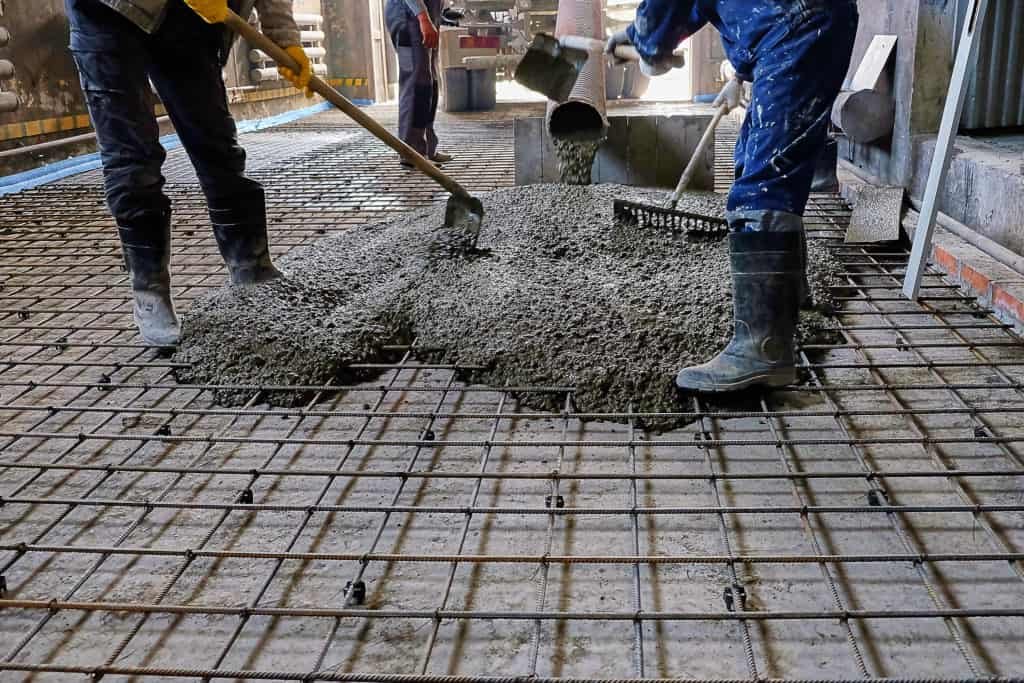
Mass Concrete Pours in West Texas
A block of concrete thick enough to trap its own heat can crack from the inside out within days of the pour, long before it carries any load. Mass concrete is any placement large enough that heat from cement hydration builds faster than the surface can shed it, and the temperature difference between a hot core and a cool face is what tears the member apart.
We plan and place thick mat foundations, large pile caps, heavy machine bases, transformer and turbine pads, thick walls and bridge-type footings for industrial owners, utilities, energy developers and general contractors. We coordinate forming, placement, finishing and curing, and partners we manage supply thermal modeling, temperature monitoring, cooling materials and the extra trucks and pumps a big pour demands.
A mass pour in West Texas is a logistics event. Hundreds of cubic yards in a day means a steady stream of trucks, a plant that can keep pace without running dry and a site that can stage that many mixers without blocking access. We start with the plant's real output, the haul time and the night temperature, and build the pour plan from them.
Where large placements come from here
The Santa Rita No. 1 well struck oil on May 28, 1923, at 3,028 feet near Big Lake, and by 1924 the Big Lake field was the first major oil field in the Permian Basin. A century later the region still builds around energy, and many of the heaviest foundations we see support compressors, processing equipment, power equipment and storage.
Angelo State University joined the Texas Tech University System in 2007 and enrolls about 10,000 students, and campuses like it add thick foundations for science buildings, athletic facilities and central plants. Municipal water and wastewater plants, wind and solar substations and manufacturing sites supply the rest of the large placements. Each of these owners wants a foundation that stays whole through years of vibration, heat and loading, and the first week of curing is when that outcome is decided.
Crew, pump and thermal plan
Placing and finishing, thermocouple setting and curing belong to the concrete partners we coordinate. We coordinate engineered thermal control plans, ice or liquid nitrogen cooling where specified, additional pumps and standby trucks, and the testing firm that reads temperatures.
Staffing matters on a long pour. A large placement may run twelve hours or more, and fatigue shows up in finishing and in safety. We rotate crews, bring a supervisor who does not place concrete and keep a standby crew for pump or truck problems. Because we own the pour, we can adjust the rate on the spot when the temperature probes say the mix is running hot. The superintendent, the testing technician and our foreman agree on stop criteria before the first truck so that nobody has to invent them at three in the morning.
Long hauls for a big pour
A big pour needs more trucks per hour than a small-town plant can supply alone, so we often book multiple plants and stagger deliveries. Andrews is reached by US 385 and two state highways, 115 and 176, and routes like those decide how far a second plant's trucks have to travel to join the first.
Lamesa has U.S. 87 on its east side, U.S. 180 along 4th Street, State Highway 137 and State Highway 349, the last of which heads southwest toward Midland. We mobilize crews and pumps to Lamesa, Andrews and Ozona, where Interstate 10 passes just south of town with exits 363, 365 and 368 and State Highway 163 runs through the center. For each of these we time the truck cycle before we promise a pour date, and we write down the backup plant, the order trucks will roll and the point at which the pour switches to a planned joint.
Heat of hydration, cooling and cracking
The specification sets a maximum temperature in the core and a maximum difference between the core and the surface. Controlling both involves mix design (lower cement, supplementary materials, larger aggregate), placement temperature, lift height, insulation and sometimes cooling pipes. We work with the engineer and the plant to refine the mix with trial batches when the schedule allows.
During the pour and the days after, thermocouples report temperature at set depths. We cover the surface with blankets or insulating forms to slow cooling and hold the temperature difference within limits. In winter, the risk shifts; the surface chills fast, so protection is vital. In summer, hot concrete arrives from the plant and needs ice or chilled water to stay within the placement temperature limit. See also hot and windy weather concrete.
Submittals and special inspection
Concrete formwork and rebar placement feed directly into this plan, since thick sections need heavy forms and dense steel. Mass concrete usually requires a written thermal control plan before the first truck. It includes mix proportions, expected temperatures, monitoring locations, curing, protection and criteria for corrective action. The engineer reviews it, and the special inspector verifies each step. We keep the temperature logs, batch tickets and cylinder results together.
Crosbyton is the county seat of Crosby County, chosen in a 1910 election over Emma, and small county seats like it often have limited inspection capacity. We confirm in advance how inspection will be provided, including night shifts if the pour runs long, so there is no gap in the record.
Owners with heavy foundations
Industrial and manufacturing owners place thick pads for presses, furnaces and mills. Oil, gas and midstream operators need compressor and processing foundations. Utilities and wind developers place turbine and transformer bases, and public works departments build large structures at treatment plants.
Each of these owners cares about uptime. A foundation that cracks can delay equipment startup, so the thermal plan is as important as the schedule. We explain the plan in plain terms and show the owner what the monitoring data means, including what a normal temperature curve looks like and when a reading should prompt a call to the engineer.
Send the foundation size and the site
Share the dimensions, the mix requirements and the town. Our response is a placement plan showing truck cycles, plant sources, thermal monitoring and crew shifts, so the owner can review it with the engineer before a date is set.
Common Questions
How thick does a pour have to be to count as mass concrete?
No single dimension applies everywhere. The specification or the engineer defines it, usually by thickness or by expected temperature rise. If the design is close to the line, we ask for the engineer's ruling before ordering.
Can mass concrete be poured in summer in West Texas?
Yes, with cooled materials, night or early morning placement and surface protection. Ice replaces part of the mix water, and trucks are dispatched tightly so concrete does not sit in the sun.
What if the plant cannot deliver fast enough?
We plan lifts and construction joints that the engineer approves, or we book a second plant. A cold joint in a mass pour is a serious defect, so we prefer a planned joint to a gap in deliveries.
How long are temperature probes monitored?
Until the core and surface temperature difference falls inside the limit and the temperature is falling steadily. That may be several days to over a week, depending on size and weather.
Who pays for the extra trucks and standby equipment?
The proposal lists them as separate lines so you see what the pour needs. Standby equipment costs less than a failed pour, and we explain why each item is included.