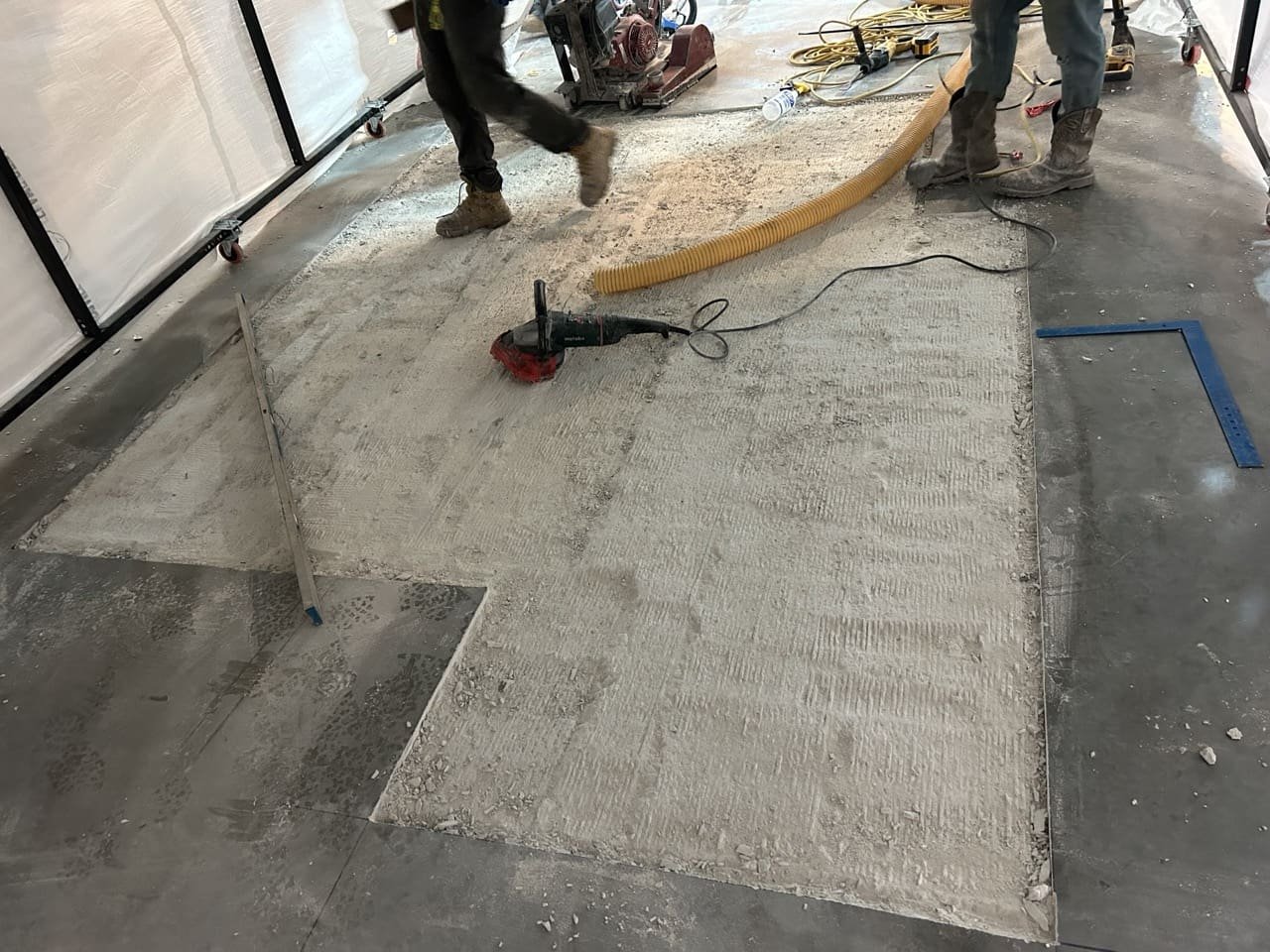
Concrete Repair and Restoration in West Texas
Spalled edges, cracked joints and rusting rebar rarely get worse slowly in a climate that swings from a freezing morning to a hot afternoon in the same week. Repairing concrete in West Texas means finding out why it failed before choosing the patch, because a repair placed over an active cause lasts a season, and one placed over a corrected cause lasts as long as the original.
We repair and restore floors, docks, sidewalks, parking structures, tilt-up panels, foundations, tank pads and bridge-type structures for general contractors, facility owners, schools, municipalities and industrial operators. The concrete partners we coordinate do the demolition of unsound concrete, surface preparation, forming and placement of repair material. We coordinate trade partners for structural engineering, crack injection, coatings and specialty testing.
Travel is part of every repair estimate in this region. A crack injection that takes four hours in town may take two days when the crew has to drive from the nearest plant and sleep near the site, so we scope repairs to minimize return trips, carry the right materials the first time and photograph the work so owners can see what was done.
What a repair job includes
Typical work includes survey of damage, sounding for delaminations, saw-cutting the repair boundary, removing unsound concrete, cleaning and treating reinforcing steel, bonding agents, repair mortar or concrete, joint replacement and surface sealers. Larger jobs add form-and-pour sections, doweled replacement panels and structural strengthening.
We also repair slab edges at doors, damaged dock aprons, popouts, scaled surfaces and cracked curbs. When a repair needs more than patching, such as a settled floor, we propose the right fix and say when the problem is bigger than a patch can solve. Concrete leveling and slab lifting is an option for slabs that have dropped but are otherwise sound.
Repair trips across long distances
San Angelo sits at the junction of the North, South and Middle Concho rivers, and a flood in 1882 destroyed the Tom Green County courthouse at the former county seat of Ben Ficklin. Floods and drainage are old problems in the region, and many of the repairs we see trace back to water moving where it should not.
We run repair crews to the Permian Basin, South Plains, Big Country, Concho Valley and Trans-Pecos, staging materials to match the work. A trip to San Angelo is one thing, and one to Andrews or Presidio is another. We bundle repair items on a site, ask owners to list every known defect and plan one mobilization instead of three.
Working in active buildings and around traffic
Repair crews often work in operating facilities. Dust from grinding and chipping contains silica, so we use water suppression or vacuum collection, wear the right respirators and isolate the work area. Noise and vibration are managed with hours and methods that suit schools, clinics and offices next door.
Around roads and parking areas, we use barricades and flaggers. In industrial yards, we respect whatever hot work, confined space and lockout permits the owner issues. Because repair work exposes steel and may cut near utilities, we locate buried lines before saw-cutting and drilling.
Services that often come with a repair
Repair is frequently the first step toward something bigger. Removal of failed slabs leads to concrete demolition and removal, replacement of failed joints needs concrete sawing, cutting and coring, and corroded reinforcement may need new rebar placement before the patch goes in.
Where the existing surface is beyond reasonable repair, we propose new flatwork or paving and price both so the owner can compare. We would rather spend a customer's money on the correct fix than on repeated patching.
Specifications, special inspections and records
Structural repairs may need engineered repair drawings, a repair procedure from the engineer of record and special inspection of surface preparation and bond. The local permit office decides whether a building permit is needed, and we ask early so the calendar includes the review time. A repair in the Midland metro area, with its Interstate 20 business route and several loops, often brings right-of-way permits that a smaller town never asks for.
Product data sheets, cure times and mixing instructions are part of the submittal. We follow them to the letter, record batch numbers and weather at the time of application and hand the owner a complete file.
Diagnosis first, patch second
Our first step is a walk of the building with a list of every visible defect. Sounding with a hammer or chain drag finds hollow areas, a cover meter shows how deep steel sits and a few cores or samples can confirm the cause. If the problem is corrosion, we remove contaminated concrete behind the bars, not only where it has cracked. If it is shrinkage, we look at joints and curing.
The repair itself follows the product manufacturer's instructions and the engineer's detail: saw-cut edges, cleaned steel, proper bonding, correct mix and careful curing. We test a small area first on larger jobs to confirm that the product bonds and cures as intended in local temperature and wind.
Weather, cure windows and downtime
Most repair materials have narrow temperature ranges for application. A rapid-set mortar placed in a hot afternoon can flash before it is finished, and a cementitious patch placed on a cold slab may never reach strength. We schedule early morning or evening work in summer and protect repairs in winter with blankets or heated enclosures.
Downtime is the other constraint. Dock doors, aisles, pump pads and entrances cannot stay closed long. We choose fast-cure materials where they fit, split work into phases and post return-to-service times. Abernathy lies on Interstate 27 and U.S. Highway 87, about eighteen miles north of Lubbock, and a facility near such a corridor gets the benefit of regular truck traffic, which also means hard wear on joints and edges.
Where we see repair work most
Warehouses and distribution centers need dock apron and joint repair. Government and municipal buildings call for sidewalk, ramp and entry repair. Public buildings carry heavy foot traffic and need durable floors at every entry. The Andrews Business and Technology Center, a shared campus operated with two higher education partners, is the kind of building that eventually needs joint and slab maintenance.
For schools and healthcare owners, we plan repairs around calendars, so noisy and dusty work lands on breaks and weekends.
Walk us through the damage
Send photos, the building type and the town, and we will schedule a site walk or a remote review. We combine every item into one trip when possible and give you a written repair sequence with cure times and return-to-service dates.
Common Questions
How do you know whether a crack needs injection or a full replacement?
We look at width, movement, moisture and location. A crack that moves needs a flexible repair, while a stable crack in a structural member may need epoxy injection. If the slab has settled or lost support, replacement or lifting is usually the better choice.
Will a patch match the color of the old concrete?
Seldom exactly. Repair materials differ from aged concrete, and sun fades the surface. For visible areas, we can test colors, grind the surface and use a thin overlay. For industrial floors, function matters more than color.
How long do repairs last?
It depends on the cause and the product. A well-prepared repair with the cause corrected can last many years. A patch over active settlement or leaking water will not. We explain the likely life when we propose the repair.
Can you repair concrete in winter?
Winter is workable with protection. We use heated enclosures, insulated blankets and cold-weather products where required, and we avoid placing on frozen surfaces. Some work is better left for warmer weather, and we will say so.