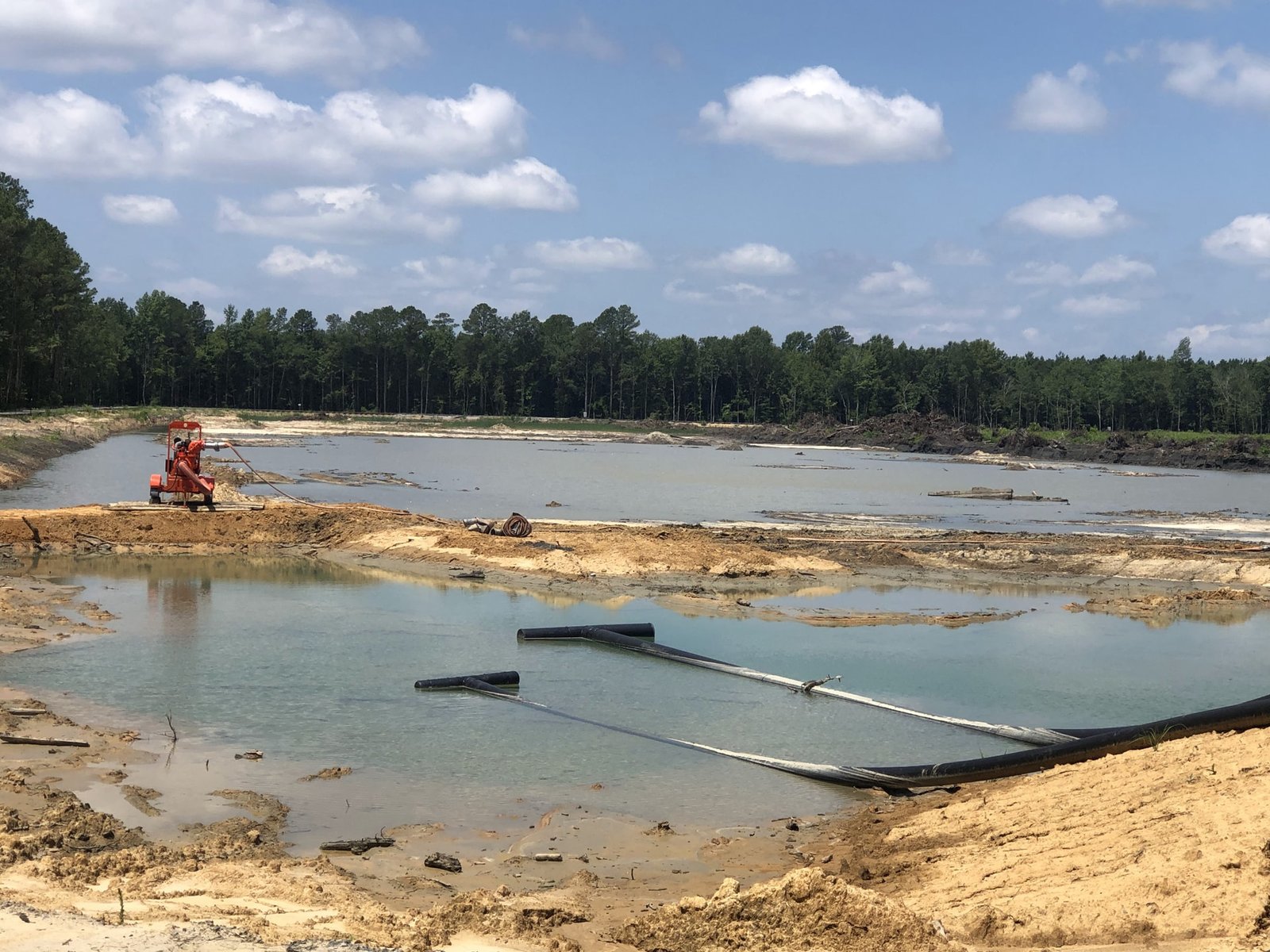
Pond and Basin Excavation for West Texas Sites
Ponds in West Texas have to do two opposite things: hold water when a storm drops an inch in an hour, and stay dry the rest of the year without turning into a hazard. A detention basin that drains slowly after rain collects mosquitoes and weeds, one that drains too fast sends flood water downstream, and one dug in the wrong soil never holds a drop. We plan every basin from the outlet backward, because the outlet controls what the pond does.
Trade partners we coordinate do the digging; the concrete partners we coordinate build the concrete parts of a basin, meaning outlet structures, headwalls, spillways, inlet aprons and, at times, lined channels. This split gives the owner one party who understands both how to dig a basin and how to make the structure at its low point actually work.
The sections below describe the buildings and sites that need basins, the conditions that shape them, the scope, the regional setting and our role.
Sites that need a pond or a basin
Large roofs and parking areas shed water quickly, so warehouses, distribution centers and retail centers need detention to slow the flow. Truck terminals and manufacturing plants may add retention for process water or fire suppression. Schools and medical campuses often have a pond that doubles as a landscape feature.
Agricultural buildings and dairies need ponds for wash water and runoff, built to strict rules. Some owners want a pond for irrigation storage. For the typical warehouse project, see warehouse work, and for related design questions see detention and retention ponds.
Self-storage facilities, hotels and multifamily complexes bring large paved areas and need basins as well, usually tucked into a corner of the lot. For these, the basin shape is often dictated by the lot, so the design is long and narrow, with outlet and overflow works that fit the space. See also commercial developers for the owner's side of that decision.
Soil, groundwater and safety
Soil decides whether a pond holds water. Sand and gravel drain, so a retention pond may need a clay liner, while heavy clay holds water but can crack when dry. Groundwater can fill a deep basin from below, and the plan may need dewatering during the dig. Tye stands near 1,811 feet, and low ground like that around Tye can raise groundwater questions that the higher plains never do.
Side slopes must be stable and safe for mowing, usually three to one or flatter. Fencing, warning signs and access ramps for maintenance are part of many designs. We confirm the slope and the freeboard against the plan before the dirt contractor starts.
Weather also affects timing. A basin dug in a dry spell may fill with the first storm before the outlet is built, and a half-built pond is a hazard. We schedule the outlet structure early, protect open excavations with temporary diversions and keep the pond bottom free of loose spoil that could clog the outlet.
What a basin scope includes
The scope starts with clearing and topsoil stripping, then excavation to the design bottom and sides, compaction of embankments, shaping of slopes and construction of the outlet. It may include a liner, a forebay for sediment and an emergency spillway. Seeding or sod finishes the slopes.
Surveying is a major part of the scope. We check the bottom elevation, the side slopes and the outlet invert at several stages, because a few inches of error in an outlet changes how long a pond takes to drain. Spoil is hauled off or used to build berms, as the plan directs.
Compaction of the embankment is critical where a berm holds water. Thin lifts go down at the right moisture, get tested, and key into the natural ground. A poorly compacted berm can seep, slump or fail, so this is the part of the job we watch most closely, with the lab on site for testing.
Water storage in a dry region
Stamford draws its municipal water from Lake Stamford, formed in 1953 when Paint Creek was dammed, and about 7 miles east of Winters, W. Lee Colburn Park borders Elm Creek Reservoir. These lakes show how much the region depends on stored water, and they set a standard for earthen dams and spillways that smaller basins follow in miniature.
For commercial sites, a basin is usually about stormwater and not supply. Van Horn is served by Interstate 10, U.S. Highway 90 and State Highway 54, and a business near Van Horn may find that a single basin serves several lots. We help owners decide whether a shared basin or individual basins fits the site.
Playground and park ponds, stock tanks and irrigation reservoirs make up the older tradition of earthen water storage in the region. Commercial detention is a newer use of the same craft, with tighter tolerances and more paperwork, but the same rule applies: the water has to go somewhere, and the pond is the answer.
What we pour and what we coordinate
We coordinate the excavation through the responsible trade partners. Trade partners dig and shape the basin under our coordination. The concrete partners place the concrete for outlet boxes, headwalls and aprons, set the forms and reinforcing and finish the surfaces.
The concrete work must fit the dirt work exactly, so we survey the outlet location before excavation reaches it and again before forming. Where a pond ties into a storm line, we coordinate with the pipe crew, as described in culverts and headwalls.
Formwork for headwalls and spillways is precise work, because the shapes control how water leaves the pond. The concrete partners form, place steel and finish those structures, and we coordinate with the pipe contractor so inverts match. Cold joints, honeycombing and cracks at a spillway are costly to fix once water is flowing, so we take the time to get the concrete right the first time.
Send the drainage plan
Pass along the drainage study, the grading drawings and the outlet details, along with the closest town. We will review the haul and the soil, mark the outlet details that need an engineer and phone to work through them before the dirt contractor is booked.
Common Questions
What determines the required capacity of a detention pond?
Size follows from the lot area, how much of it is paved, the design storm and the release rate the city allows. The engineer calculates it, and the city or county reviews it. We build to the plan and check the volume by survey, since a pond that is a little short can fail inspection.
Will a pond hold water in sandy soil?
Not without help. Sandy soil lets water drain through, so a retention pond in sand needs a clay liner or a synthetic liner. A detention pond that is meant to drain between storms can use the natural soil. The geotechnical report tells which approach applies.
Who maintains the pond after construction?
Usually the owner or an association, and the maintenance plan comes with the design. Typical tasks include mowing, clearing the outlet, removing sediment and checking the slopes. We hand over the as-built drawings and note the items that need regular attention.
Do ponds need fences?
It depends on the depth, the slopes and the local rules. Some jurisdictions require fencing around deep or permanent ponds, while others accept gentle slopes. Schools and public sites are more likely to need fences. We check the requirement early so that the cost is in the budget.