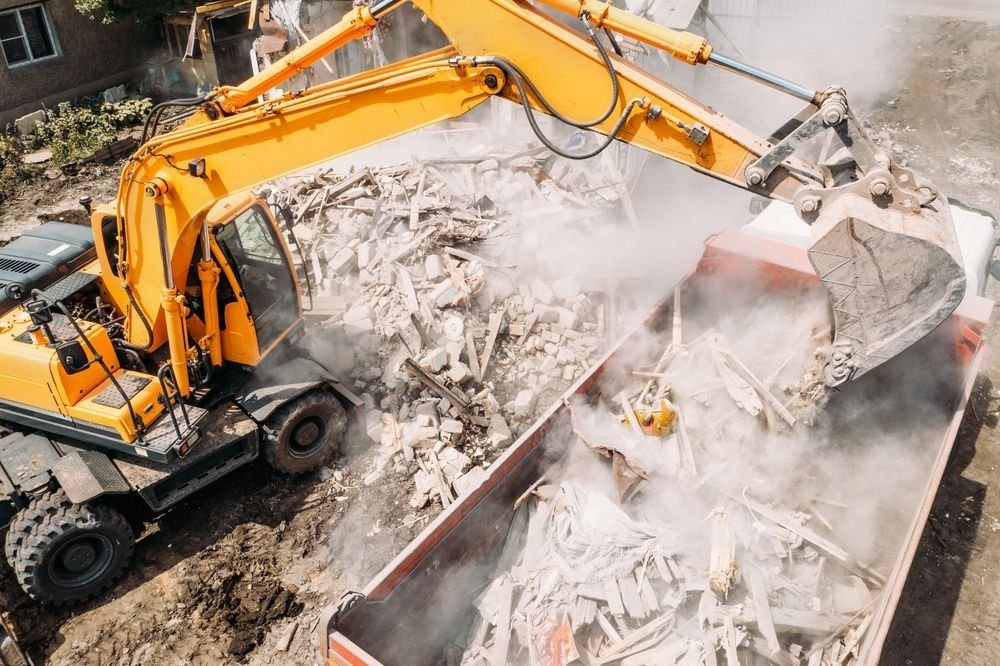
Concrete Demolition and Removal in West Texas
Hauling broken concrete eighty miles to a recycler can cost more than breaking it, which is why demolition in this region is priced by the truck route as much as by the square foot. In towns with no crushing yard, the slab you remove has to go somewhere, and the answer shapes the plan from the first day.
We demolish and remove slabs, footings, foundations, curbs, sidewalks, dock aprons, pavements, pads and structural concrete members for general contractors, developers, municipalities and industrial owners. The concrete partners we coordinate break, sort and load concrete, and we coordinate trade partners for heavy hauling, crushing, hazardous material surveys and utility disconnects. Selective demolition inside existing buildings is planned with the owner and the design team so surrounding structure stays intact.
A demolition job tells us a lot about the site that new construction depends on: how thick the old slab is, whether it has steel or fiber, what lies beneath and how much of the material can be reused as fill or base. We record that information and pass it on to the crew that builds the replacement, along with photographs of the exposed subgrade, so nobody has to guess what was under the old floor.
Demolition and related trade responsibilities
The concrete partners handle breaking, saw-cutting, sorting and loading. We use breakers, hydraulic hammers and loaders suited to slab thickness, and we separate rebar from concrete when the recycler requires it. Selective removal for tie-ins, such as a strip along an existing wall, is done by hand tools and small equipment to protect adjacent structure.
We coordinate trade partners for large-scale hauling, crushing on site, asbestos or lead surveys, utility disconnections and structural shoring. Earthwork under removed slabs is handled by an earthwork partner scheduled before our replacement forms are ready. This clear split keeps responsibility simple and prevents delays between demolition and rebuilding.
Reinforcement, thickness and hidden surprises
Old slabs vary. Some are four inches of plain concrete, some are eight inches with heavy mats, and some hide post-tension tendons or embedded conduit. We probe and scan before breaking and ask for old drawings. A tendon in a post-tensioned slab is under load and can be dangerous to cut, so those areas require an engineer's plan.
Stanton, the Martin County seat, sits along Interstate 20, which gives debris trucks an easy route out. Tye, at roughly 1,800 feet, lies in a landscape of long straight roads. Even where roads are good, loads of broken concrete are heavy and the permitted route may force a detour, so we plan trips with the haul route in mind. On a county road or a farm-to-market road with posted weight limits, we cap the load size, schedule hauling outside school bus hours and keep a log of trips so the owner can see how much material left the site and where it went.
From saw cut to clean subgrade
Our typical sequence is to mark the removal limits, saw-cut the edges so the break stays clean, break the slab in sections, load the pieces and trim the exposed edge. We then check the subgrade and report soft spots, buried debris or utilities uncovered during demolition. Concrete sawing, cutting and coring is used for clean boundaries on partial removals.
For structural elements such as walls and footings, we sequence the removal to avoid undermining adjacent structure. If a footing carries an adjacent wall, shoring and a new support must be in place first. The exposed work area is left clean and safe, with open edges barricaded and trip hazards removed, and any area that stays open overnight gets lighting or reflective markers so a night shift or a passing driver can see it.
Haul routes, plant windows and the next pour
A demolition schedule runs on trucks. We count how many loads a day can be hauled, check the recycler's hours and plan the break to keep pace. On sites where the route crosses a railroad, the Texas Pacifico line runs 376 miles from San Angelo Junction near Coleman through San Angelo to Alpine, and a train can hold up trucks at crossings. Texas Pacifico also continues to provide rail service through Big Lake on a line first built in 1912, a reminder that rail crossings are part of the haul plan in more towns than you might expect.
We tie the end of demolition to the beginning of the next scope. If new concrete is going in, we coordinate with slab-on-grade crews and the plant so the subgrade is inspected, the forms are set and the pour can begin without the site sitting idle.
Owners who need things taken out
Municipal and public works departments remove broken sidewalks, curb sections and aprons. Commercial developers clear old parking lots and floors for new tenants. Industrial owners remove obsolete pads, pits and floors when equipment changes.
Floydada, where U.S. 62 and U.S. 70 meet State Highway 207 and two farm roads, is fed by a network of rural roads and an agricultural economy. Gins, grain facilities and implement dealers in towns like it are the sort of buildings that change use and need partial demolition for the next occupant. We scope each removal to the new use and review the reuse of materials.
What drives the cost of removal
Thickness, reinforcement, access and disposal are the main drivers. A thin plain slab on an open lot with a recycler nearby is cheap, while a thick reinforced floor inside a building with a long haul is costly. Saw-cutting, shoring and dust control add to the price, as does any hazardous material found in the structure.
Disposal can be the largest single item. We ask for the nearest accepting site, compare the haul cost with on-site crushing for reuse as base and give the owner the choice. Grouping removal with a concrete repair and restoration scope often cuts mobilization, and we explain the trade-off between breaking more and patching less.
Share the plans or photos of what has to go
Tell us the thickness if you know it, the area, and where the debris can be hauled. We will check haul routes, plan the sequence and give you a written scope that ends with a clean, surveyed subgrade ready for the next trade.
Common Questions
Where does the broken concrete go?
It goes to a recycler or approved fill site, or it is crushed on site for reuse as base. Where no crusher is near, hauling becomes the main cost, so we compare options before breaking.
Can you remove a slab next to an existing building?
Yes, with saw cuts and controlled breaking to protect the structure. Footings and shared edges are checked first, and shoring is installed if the removal could change support.
Do you test for hazardous materials?
Older buildings may have materials that require a survey before demolition. We coordinate qualified firms to test and abate before the concrete partners begin.
How noisy and dusty is the work?
Breaking is loud and creates dust. We use water suppression, work within the hours the owner allows and place barriers near occupied areas. Dust control gets written into the plan before the first break.
What happens to the rebar?
It is separated and sent to a scrap yard when the recycler requires it, or it is crushed with the concrete where the recycler can handle it. Either way, the cost and the outlet are written into the proposal.