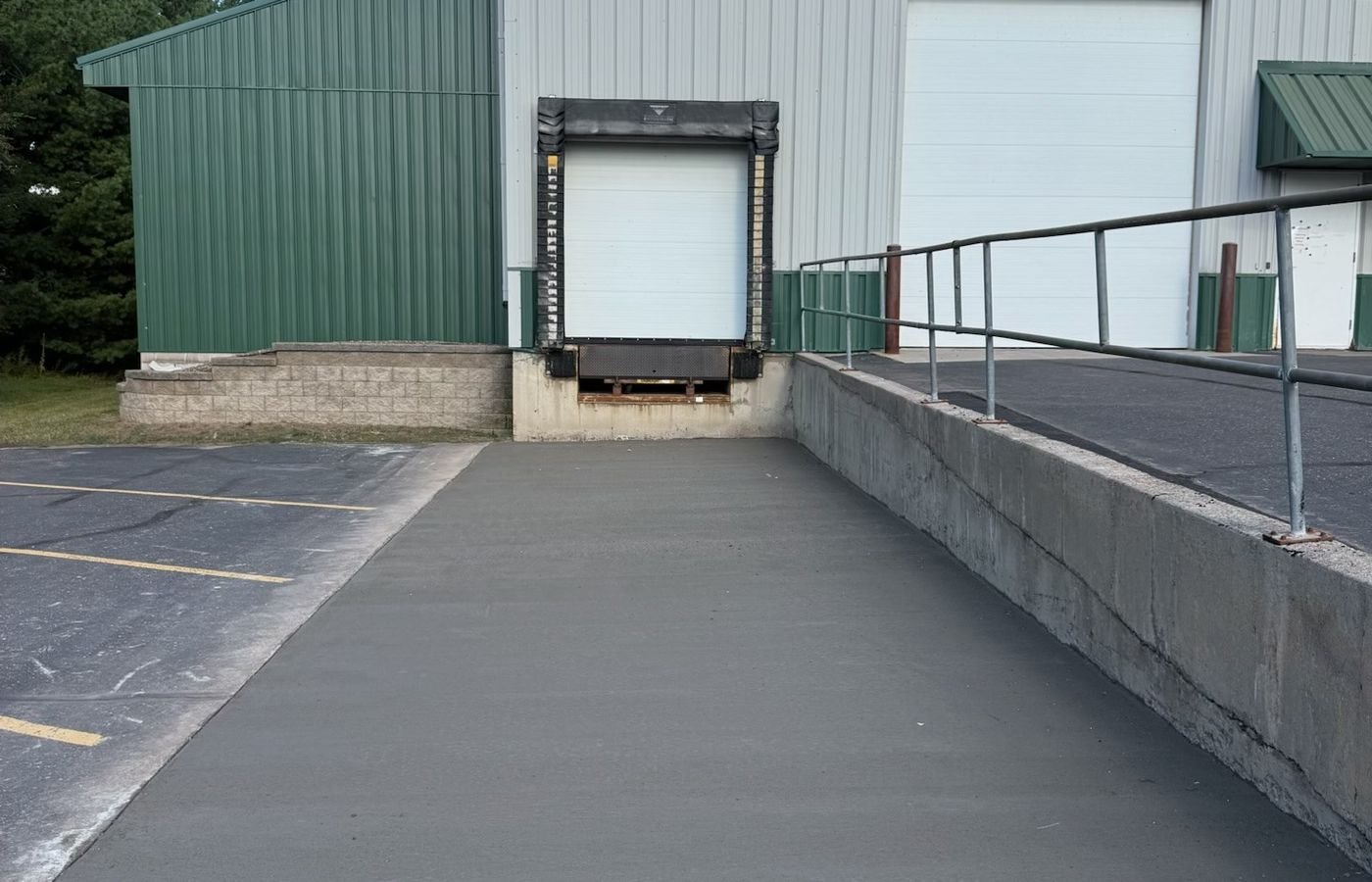
Truck Courts and Dock Aprons in West Texas
Trailer landing gear punches through weak pavement, and a truck court is where that failure shows up first. Trailers park with their weight on two small steel pads, then pull away in heat that has softened anything but concrete. A dock apron faces the same abuse from the other side: loaded trucks backing in, braking and turning in the same few feet, day after day.
Our work includes truck courts, dock aprons, trailer storage, driver lanes and gate approaches in reinforced or dowelled concrete. Typical thickness is well beyond what a parking lot uses, and the joint layout is designed around wheel paths. The concrete partners we coordinate do the concrete placing and finishing, and earthwork and utility partners who prepare the base.
Below you will find the services that connect to this work, who does what, our scope, the owners who build these courts, safety and the specifications and permits we follow.
Services that surround a truck court
A truck court seldom stands alone. At the building face it meets loading dock pits and ramps, runs into concrete paving for the drive lanes and often borders parking lot concrete for cars. The three have different thicknesses, and transitions need dowels or thickened edges to avoid cracking.
The tie to the building matters most. The apron should pitch away from the dock doors while staying within the grade that the door seals and levelers can handle. We coordinate slab elevations with the dock equipment supplier, since a half inch of difference at a leveler lip becomes an expensive adjustment. Door spacing, trailer swing and the turning radius of the longest truck all go on one sketch before forms are set, and we share it with the general contractor so the layout matches what drivers will actually do.
Concrete placement and related trade coordination
The concrete partners form, set dowels and bars, place concrete, finish, cut joints and cure. We build the thickened edges, landing pads and embedded steel that a truck court needs. For heavy pours, we bring a larger finishing crew and use screeds that hold grade over wide bays.
Earthwork, base stone, stabilization and drainage are partner trades, and we coordinate them. Abernathy has Interstate 27 and U.S. Highway 87 running through it, about eighteen miles north of Lubbock, and traffic on routes like that is a reminder that trucks bring their weight across every kind of subgrade. We insist on proof rolling before steel goes down, and we ask for the test results in writing so a soft area is found by a loaded truck on a weekday morning, not by a trailer on a Friday afternoon.
What is in our scope
Our scope covers forming, dowels, tie bars, reinforcing, placement, texturing, curing, sawing, sealing and test records. We build landing pad zones thicker or reinforced when the design calls for them, and we include blockouts for bollards, light bases, dock equipment and trench drains where the plan shows them, because cutting those into hardened concrete later is slow, noisy work. A placement plan shows pour order, joint locations and equipment paths.
We exclude grading and utilities unless added by agreement. We state the handoff conditions: subgrade within tolerance, base compacted and drainage set. Once the concrete is down, barricades keep early traffic off it, and we coordinate with the owner on a date for the first trailers.
Who builds truck courts
Logistics and warehouse developers are the main buyers, followed by trucking terminals, food distributors, farm suppliers and industrial owners. San Angelo sits at the junction of the North, South and Middle Concho rivers, and a flood in 1882 destroyed the Tom Green County courthouse at the former county seat of Ben Ficklin. Floods shape how San Angelo area owners think about drainage and base, and we apply that caution at any site near a drainage way.
Crane sits on U.S. Highway 385 and State Highway 329, and the 385 stretch reaches Odessa 32 miles to the north and McCamey 21 miles to the south, which is a typical corridor for oilfield and freight traffic. Owners along such routes want courts that take loaded trailers without ruts, and they usually ask how fast the pavement can open after the pour. We answer with the strength gain curve of the mix rather than a guess, and we tell them which lanes can open first.
Safety on a working court
Many truck courts are built next to active operations. We separate our work area with barricades and spotters, keep truck routes clear and agree with the owner on delivery windows. Concrete trucks and operating trailers do not share lanes during the pour, and a flagger controls the gate so mixers never wait in the public road with a load in the drum.
Heat deserves respect. Tahoka has a semiarid climate with average annual precipitation of about 20.68 inches, a July mean daily high of 93.3 degrees F, and a record low of 15 degrees below zero F. Courts built in that kind of range see both extremes, and the concrete partners work with shade, water and rest breaks in summer and protect fresh concrete from freezing nights.
Specifications and permits
The specification should state the design traffic, concrete strength, slab thickness, reinforcement, joint spacing, dowel size, curing and sealing. We build to those and flag any conflicts between drawings. Many courts also require stormwater controls and inspection during construction, which the site contractor handles.
Permits depend on the jurisdiction. Some places review pavement sections, others only drainage and access. We ask the local permit office what they need and prepare mix designs and test reports early. Owners with a truck terminal or cross-dock may have extra rules for fuel areas and oil separators, and we coordinate with the designer. Truck routing inside the site also matters: a court that forces drivers to back across the main entry will wear that spot out first, so we mention layout concerns to the design team while the plan can still change.
Share the dock layout and truck counts
Send the site plan, dock layout and the type of trucks that will use the court. We will check the base, the supply and the travel, and send back questions that help tighten the price.
Common Questions
What slab depth does a truck court call for?
The designer works it out from axle loads, truck count and the subgrade. Heavy courts often exceed what a car lot needs by a wide margin. If the design seems light for the traffic described, we raise the question before bidding.
Why do landing pads matter?
Trailer legs concentrate a large load on a small area. Thickened or reinforced pads spread it. Without them, the slab can punch or crack, particularly in heat. We build pads where trailers will park.
Can you pour while the yard stays in service?
Yes, in sections. We phase the work and keep lanes open. Concrete takes a few days to reach traffic strength, and we use barricades and clear signs. Phasing may extend the schedule but protects operations.
What joint sealant do you use?
We use sealants named in the specification, with backer rod where needed. Fuel-resistant types suit fueling areas. Sealing joints keeps water and fines out of the base, which extends the life of the court.
How do you manage drainage on a large court?
We follow the grading plan and check slopes with a level during forming. Water should leave the court without ponding near the dock. If a design shows flat spots, we ask the engineer to revise.