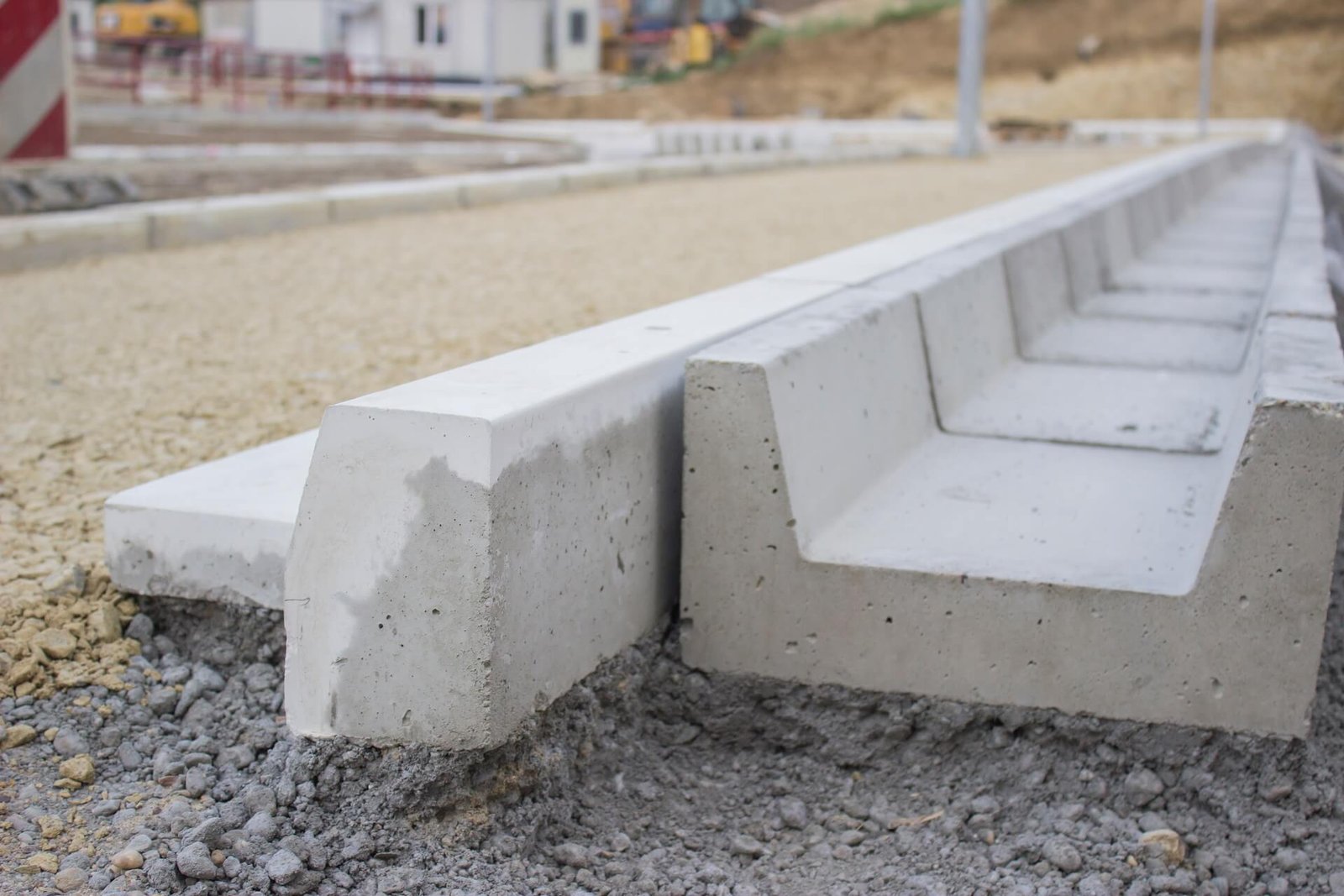
Curb and Gutter in West Texas
Curb and gutter lines carry storm water off pavement, and in West Texas they must do it during rainfall that arrives hard and leaves quickly. A gutter that keeps even a thin film of water behind a flat spot will stain, soften the base and eventually crack the pavement. Our work starts at the flow line: where water enters, where it travels and where it leaves the site.
We build curb and gutter by slipform machine on long runs and by hand-set forms on tight radii, driveways, islands and repairs. The product is simple to describe and hard to do well, since line, grade and consistency show for the life of the street. Owners in towns, on plant sites and at shopping centers all rely on it.
This page explains what moves the price, the places that need curb work, how we manage delivery, the choices that help, who handles each part of the concrete package and the related work that goes with it.
What affects curb and gutter pricing
Linear footage is the base, but the number of curves, driveways, ramps and inlets changes the labor per foot. A straight run on open ground with the machine moving all day is cheaper than short pieces with many stops. Cross-section matters too: standard curb, mountable curb, reverse pitch and valley gutter each need different forms or machine molds.
Distance enters twice. A curb machine and its crew must travel to the site, and the mix must arrive in a steady supply with a stiff slump. If the plant is far, we may recommend a mix designed for the haul. We separate the mobilization from the per-foot price so the owner can see how a larger quantity lowers the unit cost. Reinforcing, dowels into existing pavement and removal of old curb are priced as their own items, since a repair job and a new-build job can look the same on a plan and cost quite different amounts.
Where curb and gutter is used
Parking lots at retail centers and clinics rely on curbs to channel water and guard islands. Industrial sites use them to define truck routes, and municipal streets use them for storm collection. San Angelo is served by U.S. Highways 87, 67 and 277 and State Highways 208 and 126, a network that brings arterial street work into the picture.
Ballinger sits where the Colorado River and Elm Creek converge, which is a reminder that drainage structures and curbs on streets near water must be designed to move runoff predictably. We keep the submitted grades in the cab of the machine truck, because the best operator in the world still needs a reference when the ground rises and falls along a creek crossing. Eden gets 26.51 inches of moisture in a year and has touched 111 degrees F, and both extremes test curb concrete, which must survive heavy rain and baking sun without surface scaling.
Delivery, slump and the machine day
A curb machine day depends on steady concrete. Too wet and the curb slumps, too dry and the machine tears the surface. We agree with the plant on slump and truck spacing, and we plan for a full day of production so the machine does not wait. When the haul is long, we add a plant visit to check mix temperature before the first load.
Weather also decides the day. Strong wind dries the exposed surface while the crew is still finishing, and a heavy shower can ruin new work. We watch forecasts and move the run when needed. Sawing or tooling joints follows soon after placement, and backfill goes in once the concrete reaches strength, so curbs are not pushed out by compaction equipment. Expansion joints at ramps, driveways and structures are placed as the drawings show, and we mark them clearly on the cured curb so the next trade does not pave over them.
Details owners should decide early
Confirm flow lines and inlet locations with the engineer before placement. Ask how driveways will be treated, where ramps meet curbs and how the pavement will tie in. If asphalt will sit against the gutter, the elevation of the gutter lip should account for the thickness of the overlay. A missed detail here leaves a curb too high or too low for the pavement it serves.
Utility conflicts also matter. Valve boxes, manholes and light poles can sit in the path of a curb, and we want them located before the machine runs. In dry country, owners sometimes assume drainage is minor, but a single storm can show every low spot. We encourage a water test on completed gutters with a hose or a rain event before we release the work.
Concrete scope and site responsibilities
The concrete partners we coordinate set string lines or stakes, run the curb machine, hand-form corners and driveways, finish, cut joints and cure the concrete. We also build small repairs and tie-ins to existing curb. Where grading, base stone and drainage structures are part of the project, we coordinate those trade partners and sequence them ahead of the curb crew.
We do not claim to dig or lay pipe ourselves, but we hold the pipe, inlet and base work to the grade the curb needs. A walk with the partner before the machine arrives confirms elevations, and any issue gets corrected before concrete is on the truck.
Work that connects to curbs
Curb runs lead into sidewalks and flatwork, parking surfaces such as parking lot concrete, and storm systems like storm drain installation, which we coordinate with partners. Owners in municipal and public works often bid these together.
Scurry County sits in the Permian Basin and had produced about 1,825,517,000 barrels of crude oil from 1923 to January 1, 1991. Towns with that history have many yard roads and plant entrances where curb helps control water. The concrete partners travel to Ballinger and similar towns for these runs.
Give us the street or lot plan
Mail us the street or lot plan with its profile and an address. Flow lines, mobilization and the supply route get our first look, and then comes a short question list and a price built from the miles and the footage.
Common Questions
Is the curb run by machine or by hand?
Either, as the site demands. A slipform machine is fast and consistent on long, straight runs, while hand forms suit short pieces, tight curves, driveways and repairs. We choose the method based on length, access and the shape of the curb.
How soon can the curb take traffic or backfill?
Light backfill can begin once the concrete has gained enough strength, usually the next day in warm weather. Heavy equipment waits longer. We give the contractor a date based on test results or experience with the mix.
Why does water pond near my curb?
The usual causes are a flat gutter, a settled base or a pavement joint that sits too high. We check slope during forming and can add a water test after the pour. Fixing ponding after the fact can mean removing and replacing a section.
What joint spacing do you use?
The drawings or the local standard usually set it, and ten feet is a common rhythm for contraction joints in curb. We cut or tool joints early enough to catch the crack and deep enough to control it, and we place expansion joints at fixed structures.
Can you match an existing curb profile?
Yes. We take a profile measurement, build a matching mold or form, and tie new concrete into old with dowels. Color and surface will differ slightly at first, but they blend as the new concrete ages.