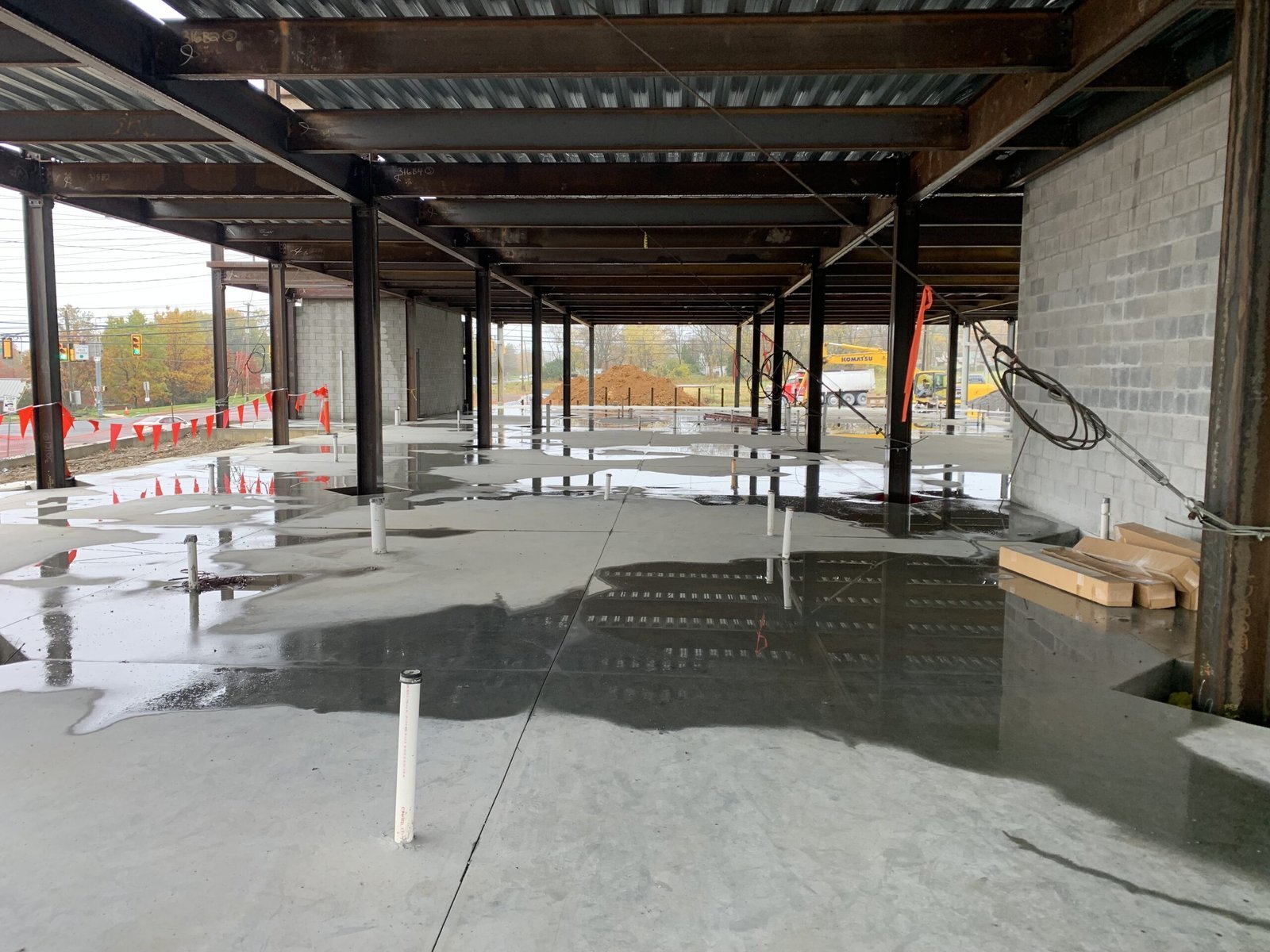
Elevated Slabs and Decks in West Texas
Hoisting a pump line to a second floor is easy to draw and hard to schedule when the nearest batch plant is an hour and a half from the site. Elevated slabs and decks in West Texas are logistics problems first and structural problems second, because a suspended pour cannot stop halfway for a late truck without leaving a cold joint in a member that carries load.
We form, reinforce and place suspended slabs, composite metal deck toppings, stair landings, mezzanine floors, parking decks and roof decks for builders and owners from the Permian Basin to the Trans-Pecos. Placing and finishing is ours, while shoring, post-tensioning tendons and metal deck installation come from partners we schedule so the sequence on the floor matches the sequence on the truck schedule.
Every elevated pour we price starts with the same list: how many cubic yards the deck needs, how many trucks per hour the pump can accept, how far each truck has to drive, and what the wind is likely to do on the day. Those four numbers decide whether the pour is a morning job or a split pour with a planned joint, and we settle that with the engineer before forms go up.
Owners who build above grade out here
Most suspended concrete in the region is built for a short list of owners. School districts and college campuses add stair towers, mezzanines and classroom wings. Hospitals and clinics need equipment floors and elevated corridors. Schools and healthcare owners tend to ask early about noise, vibration and pour hours near occupied space.
Commercial developers use elevated decks for parking over retail and for multi-level office shells, and oil, gas and midstream owners call for pipe racks, equipment mezzanines and elevated control-room floors. Each buyer has a different tolerance for downtime, so we ask who is working below the deck before we plan the shoring layout and the pour window.
Why suspended work behaves differently in small markets
Texas Tech University was authorized in 1923, and the medical school added in 1970 grew into the Texas Tech University Health Sciences Center. That history is why Lubbock supports a deeper bench of structural concrete work than towns of similar size elsewhere in the region, with specialty crews and pump operators who understand multi-story pours.
Move east or south and the bench thins. Sweetwater sits on Interstate 20 and several U.S. and state highways, 42 miles west of Abilene, which gives a deck job there reasonable truck access but a limited number of nearby pump operators. In Ozona, off Interstate 10, a suspended pour usually means booking the pump and the testing lab days ahead, because neither can be summoned the same afternoon.
What goes into a suspended pour
Our scope covers formwork or deck support, edge forms, embeds, reinforcing placement, sleeves and blockouts, concrete placement, finishing and curing. On conventional flat plates and beam-and-slab systems we run the shoring and reshoring plan with the engineer, then strip only after cylinder breaks confirm the release strength. On composite deck we check deflection, stud layout and edge closures before we release the first truck.
We also handle the details that cause trouble later: slab edge angles, stair pan landings, drains in parking decks, trench for mechanical risers and the sleeves that plumbers and electricians want in the exact spot the rebar is thickest. A coordination walk with those trades before the pour costs an hour and avoids core drilling afterward.
Work that feeds into the deck
A suspended slab is only as good as what is under it. Columns and walls come first through cast-in-place structural concrete, and deep foundations for taller structures often mean drilled pier foundations set before anything rises.
On the reinforcing side, a deck lives or dies by rebar placement, since cover, lap lengths and chair spacing are the usual inspection findings. Post-tensioned decks add stressing and grouting steps that extend the schedule, and the concrete partners we coordinate plan those days into the sequence rather than treating them as an afterthought.
How we plan a pour that cannot be paused
We build the pour plan around the truck, not the finisher. We confirm batch plant output, the haul time to the site and the number of drivers available, then size the pump and the placement rate to match. If the plant cannot sustain the rate the deck needs, we plan a construction joint at a location the engineer approves instead of hoping the trucks keep arriving.
On the day, we stage the pump the afternoon before, walk the deck with the inspector, check rebar and embeds once more, and set a go or no-go point for wind and temperature. Evaporation retarder, windbreaks and a finishing crew sized for the deck keep the surface from crusting before the screed passes. Cylinders are cast and held for strength tests that decide when the shoring comes down.
Where we mobilize for elevated work
We move crews and forms to job sites along the Interstate 20 corridor, up the Interstate 27 corridor into the South Plains, and out into the Concho Valley and Trans-Pecos when a project calls for it. A deck pour in Lubbock rarely needs lodging for the crew. One in Fort Davis or Presidio does, and that cost goes into the number up front.
If your project sits in a smaller county seat, tell us the address and we will work out the miles from the nearest plant and the nearest pump. That one calculation often decides whether a suspended design makes sense or a slab-on-grade layout with a lighter roof is the better choice.
Send the deck drawings and the address
Tell us the structure, the floor count and the town. We will measure the miles from the plant, check pump availability and lay out a pour plan with joint locations, strike dates and crew travel. Call or use the quote form and a project manager will pick it up from there.
Common Questions
Can an elevated slab be poured in one day when the plant is far away?
Usually yes, if the plant can sustain the placement rate and the haul time keeps concrete within its allowed discharge window. We confirm both before we commit to a date. If either is doubtful, we plan a construction joint at an engineer-approved spot and book trucks from two sources.
Who decides when the shoring can come down?
The engineer of record sets the release strength, and cylinder breaks tell us when the slab has reached it. Weather affects that number in both directions, so a cold week or a hot dry week can change the strip date. We do not remove shoring on a calendar guess.
Do you handle post-tensioned decks?
Concrete is ours; tendon layout, stressing and grouting belong to the specialists we bring in. Their inspection hold points are built into the pour schedule, and we sequence the work so nothing is cut or cored through a tendon path.
How does wind affect a suspended pour?
Wind pulls moisture off a fresh deck faster than most people expect, and a high deck sees more of it than a slab at grade. We use evaporation retarder, windbreaks and extra finishers, and we set a limit with the superintendent for calling the pour off.
What should I send to get an elevated slab priced?
Send structural drawings, the shoring or deck system you expect, the address and the preferred pour window. Our response is a one-page plan listing cubic yards, pump needs, joint locations and mobilization, so you can weigh it against other options.