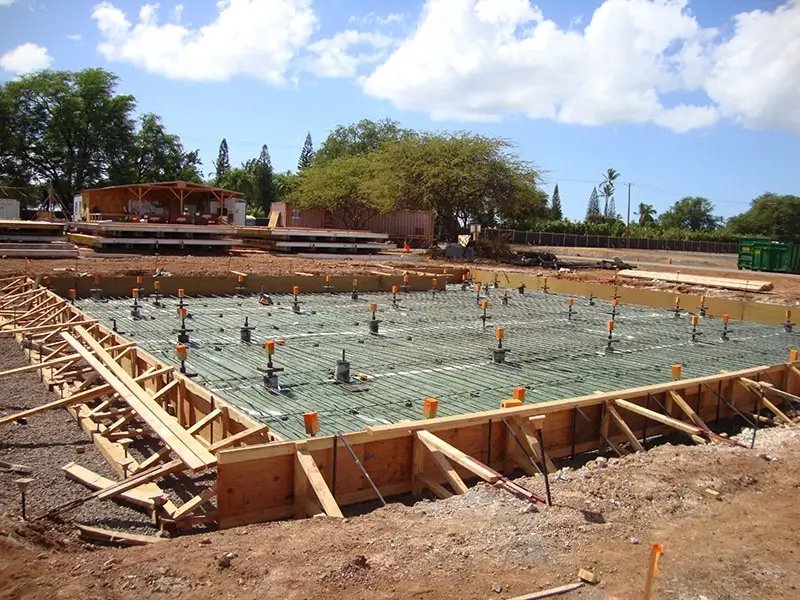
Drilled Pier Foundations in West Texas
Caliche that stops an auger at six feet, a clay that swells after a wet spring, and a rig that has to travel two hundred miles to get to the hole: those three facts decide most drilled pier jobs in West Texas before anyone looks at the drawings. A drilled shaft is a simple object, but getting the right rig, the right casing and the right concrete to a remote site on the right day is the hard part.
We build drilled pier foundations for tilt-up buildings, metal buildings, equipment structures, grain and agricultural facilities, towers and bridge-type supports. The drilling is performed by specialty trade partners that we coordinate and schedule. The concrete partners we coordinate set cages, place concrete and tie the shafts into grade beams and caps, so there is one party accountable for the whole foundation sequence.
On any pier job we start with the geotechnical report, the shaft schedule and a map of the miles between the rig yard, the batch plant and the site. A small number of shafts at a remote site can cost more per pier than a large count in town, and we want you to see that before the contract is signed, not after the rig mobilizes.
What the ground and the distance decide
Levelland has a semi-arid climate with roughly 18 inches of annual precipitation and about six inches of snowfall, and that moderate moisture matters to piers more than people expect. Seasonal wetting and drying of clay soils moves the upper few feet of a site, which is why many of the foundation designs we build call for shafts bearing below the active zone, with cardboard voids beneath the beams that tie one shaft to the next.
Elevation and terrain change from one end of the region to the other. Santa Anna, in the eastern half of Coleman County, rests at close to 1,700 feet, and the rock and soil profile there is nothing like the flat farmland at Ralls, where cotton, grains, soybeans, sunflowers and vegetables are grown. We read the boring logs for each site separately and plan drilling method, casing and dewatering from them, not from the next town's experience.
From boring log to finished shaft
Our process starts with the boring logs and a pre-drill meeting with the geotechnical engineer, the structural engineer and the drilling contractor. We confirm shaft diameter and depth, bearing stratum, reinforcement cage details, concrete mix, and who is responsible for the inspection of each shaft. If a boring shows groundwater or caving sand, we decide on casing or slurry before the rig is on the road.
On site, a typical day has three phases. The rig drills and cleans the shaft, the inspector verifies depth and bottom condition, and the concrete team sets the cage and places concrete by tremie or directly, depending on water. We aim to place concrete the same day a shaft is drilled so the hole does not sit open overnight, because open holes collect rain, loose soil and curious livestock. Where a shaft has to wait, we cover it with a rated plate and flag it, and the superintendent signs off on the cover list at the end of every shift.
Concrete and site work coordination
We coordinate the drilling contractor, the testing and inspection firm and the survey crew. The concrete partners handle the parts that follow the drilling: placing and tying cages, setting anchor bolt templates for the structure above, placing concrete, forming and pouring the caps and grade beams, and backfilling around the finished shafts with the earthwork partner on the job.
Because the same crew controls the template and the pour, anchor bolt positions land where the steel erector needs them. Misplaced bolts are one of the most common and most expensive errors on pier-supported buildings, and a rig crew who has left the site cannot fix them. After the pour we shoot the bolt pattern with a total station and send any deviation to the engineer in writing.
Shafts, caps and what ties them together
Typical scope on tilt-wall buildings, grain facilities and pipe-rack supports includes layout, drilling coordination, casing and slurry management, cage fabrication coordination, concrete placement, caps, pier caps with grade beams, and spoils handling. For remote sites we add temporary access, spoil stockpile locations and a plan for hauling excess material off the property. Where the design includes grade beams spanning between piers, we set the forms and void material before the first shaft is poured.
For sites with a lot of piers, such as a long conveyor line or a row of agricultural buildings, we sequence drilling to match steel delivery so shafts are not cured for months before the structure arrives. Where piers share a site with a slab, we tie the plan into slab-on-grade work so the subgrade is not rutted by the rig after it has been prepared.
Open holes, rigs and utilities
An open shaft is a fall hazard and a rig is a tipping hazard, so every pier job carries a written plan for covers, barriers, outriggers on firm ground and a defined exclusion zone around the auger. Before drilling starts, we verify underground utilities with locate tickets and, where needed, potholing, since an auger finds buried lines with no warning. Where pipelines or fiber cross the site, utility potholing and locating is added to the schedule ahead of the rig.
We also keep the inspection record for each shaft: depth, diameter, bottom condition, cage placement, concrete volume and any anomalies. Oil, gas and midstream owners and utilities and energy companies often ask for these records as part of the turnover package, and we keep them organized for every project, with the shaft number, date and inspector named on each sheet so any question can be traced to a specific hole.
Share the boring logs and the site address
Send the geotechnical report, the shaft schedule and the location. We will work out rig travel, concrete haul time and a pour sequence, and mark where unit rates for hard drilling or casing apply. A project manager can walk the site with you before the contract is written.
Common Questions
How do you price piers when the site is far from a rig yard?
We separate rig mobilization and demobilization from per-shaft cost. Mobilization covers the miles the rig and its support truck travel and the crew time to get there. Splitting them lets you see how the price changes if the number of shafts changes, and whether grouping this job with another nearby project makes sense.
What happens if the auger hits rock or caliche harder than the boring log showed?
We stop and notify the geotechnical engineer, who decides whether to switch tooling, core through, or revise the shaft depth. The contract should say how that situation is priced. We prefer a stated unit rate for hard drilling so an unexpected layer does not become a dispute.
Can piers be drilled and poured in the same day?
In most conditions, yes, and we aim for it. A shaft left open overnight can collect water, slough or take in debris. The limiting factor is usually concrete supply, so we confirm truck availability and haul time before the rig starts drilling.
Who checks anchor bolt positions on pier caps?
The concrete team sets the templates, then checks the bolt layout by survey once the concrete is in. We give the steel erector the as-built layout before the first column is delivered, so any adjustment is handled on paper and not at the crane.