Lime and Cement Treatment of Subgrade Soil in West Texas
Treating a clay subgrade with lime or cement changes what the soil does when it gets wet, and in much of West Texas that is the main reason a slab cracks. Lime reacts with clay to cut its plasticity and swell, while cement binds soil particles into a stiffer, stronger layer. Which one belongs on a given site is the engineer's call, based on the lab work, but we are the ones who watch how it behaves on a windy afternoon with a truck of binder idling at the edge of the pad.
We coordinate trade partners for the spreading and mixing, then pour concrete or place paving on the treated surface. Because we sit at the end of that chain, we notice when a layer was mixed too shallow, cured too dry or left uncompacted past its working time. We flag those items while the treated soil can still be corrected, which is cheaper than a repair after the slab is in.
The sections below explain what the work includes, the buyers who ask for it, the schedule and cost pressures, and the standards that decide whether a treated layer is accepted.
The sequence from spreading to curing
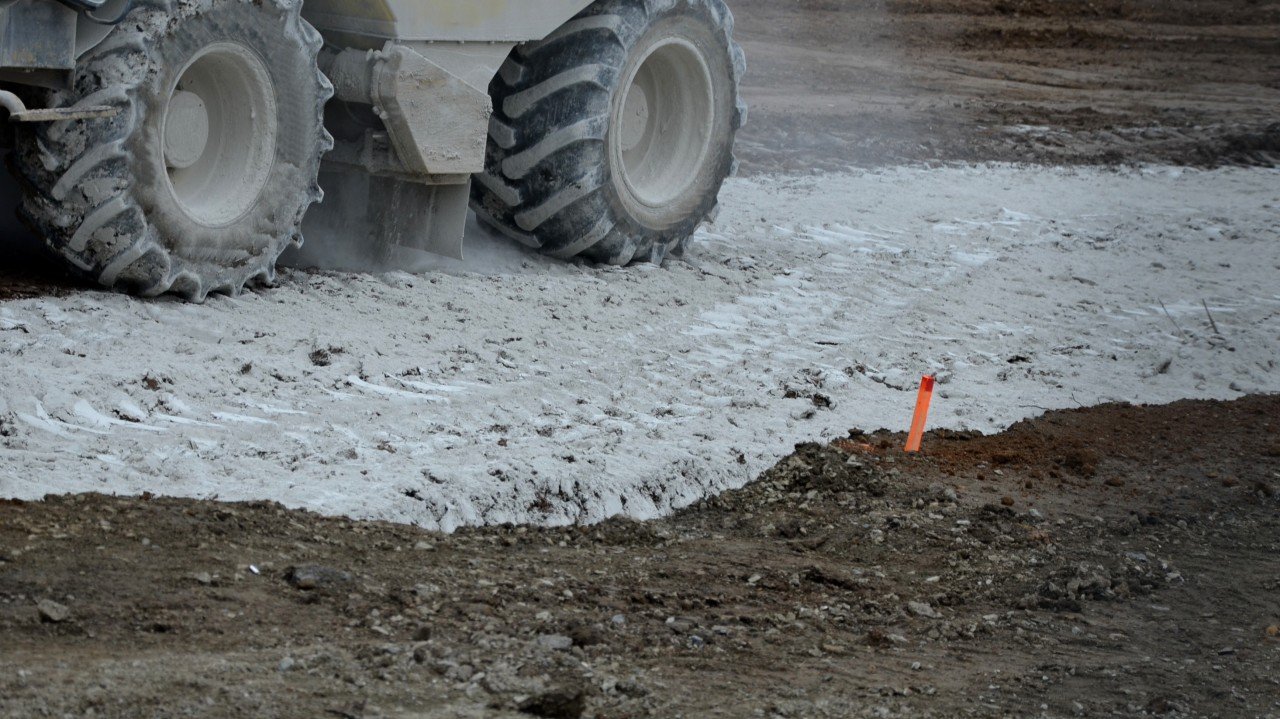
The treated depth and the binder dose come from the geotechnical report. The partner scarifies and pulverizes the soil, spreads the lime or cement with a calibrated spreader, adds water, mixes to depth and makes a first pass with a roller. For lime, a mellowing period lets the reaction proceed before final mixing; cement skips that wait and has to be compacted within a short working time.
After compaction, the surface is trimmed and kept moist or sealed for several days of curing. The lab samples the mix, checks the depth, and verifies the density. We then confirm the finish grade, and the concrete crew begins forming once the engineer approves the layer.
Owners who call for treated ground
Developers of warehouse and distribution sites often request cement or lime treatment for truck courts and floors, since the areas are large and the clay is unforgiving. Industrial owners use it under equipment pads, and public owners use it under streets and parking. See logistics and warehouse developers and oil, gas and midstream for typical projects.
The Santa Rita No. 1 well struck oil on May 28, 1923, at 3,028 feet near Big Lake, and by 1924 the Big Lake field was the first major oil field in the Permian Basin. Energy yards and lease roads around that kind of country take heavy axle loads, and treated bases hold up better than untreated clay when the trucks run in wet weather.
What drives the price per square yard
The binder itself is a major cost, and the distance from the supplier adds to it. Lime and cement are bought by the ton and delivered in bulk tankers, so the haul from the nearest terminal to a remote site can approach the cost of the material. The depth of treatment and the dose set the tonnage, which is why the lab work upfront is worth the money.
Equipment mobilization is the next factor. A pulverizing mixer is a specialized machine, and moving it a long way for a small area rarely makes sense. We group treated areas into a single visit when possible, and we compare treatment with simple over-excavation for small pads, using the numbers from over-excavation and recompaction.
Soil chemistry, wind and water
Not every soil responds well. Sulfate-bearing soils can swell after treatment with lime, and gypsum-rich ground calls for a different approach, so the engineer tests for it first. Big Spring occupies the Beals Creek valley near 2,441 feet, and valley-bottom soils often hold more water, which calls for more care than the uplands around them.
Wind is the practical hazard. Dry lime is a fine powder, and a gust can carry it well past the property line. The crew checks the forecast, waters the surface, and stops spreading when drift becomes a risk to neighbors or to the traveling public.
Buildings that sit on treated layers
Large flat structures benefit most: distribution centers, warehouses, truck terminals and light industrial buildings. For those, treatment can extend beyond the building to the truck court and the parking. Schools and medical offices use it where the clay is too reactive for a thin slab to survive.
Interstate 10 passes just south of Ozona with exits 363, 365 and 368, and State Highway 163 runs through the center of town, so commercial pads near Ozona often sit within reach of highway-served supply. A treated base under a concrete paving section can also allow a thinner slab than an untreated clay base would need.
Timing the binder, the mixer and the pour
Treatment has to be sequenced with care. The binder arrives in tankers that cannot wait long, the mixer travels on a lowboy, and the lab technician has to be on site for compaction tests. If any of the three is late, the others stand by, so we confirm all dates the week before and keep the trade partner informed about weather.
A treated layer must also be protected until the slab goes on. We seal or cure the surface and keep traffic off it, then pour within the window the engineer allows. When heat is extreme, we plan the work for early morning, because water evaporates quickly and the mix can lose the moisture it needs.
Mix design, depth checks and acceptance
The specification sets the binder type, the percentage by weight, the mixing depth, the compaction target and the curing time. A lab designs the mix with samples from the site, and field checks include depth verification, gradation of the pulverized soil and density tests on the finished layer.
Permits may touch dust, stormwater and haul routes. Binder trucks bound for Andrews run along State Highways 115 and 176 or US 385, so a project there is planned around those three routes. Where a site uses both methods, the work also ties into the engineered fill and soil stabilization scope.
Send the soil report
Pass along the lab report, the area to be treated and the nearest town, and tell us when the pour is needed. We will trace the binder haul, note where the numbers depend on the engineer and phone you to talk through the options before a mixer is booked.
Common Questions
Should we use lime or cement on our soil?
The lab tests decide. Lime tends to fit high-plasticity clays where swell is the worry, and cement fits sandy or low-plasticity soils that mainly need strength. Some projects blend both. We follow the engineer's recommendation and can price the alternatives so the owner sees how the choice affects cost.
How long must a treated base cure before it carries concrete?
It depends on the binder and the spec. Lime often needs several days of mellowing and curing, and cement-treated bases typically gain usable strength in about a week, though full strength comes later. The engineer sets the minimum, and we do not form or pour until the lab approves.
Is the treatment permanent?
A properly designed and compacted layer lasts for the life of the pavement or slab, as long as it stays protected from major water intrusion. Poor drainage, leaking utilities and cracked paving can still introduce water and degrade the treatment, so the drainage design remains important.
What happens if it rains right after mixing?
Light rain can be managed by sealing and compacting the layer quickly. A heavy storm may require the partner to remix or replace sections. We watch the forecast and schedule mixing only when the plan allows compaction to finish before rain arrives.