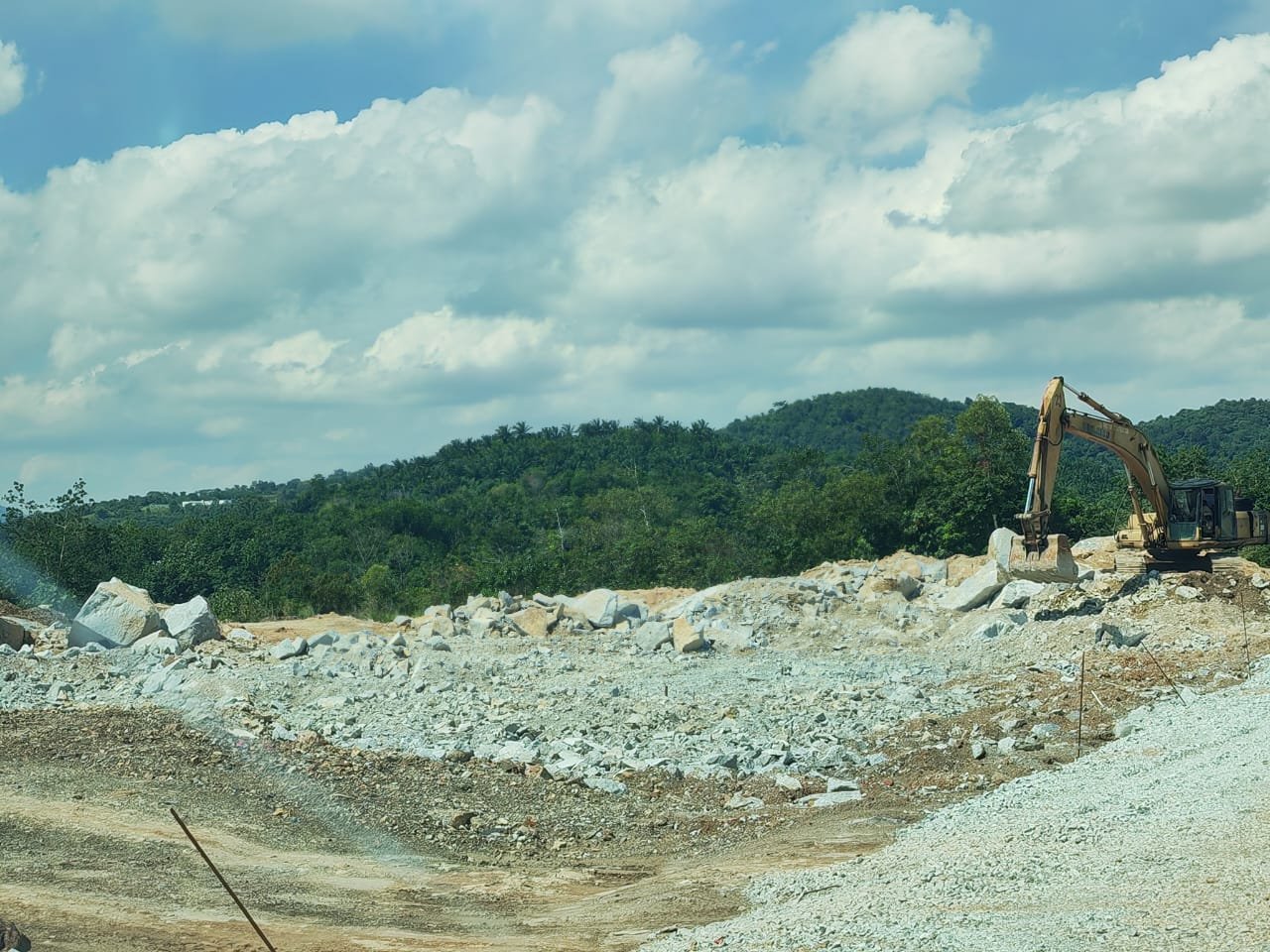
Rock and Hard Ground Excavation in West Texas
Rock in West Texas shows up as caliche, limestone, cemented gravel and the occasional ledge, and a hole that digs easily at one end can stop an excavator at the other. The price of a foundation or trench depends on which of those layers lies in the way, and the only honest approach is to find out before the contract is signed. We ask for borings, probe with test pits and write a unit rate for hard material into the scope.
The machines that break and remove rock belong to trade partners we coordinate: rippers, hydraulic breakers, rock saws and, where permitted, blasting contractors. The concrete partners we coordinate arrive when the cut is complete and the bottom is clean, to form and place the concrete that fills it.
Below are the buildings that run into rock, the places where hard ground is common, how we handle it, who buys it, how we keep people safe and how it fits the schedule.
Buildings that meet hard ground
Any building with a basement, a deep footing, a pit or a long utility run can hit rock. Warehouses on shallow caliche, plants with equipment pits and schools with deep storm drains all face the question. Small buildings on rocky lots may need only a few footings broken out, while large pads can require ripping across the whole area.
Dock-height buildings and cold storage with deep footings are more exposed than simple slabs. See cold storage and manufacturing plant projects for typical depths and the options that reduce rock work.
Utility vaults, pump stations and pits sit deepest, and they are the usual place where rock raises the budget. For those, we often suggest a test boring at the exact location, because a hole a few feet away can show a different story.
Where the hard ground sits
Texas Parks and Wildlife lists Davis Mountains State Park at TX-118 North and Park Road 3 in Fort Davis. For work near Fort Davis or Marfa, we review the site investigation before selecting excavation equipment. Morton lies on the Llano Estacado at about 3,760 feet; a proposed project there also needs property-specific ground information to establish the excavation method.
Seagraves rebuilt its business district with brick buildings after a 1928 fire, and old foundations from that era may lie under newer lots near Seagraves. Those buried masonry and concrete remnants behave like rock when an excavator meets them, so we probe for them.
Test pits, unit rates and method choice
We start with borings and, where the budget allows, test pits dug at the foundation corners. The results tell us how hard the layer is and how thick. Then we choose the method: a heavy excavator can rip soft rock, a hydraulic breaker handles harder layers, and blasting is a last resort where regulations and neighbors permit.
We write a unit rate for hard material into the contract, so that the cost of finding more or less rock is shared fairly. Excavated rock is sorted, crushed or hauled, depending on whether it can serve as fill. For related soil options, see excavation and trenching and backfill.
When a contractor must break rock inside a footprint, we also review the shape of the cut. A neat rectangular excavation in rock may need less backfill than an overcut one, and if the engineer approves, concrete can be placed directly against clean rock walls. That decision saves material and time, and we make it with the engineer before forms are ordered.
Owners who run into rock
Denver City traces its origins to the development of the Wasson oil pool, and energy owners in such places need pits, pads and pipe corridors dug through whatever lies below. Oil, gas and midstream buyers see hard ground often, and they plan for it. See oil, gas and midstream for typical scopes.
Developers and municipal owners see it less often and are more surprised by it. We explain the risk upfront and show the effect on cost and schedule, so a rock discovery is a known line and not a dispute. Utility companies trenching along rights-of-way face similar challenges, and they typically hold unit rates for rock.
Agricultural owners rarely expect rock, yet gin yards and dairy lagoons on caliche ground meet it. Because they also watch cost closely, we offer a range with and without hard material so the owner can see the exposure before committing.
Noise, flying rock and silica
Breaking rock throws fragments, makes noise and creates dust. We set exclusion zones, use shields on breakers and require hearing and eye protection. Dust is controlled with water, and respirators are used where silica exposure is possible.
If blasting is used, a licensed contractor handles it with permits, notifications, mats and seismographs. No other site personnel work within the blast zone, and we coordinate timing with neighbors and the local authority. Lake Ballinger lies beside the 55-acre Ballinger Park, which has a multipurpose sports complex, a community clubhouse and a boat launch, and work near public parks like that near Ballinger gets extra attention to noise and dust.
Rock changes the clock
Rock removal is slower than ordinary digging, often by a factor that depends on the layer. A day of excavation at normal speed might become three days when a breaker is needed. We build float into the schedule and ask the trade partner for realistic production rates.
The equipment for rock is specialized and may not be available on short notice. In the long-distance geography here, a breaker rig can be a day's drive away. We book it when a test pit shows rock, not after the excavator stops, and we keep the forms and steel waiting until the cut is accepted.
Weather matters less in rock than in soil, though heat still limits how long crews and machines can run. We start early and use the cooler hours for the hardest breaking, which also keeps noise from reaching neighbors during the afternoon.
Ask us about the ground
Send the boring logs, the foundation plan and the site address, with the nearest town. We will look at where rock is likely, set out a unit rate and call to talk through the test pits before an excavation partner is scheduled.
Common Questions
How do you price rock when you do not know how much there is?
A unit rate covers hard material, and the contract spells out what qualifies as rock, for example anything a standard excavator cannot remove. The base bid assumes an estimated quantity, and the final cost follows what the crew actually removes. Test pits narrow the estimate before work begins.
Is blasting allowed near towns?
Only with permits and strict controls, and many jurisdictions limit or ban it close to buildings. Mechanical methods are more common near occupied areas. We ask the local authority early about restrictions and plan for breakers and rippers when blasting is not possible.
Can excavated rock be reused?
Sometimes. Crushed rock and caliche can serve as fill or base if the engineer approves the quality. Oversized pieces may need crushing, which adds cost. We compare reuse with hauling it away, and the answer depends on the haul distance and the quantity.
What if we find rock after the contract is signed?
We stop, document the condition and notify the owner and engineer. The unit rate in the contract then applies to the extra quantity. If the contract has no rate, we propose one before continuing, so that the work does not stand idle.