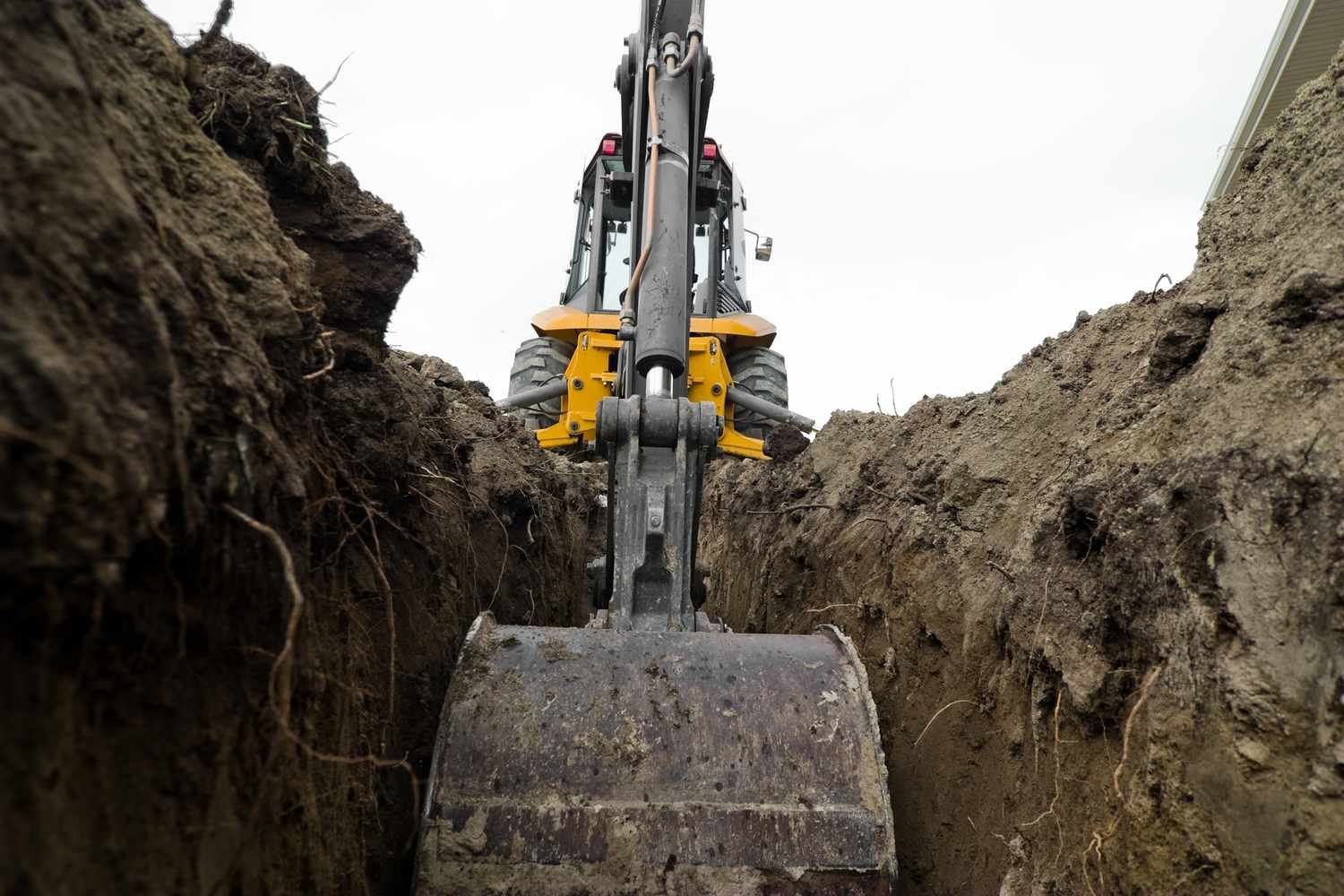
Trenching and Backfill for Utilities in West Texas
Trench work on a West Texas job usually runs longer than anything else on the site, and the length is the reason it is hard to price: a trench that crosses a pasture, a county road and a stretch of caliche has three different costs inside one linear foot rate. We break the run into segments by ground type and by crossing, then match each segment to the machine, the shoring and the backfill material it needs.
We coordinate trade partners for the digging and pipe work, and the concrete partners we coordinate arrive for the concrete that goes in the trench: thrust blocks, encasement, pipe supports, vault bases and the slab or paving that sits above the backfill. Because we pour the concrete, we care more than most about how the backfill is placed. A trench that settles under a driveway or a floor leaves a crack in our work, even when the cause was somebody else's compaction.
The sections below set out the cost drivers, the buyers, the roads and railroads that shape routing, and the codes that control how a trench is opened and closed.
What a trench costs per foot, and why it varies
Depth is the biggest single driver, because a deeper trench needs more shoring, more spoil handling and a wider cut. Rock and cemented caliche follow, since they change the machine and cut the daily footage. Dewatering, traffic control and road crossings each add a line item, and the haul distance for imported bedding sand or select backfill can exceed the cost of the trench itself.
We show owners a breakdown by segment instead of one number, so that a change in the field has a clear price attached. That approach pays off most when an unmarked line, a boulder or a wet seam appears halfway along a run.
Buyers who need trenches
Oil, gas and midstream operators trench for gathering lines, containment drains and pad utilities. Utility and energy companies open ground for duct banks and service connections, and municipal buyers do water and sewer extensions. See our work for oil, gas and midstream and for municipal and public works.
Industrial plants and warehouse developers trench for fire lines, storm drains and electrical service before the slab goes down. In every case, the owner expects trench restoration that matches the surrounding surface, so we plan the final pavement or flatwork repair at the same time as the pipe.
Routing trench crews around the region
Stanton, the Martin County seat, lies on Interstate 20, which makes it a natural staging point for utility work along the Permian Basin corridor. From there, a crew can reach Stanton work quickly, while jobs near Floydada, at the junction of U.S. Highways 62 and 70, State Highway 207 and Farm Roads 784 and 1958, come from the South Plains side.
Tye stands near 1,811 feet, lower than most of the plains to the west, so a trench dug beside Tye may meet a different groundwater picture than one in the high country. We plan each route with the closest plant, the nearest town for crew lodging, and an honest read of the road conditions.
Why trench work is steady here
Since the first well came in during 1929, oil production in Andrews County has topped a billion barrels, and the field is still the town's economic base, leaving much buried infrastructure around it. New pipe, conduit and drainage follow every new facility, and the older lines require relocation and tie-ins.
The Texas Pacifico line runs 376 miles from San Angelo Junction near Coleman through San Angelo to Alpine, which means railroad crossings are part of many trench runs. Any trench that goes under or beside a rail line needs the operator's approval, and we ask early because that review can take weeks.
Ground, groundwater and crossings
We watch for four things on a trench job: soil type, groundwater, other utilities and surface crossings. Sandy soil can cave quickly, clay stands but holds water, and shallow rock slows the machine. We confirm the depth of existing lines by potholing, and for road crossings we plan a bore or a cut with traffic control and permits.
Where a long trench meets a wind-prone ridge, open spoil can blow or wash. We keep the open length short, backfill within the day when possible, and restore the surface before a storm arrives.
Trenches that serve buildings
Buildings of every kind need trench work: warehouse fire service, plant process piping, school storm drains and medical office sewer laterals. Some of the most demanding trench work sits under a floor, where backfill must support a slab for decades. We coordinate those runs with the slab-on-grade floor schedule so that the trench is closed and tested before the vapor barrier goes in.
Remote buildings, such as pump houses and equipment shelters, often need a long single trench for power and fiber. See conduit and fiber trenching for the specifics of that work.
Trench safety, backfill specs and inspections
Trench safety rules require a protective system in deeper cuts, a competent person on site, and a way out within a short travel distance. The plans normally spell out bedding, initial backfill, final backfill and the compaction target for each layer, and the lab reports against them. Inspectors usually view the pipe before backfill and again for the final cover.
Public right-of-way work needs permits that vary by county seat, and some jurisdictions require pavement cuts to be restored to a specific section. We read those details at bid time. Backfill under pavement or slabs may call for flowable fill or cement-stabilized sand, which we can place and finish.
How we run a trench from stake to surface
We lay out the alignment, confirm the locates and agree with the trench partner on the daily footage, the shoring and the spoil path. As the pipe is set, the concrete team places any concrete encasement or thrust blocks, and the lab tests the compaction in each lift.
Before the surface goes back, we check that the trench is settled, the restoration section matches the plan, and the markers are in place. For the larger network picture, see storm drain installation and site utilities.
Send the utility route
Share the route drawing, the profile and the list of crossings, and tell us the nearest town to each end. We will walk the line, flag the segments that carry extra cost and phone with the questions that deserve an answer before a crew is lined up.
Common Questions
How soon after a trench is backfilled can concrete go on top?
The answer depends on the backfill type and the test results. Compacted granular fill that passes density can usually take a slab or paving once the lab approves it, while flowable fill may need a day or so to gain strength. We wait for the sign-off and avoid placing concrete over any trench that shows movement.
Why does a trench settle after it has been backfilled?
Settlement usually comes from thick lifts, wet backfill or poor compaction near pipes and walls. Voids can also form where the trench wall caves during backfill. Placing material in thin lifts and testing each one is the best prevention, and flowable fill is useful in tight spots where a compactor cannot reach.
Do you trench across county roads?
Yes, with the right permit and traffic plan. Many crossings use boring to avoid cutting the road, while others are open cuts that are patched to the county standard. Either way, we coordinate the work with the county road crew and schedule it to avoid harvest hauling and school bus times.
What if the trench hits groundwater?
We stop and decide on a method: sump pumping, well points or a revised depth, depending on the inflow. The pipe bedding must stay stable, so we do not set pipe in standing water. Dewatering adds cost, and we show it as its own line when the geotechnical report suggests it may be needed.