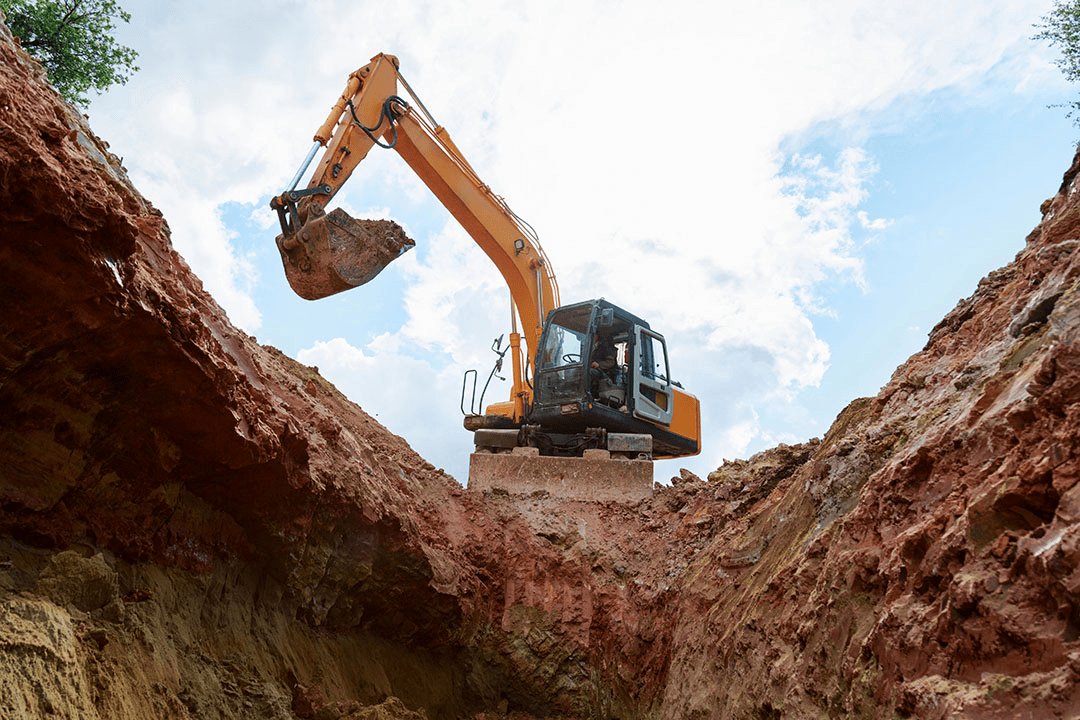
Excavation for Foundations and Site Work in West Texas
Excavation in West Texas starts with a question about the ground that is easy to ask and hard to answer: what is under this section of the field? Caliche that digs like soft rock in one trench can turn into hard cemented layer a hundred feet away, and the bid for a foundation excavation depends on which one the machine finds. We plan every dig around the borings, the utility locates and the honest possibility that the ground will surprise us.
The excavator operators and haulers on our jobs are trade partners we coordinate, and the concrete partners we coordinate arrive afterward to form, place steel and pour. That split keeps one accountable party for the hole and one for what goes inside it. We stay on site during the dig so that depths, widths and benching match the foundation drawings the day the concrete crew is due.
What follows is how we scope excavation for the buyers who ask us most often, the permits and codes in play, the schedule realities of remote work, and the safety rules that go with any open hole.
Who we dig for
Agricultural buyers dig for gin and warehouse foundations, shop pads and silos, and the numbers are large. Gaines County irrigates roughly 400,000 acres and stands second among Texas counties for cotton, so cotton-related buildings and processing facilities give the South Plains a steady stream of foundation digs. Those buyers want a dependable schedule around harvest and a crew that arrives when promised.
Energy buyers are the other major group. The Roscoe Wind Farm in West Texas has 627 wind turbines and a total installed capacity of 781.5 MW, which shows the scale of the foundation and access work that follows a wind project. For these customers see utilities and energy companies, and for the heavy end of the work see oil, gas and midstream.
Utility locates, depth limits and permits
Every dig begins with a locate request and a review of the utility drawings, because buried lines in small towns are not always where records say. We pothole in advance where lines are suspected. Excavations deeper than the limit in the trench safety rules need a protective system, and the competent person on site signs the daily inspection.
Local permit offices may require a grading or right-of-way permit for work beside a road, and county seats vary in how quickly they review. Where the excavation sits near a state highway, an additional permit can apply. We confirm the paperwork before mobilization so that machines are not parked at a site waiting for approval.
What we coordinate and what we pour
We coordinate excavation through the responsible trade partners. We coordinate trade partners for the machines, trucks and operators, and we write the scope so that depth, slope and spoil handling are clear. On our side, we survey the layout, set the forms, place reinforcing and run the concrete placement and finishing crews.
That division matters on a rural job, because the person who knows how the footing must look is the person who checks the excavation. We make the call to widen a trench, step a footing or stop and wait for the engineer, then hand the finished hole to the forming partner within hours.
Digging across the sub-regions
Distance is the first line in an excavation estimate for us. Slaton is served by U.S. Highway 84, Farm to Market Road 400 and Farm to Market Road 41, so equipment bound for a job near Slaton follows a short, direct route from the Lubbock area. The Caverns of Sonora lie about eight miles west of the city, which sits at an elevation of 2,129 feet, and crews bound for Sonora have a much longer haul over Concho Valley roads.
Schools shape some of that work as well. Rotan is served by Rotan ISD, and Schleicher County Independent School District serves Eldorado, where Eldorado High School is its comprehensive high school. When a campus job comes up in Rotan or Eldorado, the excavation plan accounts for school hours and bus routes.
Mobilizing machines and sequencing the dig
A remote excavation has an unavoidable lead time. Equipment travels on lowboys that must be routed and permitted for oversize loads, and operators come from wherever the partner is based. We ask for a firm mobilization date, align it with the lab and the survey crew, and set forms to begin the day after the last depth is signed off.
Weather works against open holes. A spring storm can fill a foundation cut with water, and a dry spell can leave sandy walls crumbling. We keep spoil piles away from the edge, dewater when needed, and avoid leaving a deep excavation open longer than the pour schedule requires.
Open holes and moving machines
Depth and ground conditions determine the excavation protection: a trench box, shoring, benches or sloped sides. The morning inspection and any inspection following rain are assigned to a competent person, and walls that show cracking or sloughing are cleared of workers until corrected. Ladders or ramps are placed so that no one has to travel more than a short distance to climb out.
Machines moving around an open cut are the second hazard. Spoil piles and machines keep clear of the lip, operators follow a spotter, and drivers are guided so no truck ever reverses toward an open trench. Barricades and warning tape mark each open hole, and at the end of every shift we confirm that nothing is left open in a way that would endanger a person or an animal.
Where excavation leads next
A foundation dig feeds directly into concrete foundations, footings and stem walls and drilled pier foundations. If the soil is poor, the next call is often over-excavation and recompaction before the steel goes in.
Where the hole is for a pipe run, the same crew and trade partners shift to trench work and backfill. We keep the excavation scope, the backfill scope and the concrete scope on a single schedule, so that each trade knows when the previous one finishes and when the next arrives.
Bring us the foundation plans
Send the foundation drawings and boring log with the site address, and name the nearest town. We will map the haul distance, flag the soil questions that deserve a second look and ring you back with a staging plan before any machine is sent.
Common Questions
How deep can a foundation excavation go before it needs shoring?
The trench safety rules require a protective system for most excavations deeper than five feet, and sooner if the soil is unstable. In stiff West Texas clay, shallow cuts often stand, but sandy ground and fractured caliche can collapse. The competent person decides on site, and we price shoring as a line item when depth or soil makes it likely.
What happens if you hit rock or caliche that was not in the boring log?
We stop, document the condition and call the engineer and the owner. Hard material may need a different machine, such as a hydraulic breaker, and it changes the cost and schedule. A unit rate for hard material in the contract makes this a routine adjustment and not a dispute.
How do you protect underground lines on a rural site?
We request locates, review the utility drawings and pothole where a line is expected to cross the dig. In small towns, old service lines are not always mapped, so we hand dig near any suspicious marker. If a line is hit, work stops and the owner is notified at once.
Can excavation and concrete be scheduled back to back?
Yes, and it is the best way to keep a hole clean. We prefer to form and place steel the day after the final depth is accepted, so the walls do not dry out or take on rain. The limiting factor is usually the inspection, so we book the inspector early.
Do you haul away spoil?
Spoil handling is part of the scope we write with the excavation partner. Some sites need the material removed, while others use it for backfill or grading. We compare the cost of off-site disposal with on-site reuse and keep the haul route and dump location agreed before the first load leaves.