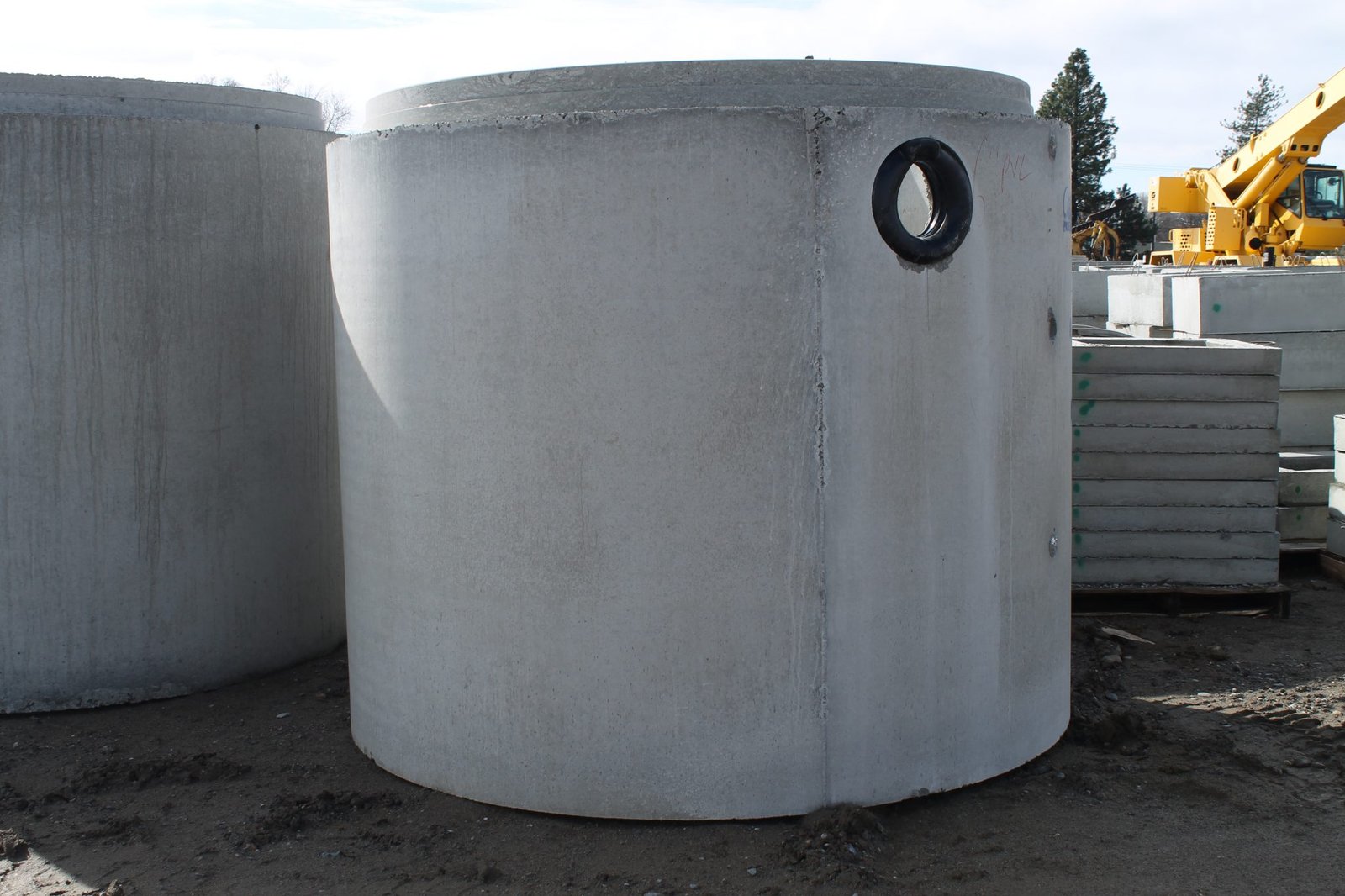
Manholes, Vaults and Underground Structures in West Texas
Every manhole on a site is a promise that someone, years from now, can lift a lid and reach the line below. We build and set manholes, valve vaults, meter vaults, junction boxes, wet wells, headwalls and similar underground structures, using precast pieces where they make sense and cast-in-place concrete where the geometry or the loads call for it. Excavation and pipe belong to trade partners we coordinate, and the concrete partners we coordinate pour the base slabs, benches, channels, collars and surrounding flatwork.
Structures are the most exacting part of a utility package, because everything lines up on them. A sewer manhole sets the invert for the pipes that enter and leave it. A water vault holds valves and meters at heights a worker can reach. A storm junction box carries several pipes at different elevations. If the structure sits an inch off, the pipes hang or the lid lands below the finished surface, and either error is expensive to correct after paving.
West Texas adds the matter of delivery. Precast sections are heavy, plants are few, and a truck with a manhole riser may drive most of a day to reach a remote pad. We schedule structures early, confirm the pour or set date with the supplier and make sure the crane or the excavator that sets the section has the lift capacity and a firm place to stand.
Owners who depend on structures
Municipal public works departments rely on manholes for every sewer and storm system they own, and they have standard details for walls, steps, covers and frames. Wind and solar developers need junction vaults along collection systems, and the Roscoe Wind Farm, with 627 turbines and a total installed capacity of 781.5 MW, shows the scale of cable and vault work that a single project can require.
Utilities and energy companies use vaults for splices, transformers and valves. Farm operators and processors use them for irrigation control and wastewater handling, so we adapt the structure to fit the owner's standards, not the other way around. For repeat owners we keep a list of preferred lids, steps and boot types, which shortens the submittal review on the next job.
What a structure costs
Depth and diameter are the largest drivers. A deep manhole needs more riser sections, a stronger base and shoring during setting, and a large vault needs a heavier crane. Cast-in-place structures cost more in labor and cure time than precast, but they allow unusual shapes, odd pipe angles and thick walls where loads are heavy.
Freight is the cost owners underestimate. Precast pieces are priced per piece, and shipping a heavy piece across the region adds substantial cost. The crane or excavator needed to set it adds more, and a remote pad that needs a larger crane can change the price of the whole structure. We list the structure, the freight and the setting as separate items. Waterproofing, coatings and special lids add lines for particular uses, and a sanitary sewer manhole may call for an interior coating where gases are expected.
Groundwater, loads and corrosion
Once buried, a structure stays put through every season the site sees, and it faces loads and chemistry that pipe does not. Groundwater pushes up on an empty vault, so the base must be heavy enough to resist flotation or the vault must be held down with a cast base extension. Traffic loads at the lid require rated frames and covers, and a lid in a travel lane has to sit flush with the pavement.
Sewer gas attacks unprotected concrete, and sulfates in some soils attack the outside. We ask for the soil and groundwater report, set joints with sealants rated for the conditions and place cast-in-place walls with the cover and mix the engineer specifies. Our formwork crew builds vault forms with the openings, blockouts and sleeves for each pipe, so cores are not needed later.
Structures across farm and energy country
Irrigation reaches roughly 400,000 acres of Gaines County, which puts it second among Texas counties for cotton. That much irrigation means pumps, valves and meter vaults spread across large areas, and each needs a base, a lid and a road to reach it. Agricultural owners often ask for a durable structure that a pickup can reach in any season.
Roscoe lies roughly eight miles west of Sweetwater on the U.S. 20/80 and 84 corridors, and a farm road ties into town as well. Roads like these carry the loads that deliver precast to wind, farm and town projects, and they shape which supplier can reach the site on a given day.
Cast concrete and installed structure responsibilities
On cast-in-place work the concrete partners handle the forms, the steel, the pour and the finish: structure bases, benches and channels, collars around frames, valve and meter pads, and thrust blocks near vaults. Where the structure is precast, we coordinate trade partners and the supplier for delivery and setting, and the concrete partners grout the joints, pour the base and protect the work.
This split matters on schedule. The precast supplier and the setting crew know their equipment, and the concrete crew knows the cure and finish. We bring them together on one day when possible, so the structure is set, grouted and backfilled in a single visit.
Where structures connect
Structures link the other underground services. A storm drain uses junction boxes and inlets, duct banks use handholes and pull boxes, and water systems use vaults for valves and meters. A single site can hold all of them.
For that reason we coordinate structures with the rest of the underground work, adjusting lid elevations to the paving grade and checking pipe penetrations against the structure drawings before anything is poured. A structure built to the wrong elevation is hard to correct once the pavement is down. We check the finished grade with a level on the day the frame is set and again after the base course goes in, so a rim that sits too high or too low gets adjusted with grade rings before the asphalt or concrete is placed.
Tell us what has to be reached
Send the structure schedule, the pipe sizes and the site conditions, and let us know where the nearest precast plant is. We can review the weights, the freight and the setting plan with you.
Common Questions
Precast or cast in place for a manhole?
Precast goes in faster and arrives uniform, which suits most sewer and storm structures. Cast-in-place suits odd shapes, large vaults and tight sites. The engineer's drawings usually state the choice, and we discuss alternates if freight or lead time is an issue.
How do you keep a vault from floating?
Where groundwater is high, the base is designed heavy enough to resist uplift, or a base extension adds weight. Dewatering during construction keeps the trench dry until the structure is complete and backfilled. The engineer sets the design.
What lid and frame do we need?
It depends on traffic load and use. Lids in roads need heavy duty frames, and lids in fields or yards can be lighter. Some owners want locking or bolted lids to prevent tampering.
How do you seal pipe connections at a manhole?
Flexible boots, gaskets or grout are used, depending on the structure and the pipe. The detail comes from the engineer and the manufacturer. A tight seal prevents leaks and infiltration.
Can you set a vault on a remote site?
Yes. We confirm the crane access, the delivery route and the weights beforehand. For very remote pads we sometimes recommend cast-in-place work to avoid moving a heavy precast piece over a long distance.