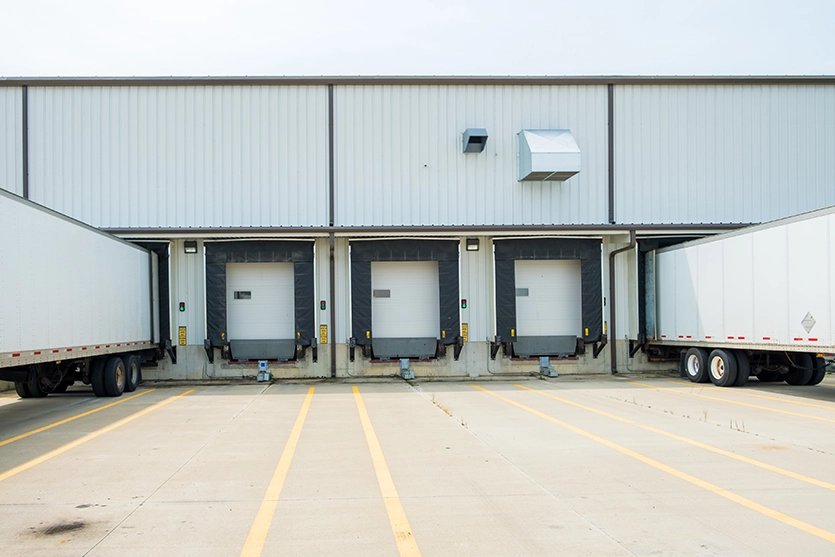
Truck Terminal and Cross-Dock Concrete in West Texas
Trailers backing into a cross-dock all day, every day, wear out concrete faster than any other building type we pour, because braking loads, landing gear and turning tires concentrate on a few feet of pavement at the dock face. A terminal in West Texas serves a long-haul network where one wrong decision on the apron means a crew returning to a remote site for a repair, so the pavement section is worth more attention than the building. The structure itself is often a long, narrow shell with doors on both sides, and the concrete around it carries more of the load than the shell does.
We build the dock slab, the truck apron, the trailer lot and the driveways for terminals and cross-docks, with the pipe and dirt-work firms coordinated by us. We also ask the questions a dispatcher asks: how many trailers move through on a busy night, which way they turn and where drivers wait. A general warehouse floor can sit on a lighter section, but a terminal drives the design to the pavement.
Terminals, cross-docks and the buildings beside them
A pure cross-dock moves freight from inbound to outbound doors with little storage. A terminal adds offices, driver areas, fuel and maintenance. A regional distribution center may include a cross-dock wing, and a logistics and fulfillment center may include a similar dock run for parcel carriers.
Each of these puts different demands on the slab. A cross-dock needs a narrow, long floor with consistent flatness for forklift traffic. A terminal needs heavy pavement in the trailer lot. We confirm the building type, then match the section to the traffic.
What a terminal package covers
Typical scope includes footings, the dock slab, leveler pits, concrete aprons with reinforcing and dowels, trailer parking, curb and gutter, drive lanes and a wash or maintenance pad. We also build bollards, guard posts and wheel stops, which protect the building from impact and are easy to forget in early budgets.
The joint layout follows trailer movement. We place joints where tires do not turn across them and plan load transfer so panel edges stay level. Poorly placed joints chip and fail early, and the repair costs more than the extra dowels would have.
Dock approach grades need their own attention. A trailer bed has to meet the leveler within a narrow height range, so the slab slopes into the dock are held tight, and the pit depth is checked against the leveler manufacturer's drawings. A pit poured a quarter inch off becomes a daily annoyance for every driver who backs in.
Pavement design, permits and drainage
The civil engineer designs pavement thickness from the projected truck count and subgrade strength. We review it and flag any detail that is hard to build, such as thin sections near drainage structures. Building officials enforce the adopted code on the structure, while driveway approaches on state or county roads need their own permit and sight-distance review.
Stormwater matters as much as strength. Water that stands beside a dock softens subgrade and undermines the apron, so slopes, inlets and trench drains get checked against the grading plan before the first form is set. In a dry climate this gets neglected, until the rare storm drops an inch in an hour and the yard shows every mistake.
Concrete and site trade responsibilities
The concrete partners we coordinate place and finish the dock slab, apron panels, curbs, drive lanes and trailer lot. Heavy pavement needs a consistent finish, correct joint depth and proper curing, and the crew is organized to deliver all three on long placements. A paving train or a screed machine works well on wide aprons when the site is large enough.
Grading, underground utilities and stormwater piping stay with partners we schedule, and we make sure compaction tests are in hand before pavement forms are built.
Sequencing aprons around live freight
Some terminals are expansions of operating sites, so we build in sections that keep part of the yard open. Pavement is placed in lanes, with barricades, flaggers and overnight reopening when the owner needs it. The schedule includes cure time, since a driver cannot back a loaded trailer onto a slab that is two days old.
We also coordinate with the dispatcher on the owner's side, learning which nights are quiet, which are busy and where trucks will be rerouted. A schedule that fits the operation costs less than one that fights it.
For new sites the sequence is simpler. Subgrade is proof-rolled and signed, base is placed, and pavement goes down in lanes front to back so mixers never drive over fresh concrete. Edge forms for curbs, islands and drive approaches are set at the same time, which keeps the crew from returning to a distant yard for a small pour.
Pavement thickness, dowels and distance
Thicker pavement and more reinforcing lead the cost. Dowels at joints, edge thickening and subgrade stabilization add to it. Our page on truck courts and dock aprons explains the choices in detail. Mobilization and haul are the other drivers, and we break them out so an owner can see how a site 70 miles from a plant differs from one beside it.
Owners can save by simplifying shapes, reducing the number of pavement thicknesses and grouping pours. We offer those ideas in the estimate when they apply. Fuel islands, wash racks and scale pads may justify their own reinforced sections, and we price them as alternates so they do not inflate the base number.
Who needs terminals in this region
Post sits at the crossroads of U.S. Highways 84 and 380, with State Highway 207 and Farm to Market Roads 669 and 651 also serving the area, which is typical of a town where freight and farm traffic share roads. Abernathy sits on the Llano Estacado at about 3,360 feet, with most of the city in Hale County and about a quarter extending south into Lubbock County. The observatory directions specify a 16-mile route north from Fort Davis on Highway 118, showing why we review the approach beyond a regional highway connection. Denver City traces its origins to development of the Wasson oil pool.
Those places point to the owners we meet: logistics and warehouse developers, regional carriers and oil, gas and midstream haulers who need a yard close to the work.
Services that complete the terminal site
Terminals commonly add loading dock pits and ramps, parking lot concrete for employees and curb and gutter for drainage control. We price them with the building to hold the haul to one trip.
Give us the trailer traffic
Send the truck movements per night, the site plan and the subgrade data. We will turn them into a pavement quantity, a pour sequence that keeps your doors working, and a note on where drainage or haul distance could change the budget.
Common Questions
Is concrete worth it over asphalt in a trailer yard?
Concrete resists rutting under parked trailers and stands up to oil and fuel drips. Asphalt may suit lighter areas. We bid both and set the lifetime upkeep side by side.
How thick should a cross-dock apron be?
The civil engineer sets thickness from truck traffic and soil strength. We review the design and share what we see in comparable work, without overriding the engineer of record.
Can you rebuild an apron while the terminal stays open?
Often yes, by cutting and replacing in sections and reopening quickly with high-early-strength mixes when the plant offers them.
What causes dock apron failure?
Weak subgrade, poor drainage and missing dowels are the main causes. We look at each during preconstruction because they are cheaper to fix on paper.