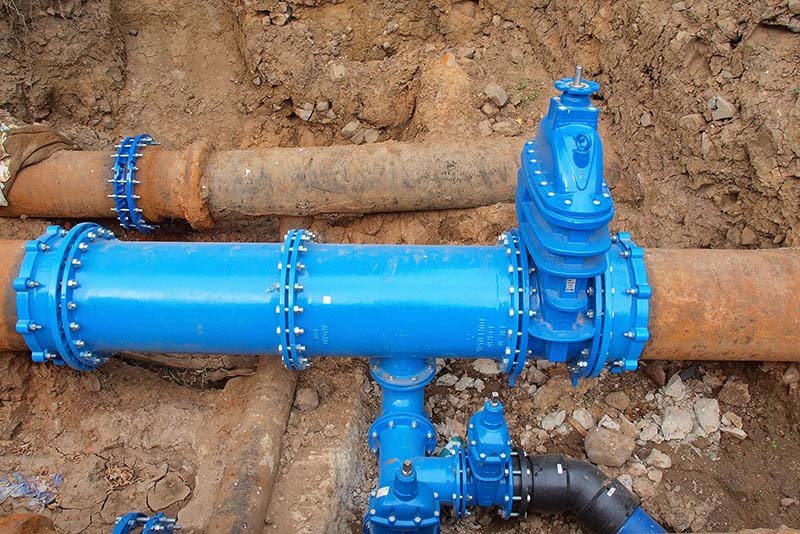
Water Main Installation Across West Texas
A water main trench in West Texas is measured in two ways: the feet of pipe laid per day, and the miles the crew drove to get there. We install water mains and services for developments, industrial sites and municipal extensions, and we coordinate trade partners for the excavation, pipe laying and backfill, while the concrete partners we coordinate place thrust blocks, valve pads, vault bases and any concrete encasement the drawings call for. One schedule and one point of contact keep the pipe, the inspector and the concrete on the same calendar.
Water work depends on what the utility owner accepts. Pipe material, cover depth, bedding, valve spacing, tracer wire and testing are all spelled out in the utility's standards, and a project that follows them avoids rework at the final inspection. We review those standards with the engineer before ordering anything, because a substitute that looks equal on paper can still fail a city's approved materials list.
The region adds its own considerations. Towns here are separated by long stretches of open road, and a pipe supplier or a fitting house may be a half day away. A shortage of one gasket or valve can stop a crew for days if the order was not placed early, so we treat the material list as the first task on every water job.
Ordering pipe before opening the trench
We tie the trench schedule to deliveries. Pipe, fittings, valves and hydrants are ordered once the engineer approves submittals, and each shipment is checked on arrival against the packing list. Storing pipe on a remote site requires level ground, supports that prevent bending and shade for plastic materials that soften or deform in extended heat.
Crews open only as much trench as they can close in a working day. That limit reduces exposure to cave-ins, keeps neighbors able to reach their properties and protects the open pipe from storm runoff. If a delivery slips, we do not start digging a long section and hope the pipe arrives. We move to another part of the job, such as service taps, valve pads or concrete work, so paid crew hours are not wasted.
What a water main costs to build
The largest variables are pipe diameter, depth, soil and distance from the supplier. Larger pipe requires heavier equipment, bigger fittings and more thrust restraint, which adds concrete. Rock or very hard ground slows the trench and may require rock-breaking tools. Dewatering becomes necessary where groundwater is shallow, as in some creek valleys, and it adds a separate line to the estimate.
Pressure testing, disinfection and bacteriological sampling add schedule time more than money, but a failed test means repairs and retesting. We budget a margin for repairs on long lines. Restoration of paved roads or driveways is a frequent surprise, so the proposal lists it explicitly. Tied into a larger site utility package, a water main usually costs less than the same line bid alone, because mobilization and inspection costs are shared.
Water in a dry region
Water is the scarce resource of the region, and its mains tend to be old, long and expensive to replace. Menard lies on the San Saba River, which flooded the town in 1899, a reminder that low ground near streams creates both a supply and a risk for utilities. A new main near a river crossing has to consider flood levels, bank erosion and the elevation of valves and vaults.
Growth has often followed energy. The Santa Rita No. 1 well struck oil near Big Lake in 1923, and by 1924 the Big Lake field was the first major oil field in the Permian Basin, which drew workers and water demand to a small town. Today, oil, gas and midstream facilities need dependable water for camps, offices and process use, and these projects often arrive faster than the municipal system can grow.
Standards, submittals and approvals
Most water work is governed by the utility owner's standards, the engineer's specification and the state drinking water rules. Contractors submit product data for pipe, valves, hydrants and fittings, and the engineer approves them before ordering. A road crossing or other work within its right-of-way requires the relevant city, county or state highway permit. The responsible authority sets the traffic-control and restoration requirements.
Connections to an existing main are scheduled with the utility, since a shutdown affects customers. We plan tie-ins for low-demand hours and notify affected owners in advance. For municipal and public works clients, we keep daily reports, test records and as-built notes in the format the city requests, so acceptance does not wait on paperwork.
Trench safety and drinking water protection
Once a trench passes a few feet in depth it needs shoring, a shield or laid-back walls, and a competent person looks it over every day and after any rain. Spoil piles sit well back, ladders stay within reach, and the crew keeps clear of the excavator swing. Overhead lines and underground lines are located before the machine moves.
The water itself needs protection. Pipe ends are capped when work stops, so animals, runoff and soil cannot enter, and the line is flushed and disinfected before it goes into service. Crews working in the sun get shade and water, because summer days on a bare trench are among the hottest places in the state. Each shift opens with a brief safety talk.
Crossings, valves and service connections
Crossings are the places where a water job slows. A bore under a highway, a pipe laid beneath a creek or a connection through a railroad right-of-way requires separate approvals and often a specialized partner. We bring those requests to the engineer in the first weeks, since agencies may take longer to respond than the trench takes to dig. Potholing at crossings confirms depth and clearance before design is final.
Valve placement and service connections affect future repairs. We set valves where crews can reach them in an emergency, install tracer wire so the line can be found later and keep a record of tap locations. On a project that adds a fire line, we coordinate the tie-in, the backflow assembly and the hydrant location with the fire marshal before ordering.
Describe the line
Tell us the pipe size, the length, the nearest town and the utility that will accept the main. We will talk through delivery, testing and the tie-in before talking about a start date.
Common Questions
Do you lay the pipe with your own crews?
We coordinate trade partners for excavation, pipe laying and backfill. The concrete partners place the concrete that supports the system, such as thrust blocks, valve pads and vault bases. You get one schedule and one contact.
How are water mains tested before use?
The line is tested at the pressure written in the specification, then flushed and disinfected, and a water sample is taken for laboratory analysis. The utility owner or its inspector witnesses the work. We schedule the tests so that a failure can be repaired and retested without extending the project far.
Can a main be installed near a creek or river?
Yes, with care. Flood levels, bank stability and the depth of scour decide the cover and the type of crossing. The engineer sets those requirements, and we plan the work for a dry season when possible.
What if the main has to cross a highway?
A bore or a jack is the usual method, and the agency that owns the road must approve it. Those permits can take several weeks, so we ask for them early. The crossing is often the item that sets the project schedule.