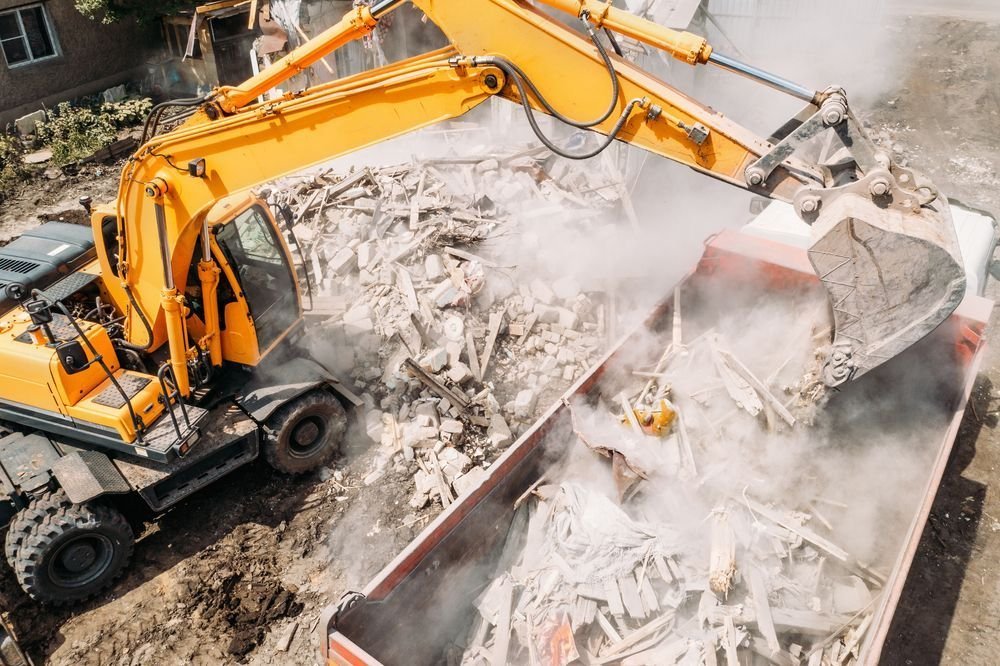
Demolition and Site Preparation Before West Texas Concrete
Redevelopment in West Texas often starts with something that used to be a building, a yard or an oilfield facility, and the cost of the new project depends on what is left in the ground. Old slabs, foundations, abandoned pipe, tanks and fill all show up once the surface is removed. We treat demolition and site prep as discovery work first and removal work second, and we price in that order.
Trade partners handle the machines and haul trucks, and the concrete partners we coordinate arrive to cut, core and remove concrete elements and then pour the replacement. Because we know how new slabs tie into old ones, we can decide where to saw, what to keep and where a clean break gives the new work a good edge.
The sections below cover the buildings involved, the scope, the permits, the regional context, the connected services, how we plan and who does what.
What gets demolished and replaced
Old warehouses, shops, retail centers and school buildings are the usual candidates, as are former service stations and oilfield yards. Hale Center stands on the Llano Estacado near 3,419 feet, close to Running Water Draw and Yellow House Draw, and flat plains towns like it often have older agricultural and commercial buildings that make way for new construction.
Some projects are partial, such as removing a loading dock or a section of floor, while others clear a whole lot. Medical and school projects often demolish an old wing to build a new one, with the occupied building next door. See education and school projects for that case.
Retail strip centers present a different mix: many small tenants, shared walls and a large parking lot of old paving. Taking out the lot can be the larger quantity, and sorting the asphalt from the concrete lowers disposal costs.
Owners range from commercial developers clearing a retail lot to municipal and public works departments replacing an aging building, and each follows its own approval path before a wall comes down.
What the work includes
The scope covers disconnecting and capping utilities, removing structures and slabs, breaking and hauling concrete, grubbing roots, filling voids and regrading. It also includes a survey of what remains, a plan for hazardous materials if any are found and a record of what was removed.
Concrete is crushed or hauled to a recycling site when allowed, and metal is separated. Underground tanks, drains and pits are located, emptied and removed or filled as the plan directs. We list each item in the scope so that surprises are limited to what is truly unknown.
Demolition permits and environmental checks
Demolition requires a permit from the local building department, and many jurisdictions require an asbestos survey for older buildings. Utility companies must disconnect services before work begins. Dust and noise rules may apply near homes, schools and hospitals.
Sites with a history of oil or fuel handling may need environmental assessment before and after demolition. The owner usually commissions that work, and we coordinate the schedule so removal does not disturb areas that still need testing.
Stormwater coverage applies to demolition when the disturbed area is large, and the plan from erosion control and SWPPP is put in place before the first wall comes down.
Old industry and new development
Fort Stockton's boom followed the opening of the nearby Yates field in 1926, and Stanton's came with its oilfield in 1951, which ended that town's dependence on ranching and cotton. Those booms left yards, pads and buildings that later owners now clear.
On July 9, 2026, Big Spring began work on $5.6 million of infrastructure at Crossroads Business Park, which readies roughly 550 acres of a master plan covering more than 2,500. Clearing old structures and preparing ground around Big Spring and similar towns supports that kind of growth. Monahans, near 2,621 feet, gets 13.54 inches of annual precipitation and recorded 120 degrees F in June 1994, so summer demolition near Monahans is planned for early hours.
Services that follow demolition
After removal, the site goes to concrete demolition and removal for slabs that remain, site clearing and grubbing for vegetation and building pad preparation for the new structure.
We keep these steps on a single schedule so the new pad can be tested soon after the old structure is gone. Open excavations from old foundations are filled and compacted in tested lifts.
Survey, probe, then remove
We walk the site and review as-built drawings, then probe the slab and ground with cores and test pits. The findings change the price and the plan, so we share them with the owner before demolition begins. We stage equipment, set up dust control and protect neighbors.
Removal proceeds from the top down, with concrete broken into pieces for loading. Reinforcing steel is cut and recycled. After the structure is gone, we regrade and compact the site and document the result.
Photos and measurements are taken before, during and after the work, and a short written summary goes to the owner at each stage. That record answers questions from lenders, insurers and the permit office.
Who removes and who pours
We coordinate the heavy demolition or the earthwork through the responsible trade partners. We coordinate trade partners for them. The concrete partners saw-cut, core and remove concrete where precision is needed, and they place the new concrete that replaces it.
Keeping both on one schedule helps. A saw cut made by the same crew that will pour against it gives a straight edge and clean reinforcing, and it saves repairs later.
Describe the site to us
Send photos, the old drawings if any and the plan for the new building, and name the nearest town. We will list what to probe, estimate the removal and call you about any unknowns that deserve a closer look before demolition is priced.
Common Questions
What do you find under an old slab?
It varies. Common finds include old footings, buried pipe, abandoned utilities, voids and fill that was never compacted. Probing and coring before pricing reduces surprises. Whatever we find, we document with photos and measurements so that the owner and engineer can decide how to handle it.
Can old concrete be recycled?
Often yes. Clean concrete can be crushed and used as base material or fill, if the engineer approves and local rules allow. It must be free of trash, steel and contamination. Recycling can cut hauling and disposal costs, and we include it in the plan where the source and the end use are close together.
How do you protect neighbors during demolition?
Water keeps dust down, noise stays inside permitted hours, and haul trucks avoid residential streets whenever a route allows. Fences and barricades keep the public away from the work. If the site is next to an occupied building, we add vibration monitoring and extra protection.
Do you handle asbestos or hazardous materials?
No. Those materials are handled by licensed abatement contractors, and the work must be done before demolition. We coordinate the schedule so removal can begin when abatement is cleared. If suspicious material appears during demolition, we stop and notify the owner.
How long does site prep take after demolition?
A small lot may take a few days to regrade and test, and a large site can take weeks. The timing depends on how much filling and compaction is needed. We schedule testing close behind the earthwork, so the new construction can start without waiting for results.