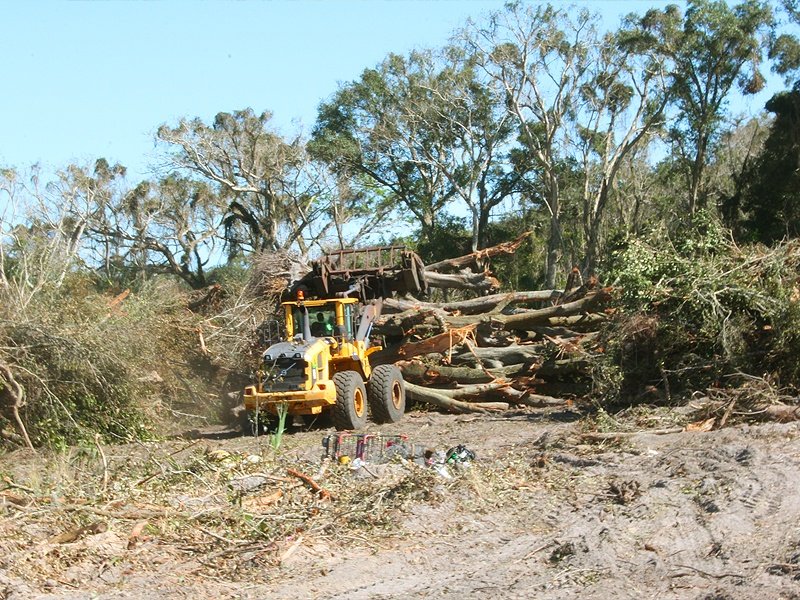
Site Clearing and Grubbing in West Texas
Mesquite roots run deeper than the brush above them looks, and clearing a West Texas lot is mostly a question of what has to come out of the ground, not what stands on top of it. We manage site clearing and grubbing for building pads, yards, roads, wind and utility sites, ponds and farm buildings: removing brush, trees, fences, stumps, roots, old debris and surface rubble so grading and concrete work can start on clean ground. We coordinate the trade firms operating the dozers, excavators, mulchers and haul trucks. Once that work is ready, the concrete specialists can begin layout and forms before placement.
Clearing is the first physical step on most projects, and a poor job here shows up later as settlement, voids and wet spots. Roots and organic material left under a slab rot and shrink, and a pad built over them can sag. Grubbing means pulling the stumps and root mass out of the soil, then screening or hauling the debris away, so the engineered fill and the slab sit on firm material.
Open range changes the logistics. A site may be miles from a landfill, the owner may want brush chipped for erosion control, and a fence line may mark a boundary that needs a surveyor, not a bulldozer. We settle these points on the first walk.
What the walk tells us
Every clearing job starts on foot. We note the brush type and density, the size of trees, the presence of fences, old foundations, wells, tanks and buried lines, and the slope and drainage. Kermit stands near 2,861 feet in a hot arid climate, with about 11.71 inches of precipitation a year recorded at the Winkler County Airport, and in country like the land around Kermit, brush may be sparse but caliche and old oilfield debris are common.
The owner gives us the clearing limits, and a surveyor stakes them. Protected trees, easements and wetlands are marked before machines start. We ask about burn permits, mulching rules and disposal sites in the county, since each varies, and we confirm that no one has an agreement to remove salvage such as old tanks or pipe.
What clearing costs
Density of growth, size of roots and the distance to a disposal site drive the price. A light brush field cleared by a mulcher can move quickly, while a dense stand of large mesquite with deep roots takes more equipment time. Hauling debris a long way adds cost, so grinding on site and spreading mulch where permitted is often the cheaper choice.
Other items add up. Removing old concrete, fence, pipe and trash is billed by volume or by the load. Rock or caliche close to the surface slows grubbing and may need heavier equipment. Dust control water and erosion control add lines. Pricing separates these so the owner can adjust the scope, and a combined bid with mass grading often costs less than two separate mobilizations.
Buildings that begin with a cleared pad
A pre-engineered metal building on a ranch or industrial lot usually starts with clearing a pad larger than the footprint, to leave room for equipment, laydown and access. Retail and medical sites begin with clearing and demolition of whatever stood there before. Sites for utilities and energy companies need laydown yards, access roads and crane pads, often on virgin brush.
State lawmakers gave McCamey the title of Wind Energy Capital of Texas because of the wind farms built around it, and clearing for access roads, turbine pads and substations is a large part of such projects. McCamey area work often means long linear clearing runs more than blocks of cleared land.
Clearing in the right order
We begin with erosion controls and perimeter protection, then clear in passes. Large trees and brush come first, followed by stumps and roots, and finally surface debris. The material is sorted: clean wood for chipping, concrete for crushing or hauling, metal for salvage and trash for the landfill. Topsoil is stripped and stockpiled when the plan calls for it, with topsoil stripping and stockpiling handled as the next step.
After grubbing, the surface is proof-rolled to find soft spots. Holes left by stumps are backfilled with compacted fill, not loose soil. We photograph the cleared area and provide a short log of materials removed, which helps the engineer accept the subgrade.
What partners operate and what we manage
We coordinate trade partners for the clearing machines, trucks and disposal, and we supervise the work as one package. The concrete partners handle layout, protection of existing features and the concrete work that follows. Because we stay on site from the first pass, we can catch problems that matter to concrete early, such as a buried foundation or a pocket of soft soil.
The coordination matters because clearing outcomes show up in our later work. A well-grubbed pad makes forming simpler and slabs more uniform, and the foreman who sees both ends of the process can ask for another pass when needed.
Machines, brush and heat
Clearing involves heavy equipment, falling trees, flying debris and, in the West Texas summer, serious heat. Operators work with clear exclusion zones, ground crews stay out of the swing and fall areas, and spotters guide trucks. Hot work like cutting steel near dry brush needs a fire watch, and a water truck stands by in dry months.
Brush hides hazards: old wells, pipelines, snakes, wasps and sharp metal. We scan the area before machines enter, wear appropriate protective gear and keep first aid supplies on the site. On a remote clearing job, we plan the drive to the nearest medical help before the first machine starts.
From clearing to pad
Clearing sets up everything that follows. Building pad preparation comes next for most buildings, and erosion control and stormwater planning run alongside it. Soil testing, utility locating and survey layout are scheduled so each trade can start without waiting.
When a project also includes site utilities and slab work, a single coordinator saves the owner from tracking a long chain of small contracts.
Walk the site with us
Tell us where the lot sits and what is growing on it, and send the clearing limits if a surveyor has marked them. We will plan the equipment, the disposal and the handoff to the grading crew with you.
Common Questions
Do you burn brush or haul it away?
It depends on local rules, fire danger and the owner's wishes. Many sites grind brush into mulch and spread it for erosion control. Where burning is allowed, a permit and a fire watch are required. Otherwise we haul to an approved disposal site.
What is grubbing?
Grubbing removes roots and stumps from the soil after trees and brush are cut. It prevents rot and settlement under pads and pavement. It is a separate pass from clearing.
Can you clear only what is needed for the building?
Yes. Clearing limits come from the plan and the surveyor's stakes. Keeping the disturbed area small reduces cost and erosion control needs. Some owners keep trees for shade or screening.
How do you handle an old foundation or tank in the way?
We locate and identify it, check for utilities and contents, and remove it according to the owner's instructions and any environmental rules. Tanks may need testing first. We document what we find.
How long does clearing take?
A few days for a small lot, longer for large tracts or dense growth. Weather and equipment availability affect timing. We give a schedule after the walk.