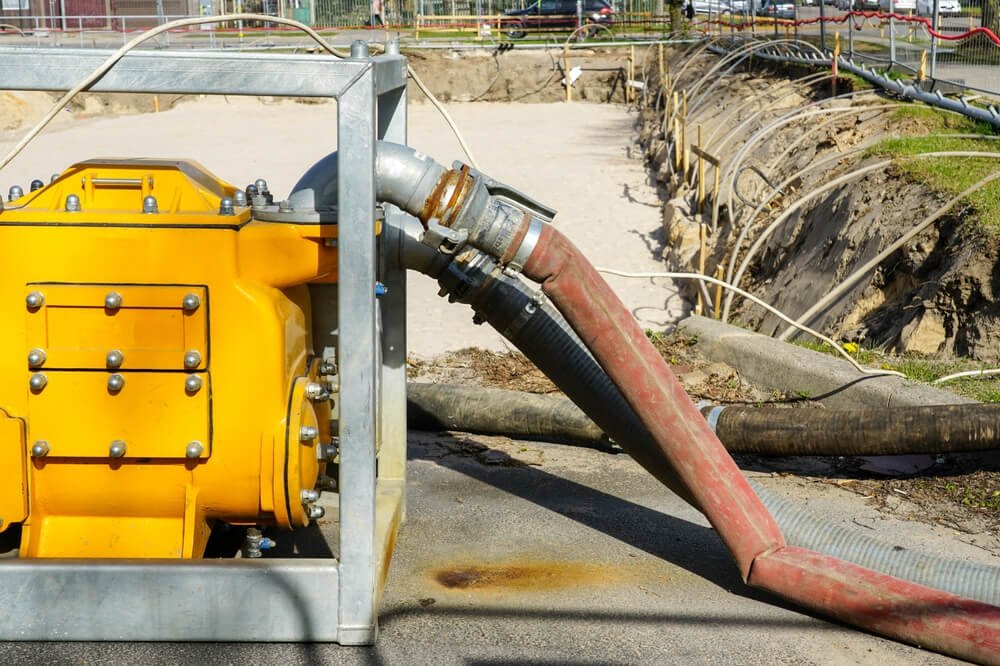
Dewatering for Excavations and Trenches in West Texas
Dry country still floods trenches, and when it does the water arrives from a place the crew did not plan for: a perched layer in the sidewall, a creek bed that filled after a storm upstream, a leaking old line or a groundwater table that rose through a wet year. We handle dewatering for utility trenches, foundation excavations, vault pits, ponds and basements, coordinating trade partners who supply sumps, trash pumps, well points, filter sock and discharge hose, while the concrete partners we coordinate place the concrete that depends on a dry subgrade.
Dewatering keeps the work safe and the finished product sound. A trench with standing water cannot be inspected or compacted properly, a pipe laid in mud loses its support, and concrete placed on a wet subgrade picks up water, loses strength and weakens the bond with the soil below. Pumping the water out and keeping it out is a small part of the project cost, but it often decides whether the rest goes well.
The region puts its own spin on the work. Pumps run on diesel delivered from a long way off, discharge hoses have to cross ground that belongs to someone else, and a pump that quits at two in the morning is not fixed by anyone nearby. We plan the equipment, the fuel, the monitoring and the backup before the excavation opens.
Pumps first, excavation second
Whenever groundwater is expected, the dewatering system goes in before the excavation reaches the water. A sump or well point system lowers the water table ahead of the dig, so the trench stays dry from the first foot. We ask for the geotechnical report and read its boring logs for water depth, noting the date of the borings, since the water table changes with the season.
Equipment arrival is part of the schedule. Well point systems and larger pumps come from rental yards that may be hours from the site, and fuel trucks need access roads. We book them with the excavation partner and set a day for startup and a test run before the trench opens. If the forecast shows a storm, we keep the pumps running overnight and add a second unit on the low end of the trench, because a trench that fills with storm water and silt takes longer to clean than the storm took to arrive.
Dewatering with the rest of the work
Dewatering supports nearly every underground task. On a sanitary sewer job, it keeps the bedding stable and the pipe on grade. On a pond excavation, it handles runoff and groundwater during construction of the outlet structure; see our work on detention and retention ponds for how the two fit together. In mass grading, shallow ditches and sumps keep haul roads usable after a storm.
The same plan covers concrete. A footing excavation with a seep needs a sump and a gravel bed, and a slab on grade needs a dry base. The concrete partners pour only after the subgrade is firm, because a pour placed on wet ground is hard to correct afterward.
Water in high, flat, and oil country
Abernathy sits on the Llano Estacado at about 3,360 feet, with most of the city in Hale County and about a quarter extending south into Lubbock County. Flat tablelands like the one near Abernathy hold rain in low spots, and a heavy storm can fill a trench there even where the aquifer is deep.
Denver City traces its origins to the development of the Wasson oil pool, and Denver City is typical of oil towns where pipeline corridors, old lease roads and buried lines complicate trenching. We confirm what is under the route before pumping starts, so we do not drain onto a lease road or into a ditch that belongs to someone else. Long hose runs add friction and fuel, so we measure the distance to the discharge point and choose the pump to match it.
Buildings that need a dry hole
Dewatering touches every building type that has a basement, a deep footing, a pit or an underground vault. A manufacturing plant may have equipment pits and trenches below the slab. A hospital may have a basement, a loading dock or an elevator pit that runs below grade, and the structure sits close to existing buildings.
Wherever the hole is deep, the excavation partner and the engineer decide whether the water can be handled with sumps or whether wells are needed. We keep the pumps going through the pour and the first stage of the cure, because a pit that floods again after the base slab is poured can float the slab.
What we pour and what partners pump
We coordinate trade partners who own and operate the dewatering equipment, because the pumps and wells are a specialty. The concrete partners handle the concrete work that rides on that system: sump pits, base slabs, collars, pads, vault floors and the footings that need a dry bed. The foreman is the person who tells the pump crew when the pour can begin and when it is safe to shut down.
The split works because it matches responsibility to skill. The pump partner knows flow rates and filter packs, and the concrete crew knows cure times and the effect of moisture on a finished surface. One daily plan covers both.
Discharge, permits and neighbors
Pumped water must go somewhere. The state construction stormwater rules and local ordinances limit what can be discharged, where, and how clean it must be. We run water through filter bags or settling basins before it reaches a ditch, and we route hose so it does not cross a road without protection. If the water may be contaminated, as on a former industrial lot, the owner and the engineer review testing before anything leaves the site; oil, gas and midstream sites often have specific rules.
Neighbors notice noise and hoses. We run pumps with silencers when we can, pad hose at driveways and tell adjacent owners what to expect. Pumping can lower a nearby well or settle nearby soil, so for deep systems the engineer may require monitoring.
Tell us about the water
Send the boring logs, the depth of the excavation and the location of any ditch or storm system nearby. We will talk through pump sizes, discharge and monitoring with the team before the dig begins.
Common Questions
How do you know if a site will need dewatering?
The soil report lists the groundwater depth at the time of drilling, and a few weeks of rain can change the answer. Low spots, creek crossings and old fill are common causes. We plan for it when borings show water within the depth of the excavation.
Is a simple sump pump enough?
For small seepage in a shallow pit, yes. For trenches in saturated sand or deep excavations, well points or deep wells may be needed to lower the water table. The pump partner sizes the system.
Where does the water from the pumps end up?
To a settling area, a filter bag or an approved ditch or storm system, depending on the rules. We never pump onto a neighbor's property without permission. Clean discharge is a stormwater requirement.
Does dewatering delay the schedule?
It adds setup time, but it usually saves time overall, because work continues in wet weather. Plan on a day or two to install and test the system.
What happens if the pumps fail during a pour?
We carry backup pumps and check fuel and discharge hose at set intervals, including overnight. A failure while concrete is curing can damage a slab, so monitoring continues until the structure can resist uplift.