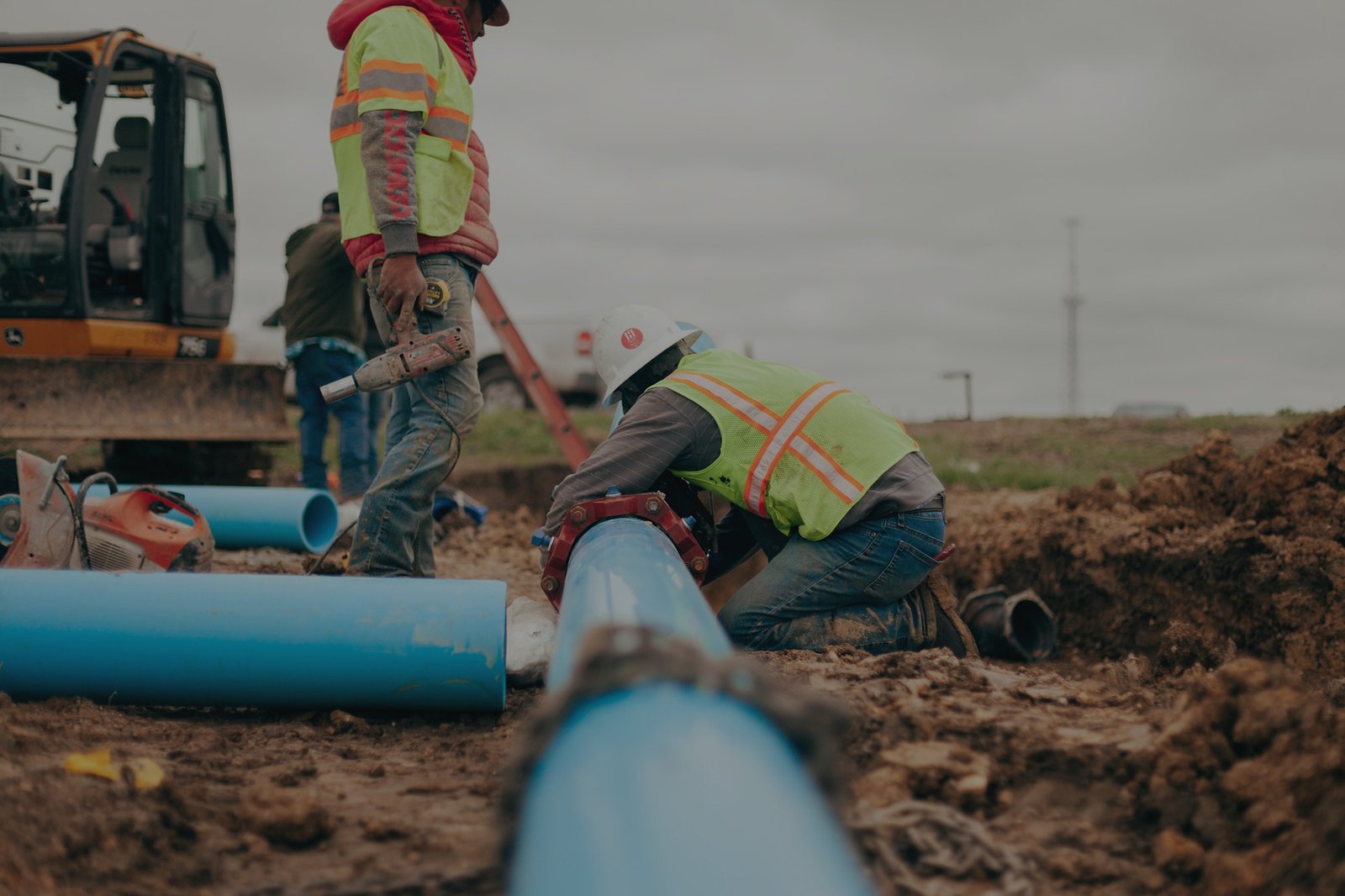
Sanitary Sewer Installation in West Texas
Gravity does the work in a sanitary sewer, which means the grade is the first thing we check and the last thing we compromise. We install gravity lines, service laterals, force mains and the manholes that tie them together for subdivisions, commercial lots, industrial sites and municipal extensions. Excavation, pipe and backfill belong to trade partners we coordinate, and the concrete partners we coordinate pour the bases, channels, collars and encasements.
A sewer that runs a quarter inch off grade can pond waste, and one that sits a few inches too shallow can freeze or crack under traffic. The work is slow and exacting, and it is rarely forgiving. We set the line with laser or string, verify the grade at every joint and keep a daily record of invert elevations so the engineer can check the system before the trench is closed.
What drives sewer cost
Depth is the major driver. A line that runs ten feet deep needs shoring, more spoil handling and slower progress than one at five feet, and each additional foot of depth raises the cost per linear foot. Manhole count follows the layout, since each structure adds a precast base, a riser, a cone and a cast ring and cover.
Distance to a connection point can outweigh everything else. A development on the edge of a small town may need a long extension to reach the nearest trunk line, and the owner should know that before buying the land. We price the extension, the manholes and the testing as separate items so the cost of every choice is visible.
Who approves the line
The city or utility district that will own the sewer sets the pipe material, bedding, manhole spacing and testing rules, and the state environmental agency reviews larger systems. We obtain the approved plans and the utility's standard details before any pipe is ordered. Work in a road requires a right-of-way permit, and stormwater rules apply to the disturbed area.
Pretreatment or grease interceptor requirements for restaurants and food plants come from the same office, and the sizes affect the structures we build. Acceptance usually includes a low-pressure air test or a deflection test, manhole vacuum tests and a camera inspection. We schedule those inspections ahead of backfill where we can and keep every record in the closeout file.
How we run a sewer crew's day
The day starts with a review of the grade sheet and a walk of the trench for hazards. The pipe layer sets the first pipe on the bedding, checks it against the laser, and then each joint is cleaned, lubricated and pushed home. Bedding material is placed in lifts and compacted around the haunches so the pipe is supported, not just covered.
Before the crew leaves, open trench is covered or fenced, and trench plates protect road crossings. A daily note records footage, structures set and test results, which keeps the engineer informed and the project moving without a long list of questions at the end. If a line passes close to a building footing or a future slab edge, the note says so, and the concrete crew knows what to expect.
Owners who need sewer service
Developers extend sewer to serve new lots, and the work is often a condition of plat approval. Municipal public works departments replace aging lines and extend service to growing neighborhoods. Food processors, feedlots and other agricultural operations may need pretreatment or lift stations before discharge to a city line.
Farm country has its own pattern. Ralls draws on cotton, grain, soybean, sunflower and vegetable production, and serves as a retail and shipping center, so sewer lines there may serve gins, packing sheds and shops as well as homes.
Soil, groundwater and crossings
Wet ground makes a sewer harder to build. Where groundwater rises into the trench, dewatering keeps the bedding stable and the pipe on grade. In expansive clay, trench backfill and bedding must prevent water from following the trench and softening the pavement above. In rocky soil, the trench takes more time, and we plan for it from the geotechnical report.
Crossings of storm drains, water mains and gas lines have required clearances, and the engineer decides who yields. We confirm the crossing elevations before laying pipe near them and flag any conflict immediately.
Services that join the sewer
A sewer project rarely stands alone. It runs with storm drains in the same corridor, water mains offset by required separation, and conduit that occupies the remaining space. The manholes and structures that we set are as important to the system as the pipe, since they carry the cleanouts, the grade changes and the inspection access.
Because we coordinate all of these under site utilities, the corridor is planned as a whole and conflicts are caught on paper.
Timing and lead times
Precast manholes and specialty fittings often take longer to arrive than pipe, so we order them at approval. A section of trench is opened, laid, tested and backfilled in sequence, which limits open ground and protects the work from storms. Heat and wind rarely stop trenching, but they do shape start times and the handling of plastic pipe, which softens in direct sun.
We publish a weekly look-ahead so the owner and the inspector know where the crew will be. When a rain shuts down a section, the look-ahead shows which footage moves to the next week, and the inspector can rebook visits without a string of phone calls.
Sewer work across the Plains and the Big Country
Sweetwater is the Nolan County seat, and the county covers 914 square miles crossed by Interstate 20, U.S. 84, U.S. 277 and two state highways, which gives crews several ways into Sweetwater but also long runs between towns. In Ralls, farm-market traffic shapes when trucks can enter. We mobilize crews to each site and charge mobilization based on the actual road distance.
Stating the miles openly lets an owner compare one town against another. Where several small connections sit along the same highway corridor, we propose a single mobilization with the crew moving down the road between them, which spreads the travel cost across the work instead of charging it to each site.
Show us the profile
Send the plan and profile sheets, the point of connection and the date the lots must be ready. We will review the depth, the supply and the testing steps with you.
Common Questions
How deep will the sewer have to be?
Depth depends on the connection point, the slope needed and the minimum cover the utility requires. The engineer sets the profile, and we confirm it in the field with a survey. Deep lines add cost, so owners sometimes adjust the layout to reduce depth.
What tests does a new sewer pass before it is accepted?
Usually a low-pressure air test or deflection test on the pipe, a vacuum or water test on manholes, and a camera inspection. The utility inspector witnesses them. We schedule tests so repairs can be made while the trench is still open.
Can you serve a site that is far from the city sewer?
It depends on the distance and the grade. A long extension or a lift station may be needed, and in some places a private system is allowed. The utility and the state agency decide which path is available.
Do you build lift stations?
We coordinate the structures and equipment with trade partners and place the concrete for the wet well, valve vault and pad. The pumps and controls come from the supplier and are commissioned with the engineer.