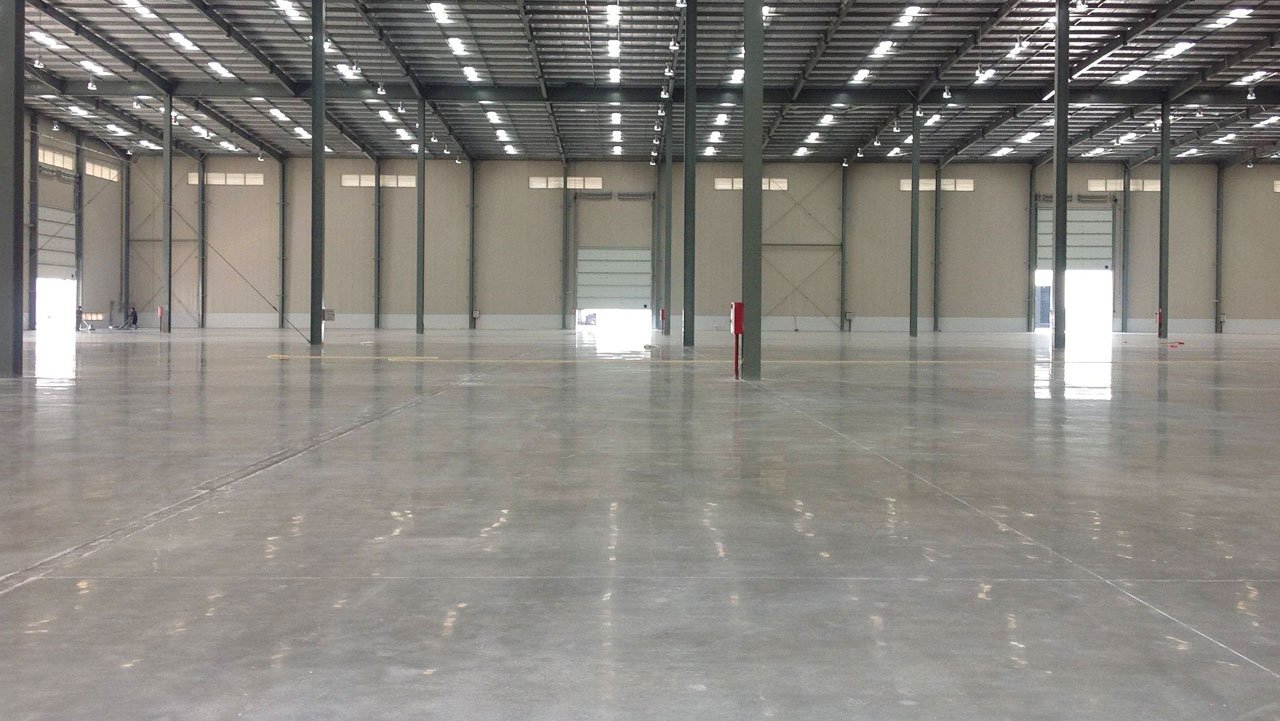
Industrial Concrete Floors in West Texas
Forklift traffic exposes every weak joint in an industrial floor, and in West Texas the floors under that traffic often sit far from the nearest supplier of replacement material. That is why we treat an industrial slab as a long-term piece of equipment rather than a surface. Thickness, reinforcing, subgrade support, joint spacing and finish hardness all have to match what the building will do for years of hard service.
We build floors for manufacturing plants, processing buildings, gins, shops, storage warehouses and equipment yards. Each of these has loads that ordinary commercial slabs are not made for: rack legs, pallet jacks, tracked machines, dropped steel and chemical splashes. The concrete partners we coordinate pour, finish and cure these floors, and we coordinate the earthwork and utility trade partners whose work has to be right before we start.
What follows covers the cost drivers that matter most, the scope we normally carry, the buildings and owners involved, and the sequence from base to acceptance.
What drives the price of an industrial slab
Thickness and reinforcing lead the list. A six-inch slab with light mesh and a ten-inch slab with heavy bars are different products, and the engineer's loads decide which one applies. Special finishes such as hardeners, sealers and tighter flatness tolerances add labor and materials. Joint sealing and armored edges add more.
Distance sits close behind. A big floor needs a steady line of trucks, and remote plants cannot always supply it. We price crew travel, staging and, if needed, a plan to split the placement. Showing those items separately helps an owner compare a floor in town with one at the edge of a lease road.
What we normally include in the scope
Our standard scope covers forming, vapor barrier when assigned to us, reinforcing, embedded items, placing, screeding, floating, troweling, hardener where specified, joint cutting, curing and protection. We keep a daily log of weather, mix temperature, slump and finishing times so the record is available for the owner and engineer.
The scope normally excludes grading, base stone and underslab utilities unless we agree otherwise, since those are completed by partners we coordinate. We list the handoff conditions in the proposal, including base tolerance and moisture, so there is no argument when the pad is delivered. If a floor is large, we also propose a placement diagram that shows the order of strips, the location of construction joints and the direction of finishing, so the owner can see how the pour will proceed on the day.
Buildings that rely on these floors
Heavy floors turn up in a manufacturing plant, a processing hall, a repair shop, a truck facility, an equipment barn and a warehouse. Each calls for a different surface. A machine shop wants a dense, smooth, oil-resistant top, a warehouse wants flat, joint-tight aisles, and a gin yard wants a durable apron that handles trailers and loader tires.
Rotan is served by Rotan ISD and Eldorado is served by Schleicher County ISD, which reminds us that small places have their own large buildings, including school shops and maintenance bays. The scale is modest, but the floors face the same loads, and the same detailing applies.
Owners who ask for industrial floors
Gaines County has about 400,000 irrigated acres and ranks second among Texas cotton-producing counties, so owners in agriculture and dairy keep a steady need for processing floors, equipment shops and storage. Wind energy is another source: the Roscoe Wind Farm in West Texas has 627 wind turbines and a total installed capacity of 781.5 MW, and the service buildings that support such fields require durable floors and aprons.
Developers working with logistics and warehouse operators bring tight tolerance and joint requirements, while industrial owners bring chemical resistance and equipment loads. We read the owner's operating plan, not only the drawings, because the way a building will be used often points to a better floor.
Sequencing a heavy floor
An industrial floor depends on the building schedule. Walls and roof should be in place or temporary protection provided, so wind and rain cannot disturb the surface. Subgrade approval, underslab inspections and steel placement are scheduled in order, and each carries a release before the pour.
We confirm the supplier's capacity for the planned placement size and tell the plant the mix, slump and delivery rate in writing. Pours start early in the day. Floors that need hardeners or sealers get additional days, because those products must be applied at specific stages of the cure. We also tell the owner when the floor can take loads from equipment erectors, so no one drives a lift across green concrete.
Specs, testing and permits
We read the specification for strength, air content, water-cement ratio, curing method, flatness and levelness targets, and joint details. Third-party testing covers slump, temperature, air and cylinders, and the concrete team keeps the samples in proper curing conditions until pickup.
Permit and inspection routines vary between local offices. Many industrial buildings need a certificate of occupancy, and the floor often passes a special inspection before it. We ask about requirements early, then deliver the pour records and test reports the inspector wants.
Working around West Texas conditions
We consider U.S. Highway 84 and U.S. Highway 385 when arranging concrete deliveries to Littlefield. The final approach still depends on the property entrance, available turning space and unloading position. We coordinate equipment travel and placing resources around those conditions, with time allowed for the owner to confirm access restrictions before trucks are dispatched.
Wind and heat set the pace of finishing. Fast drying means the surface can tighten before the finisher is ready, so we add evaporation reducers, shade and water, and reduce the size of each placement when conditions are severe. A windbreak of plywood or fabric at open wall lines can make an hour of difference in how long the surface stays workable, and we bring those materials on any pour where the walls are not yet closed.
Related floor and slab work
Many industrial owners also need post-tensioned slabs for larger spans of floor, and sawing, cutting and coring for later changes. Our slab on grade page gives the basics that apply to every floor, and the Littlefield area is one of many places where we mobilize to build them.
Share the loads and the layout
Tell us what rolls, what sits and what spills on your floor, along with the address and target dates. We will review the supply route and finish requirements, then respond with questions that make the bid stronger.
Common Questions
What thickness does a heavy-duty floor need?
The structural engineer picks it from the loads: wheel loads, rack legs, point loads and the subgrade strength. Thin floors with heavy loads fail through cracking and joint breakdown. If the drawings and the intended use do not seem to match, we raise the question during bidding.
What is the best way to keep joints from spalling?
Joint spacing, saw timing, load transfer and the right filler all matter. We cut joints early, keep the spacing within the design limit, and use filler after shrinkage has mostly occurred. Armored joints help in aisles with hard-wheeled traffic.
Can you build a floor that resists chemicals and oil?
Yes, in combination with the right topping, sealer or coating, which may be supplied by others. We make sure the concrete underneath is dense, well cured and moisture-ready for the product. Coating suppliers have specific requirements for moisture and surface profile, and we share the results of the testing.
How long before we can load racking on a new floor?
Racking usually waits until the concrete reaches design strength, often tested by cylinder breaks, and any curing or sealing steps are done. We provide the strength data and a recommended date so the racking installer can plan.